Scope
What Spring Boot actually is on top of the Spring Framework — starters,
@SpringBootApplication, the embedded server, and above all auto-configuration: the mechanism that inspects your classpath and configuration and registers sensible beans so you don’t have to. We go past “it just works” to how it decides (the@Conditionalmodel and theAutoConfiguration.importsfile), how the app boots (SpringApplication.run), how to override or disable any of it, and the classpath/placement/versioning footguns that bite in production. For the container those beans live in, see 02 - IoC Container, Beans & Dependency Injection; for the property system auto-config reads, see 03 - Configuration, Profiles & Externalized Config.
Related: Spring Boot, 02 - IoC Container, Beans & Dependency Injection, 03 - Configuration, Profiles & Externalized Config, 15 - Packaging, Containers & Deployment
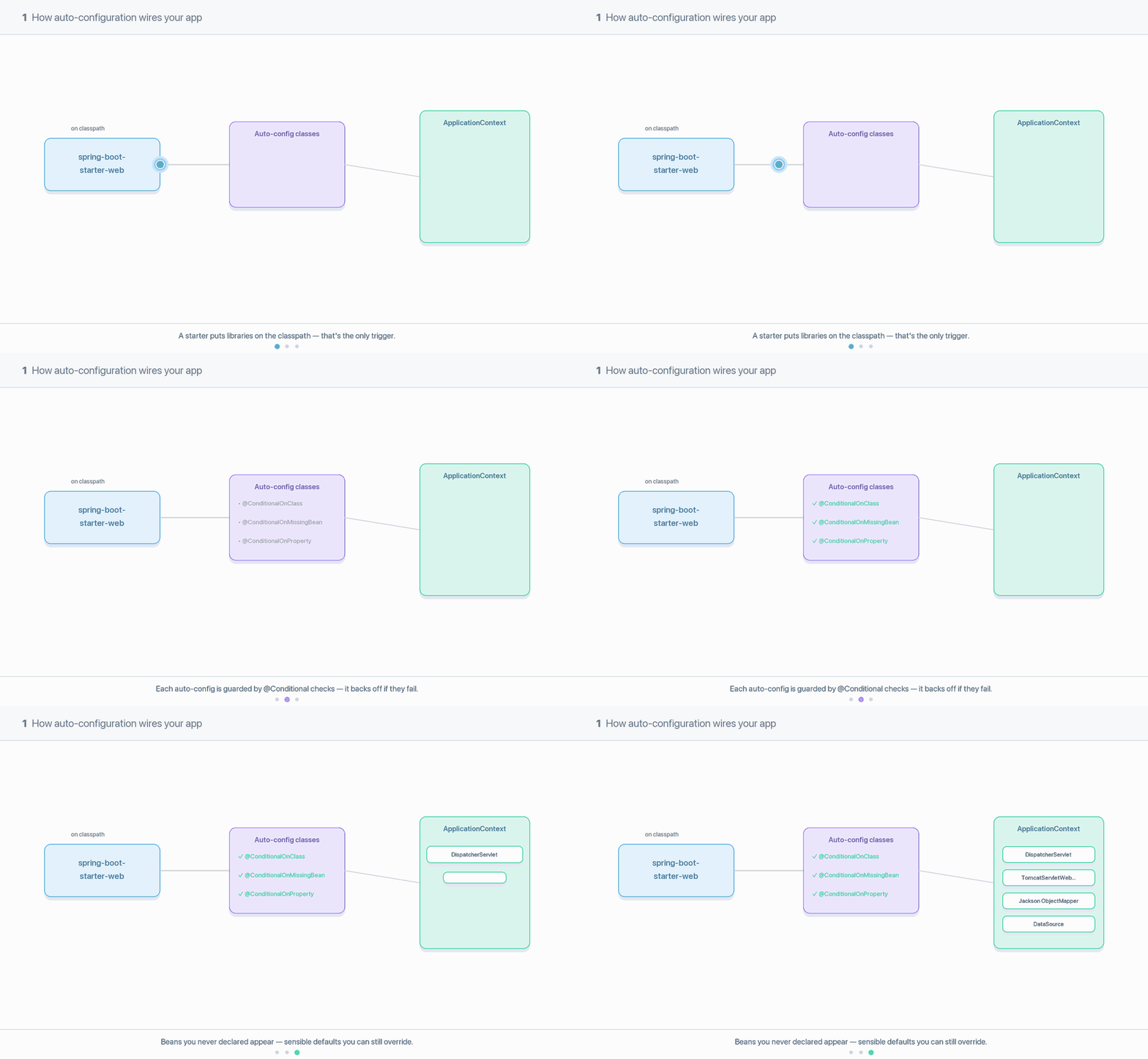
A starter puts libraries on the classpath; each auto-configuration class is guarded by @Conditional checks; the ones whose conditions pass contribute beans to the ApplicationContext — beans you never declared, and can still override.
1. The concept: Spring Framework with opinions
Spring Framework gives you the IoC container, dependency injection, and AOP — but wiring a web app by hand (a DispatcherServlet, a view resolver, a DataSource, a connection pool, a JSON message converter, an embedded server) is dozens of boilerplate @Bean methods before you write a line of business logic. Spring Boot is a layer on top that makes three opinionated moves:
- Starters — curated, version-aligned dependency bundles. One
spring-boot-starter-webpulls in Spring MVC, Jackson, validation, and an embedded Tomcat, all at mutually-compatible versions. - Auto-configuration — at startup, Boot looks at what’s on the classpath and what you’ve configured, and registers the beans a typical app of that shape needs — unless you’ve already defined your own.
- Production-ready & standalone — an embedded server so the artifact is a runnable
java -jarfat jar (no external app server), plus Actuator for health/metrics/observability out of the box (12 - Actuator, Metrics & Observability).
The one-sentence framing interviewers want
“Spring Boot is convention-over-configuration for Spring: it doesn’t add new DI or AOP — it pre-wires the container based on your classpath, and every default is one you can override.” Keeping the Framework/Boot line straight is itself a senior signal — DI, scopes, and AOP are Framework; starters, auto-config, the embedded server, and Actuator are Boot.
2. @SpringBootApplication: three annotations in one
The single annotation on your main class is a meta-annotation composing three:
@SpringBootApplication          // = the three below, with sensible defaults
public class StoreApplication {
    public static void main(String[] args) {
        SpringApplication.run(StoreApplication.class, args);
    }
}| Composed annotation | What it does |
|---|---|
@SpringBootConfiguration | a specialization of @Configuration — marks this as the primary config class (and lets tests find it) |
@EnableAutoConfiguration | switches on the auto-configuration machinery (§3) |
@ComponentScan | scans the package of this class and its sub-packages for @Component/@Service/@Repository/@Controller |
You can tune it: @SpringBootApplication(scanBasePackages = "com.acme", exclude = DataSourceAutoConfiguration.class).
Gotcha #1 — main class placement silently breaks component scanning
@ComponentScan(with no explicit base package) scans downward from the package of the annotated class. PutStoreApplicationincom.acme.appwhile your services live incom.acme.services, and those beans are never found — you getNoSuchBeanDefinitionExceptionor a null autowired field, with no error at startup pointing at the cause. This is the single most common “why isn’t my bean picked up?” for beginners.
Mitigation: put the main class in the root package, above every other package (com.acme), so the whole tree is scanned. If you can’t, setscanBasePackagesexplicitly. Never leave it to chance.
3. How auto-configuration actually works
This is the heart of the module and the most-probed topic. Auto-configuration is not magic and not reflection scanning your whole classpath at random — it is a deterministic, ordered, condition-gated bean-registration pass.
The mechanism, step by step:
@EnableAutoConfigurationimports a selector that reads every JAR’sMETA-INF/spring/org.springframework.boot.autoconfigure.AutoConfiguration.importsfile — a plain newline-delimited list of auto-configuration class names. (This replaced the oldspring.factoriesEnableAutoConfigurationkey; that key was deprecated in Boot 2.7 and removed in 3.0. If you maintain a custom starter, you must use the.importsfile.)- Each listed class is a
@AutoConfiguration(a@Configurationvariant) whose@Beanmethods are guarded by@Conditionalannotations. - Spring evaluates the conditions against the current classpath, environment, and already-registered beans. A class or bean method whose conditions fail is silently skipped — it “backs off.”
- Ordering matters:
@AutoConfiguration(after = ..., before = ...)sequences them so, e.g., your customDataSourceis seen before JPA auto-config decides whether to create one.
The condition vocabulary you must know:
| Condition | Fires the bean when… | Typical use |
|---|---|---|
@ConditionalOnClass | a class is on the classpath | ”only configure Jackson if Jackson is present” |
@ConditionalOnMissingClass | a class is absent | fallback wiring |
@ConditionalOnBean | a bean of a type already exists | build on top of another bean |
@ConditionalOnMissingBean | no such bean exists yet | the back-off mechanism — “only if the user didn’t define their own” |
@ConditionalOnProperty | a property has a given value | feature flags (spring.cache.type=redis) |
@ConditionalOnWebApplication | it’s a servlet/reactive web app | web-only beans |
@ConditionalOnExpression | a SpEL expression is true | complex predicates |
@ConditionalOnMissingBeanis why your beans winThe reason “just declare your own
@Beanand Boot steps aside” works is that nearly every auto-configured bean is annotated@ConditionalOnMissingBean. Boot registers your beans first, then auto-config runs and sees yours already there, so its condition fails and it backs off. Override precedence is a feature of the condition system, not a special case. Understanding this turns “I fought the framework for a day” into a five-minute change.
4. The boot sequence: what SpringApplication.run does
Knowing the phases lets you hook the right extension point instead of guessing.
SpringApplication.run(App.class, args)
  1. Create a BootstrapContext; fire ApplicationStartingEvent
  2. Prepare the Environment  ── loads application.yml/properties, profiles, env vars, CLI args (§[[03 - Configuration, Profiles & Externalized Config]])
  3. Print the banner; create the ApplicationContext (servlet vs reactive vs none — decided by classpath)
  4. Run ApplicationContextInitializers; load the primary bean definitions
  5. refresh()  ── instantiate singletons, run BeanFactoryPostProcessors, THEN evaluate auto-config conditions & register beans, wire dependencies, start the embedded server
  6. Call every ApplicationRunner / CommandLineRunner (your "run once at startup" hook)
7. Fire ApplicationReadyEvent@Component
class SeedData implements ApplicationRunner { // runs after the context is ready
public void run(ApplicationArguments args) {
// one-time startup work: warm caches, seed dev data, validate config
}
}Gotcha #2 — heavy work in a
@PostConstructor a static initializerDoing slow I/O (calling a remote service, running migrations) in a bean’s
@PostConstructruns it during context refresh, before the server is listening — it inflates startup time and, if it throws, the whole app fails to start with a stack trace far from the real cause.
Mitigation: use anApplicationRunner/CommandLineRunner(step 6) or listen forApplicationReadyEventfor startup side-effects; keep bean construction cheap. For schema changes, use Flyway/Liquibase (auto-configured), not hand-rolled@PostConstructSQL.
5. Starters & dependency management: never hand-pick versions
A starter is mostly an empty POM that transitively pulls a coherent set of dependencies. The versions come from Boot’s dependency management BOM, wired in one of two ways:
<!-- Option A: inherit the starter parent (also configures plugins, Java version, resource filtering) -->
<parent>
  <groupId>org.springframework.boot</groupId>
  <artifactId>spring-boot-starter-parent</artifactId>
  <version>4.1.0</version>       <!-- HIGH-CHURN: verify the current GA -->
</parent>

<dependencies>
  <dependency>                    <!-- NO version — the BOM supplies it -->
    <groupId>org.springframework.boot</groupId>
    <artifactId>spring-boot-starter-web</artifactId>
  </dependency>
</dependencies>
Gotcha #3 — pinning a transitive version by hand
Overriding one managed version (say, bumping Jackson or Netty because a blog told you to) breaks the tested compatibility matrix Boot guarantees. Symptoms are ugly:
NoSuchMethodError,LinkageError, or subtle serialization changes at runtime, not compile time.
Mitigation: change versions through the BOM by overriding a version property (<jackson.version>in<properties>), so the whole family moves together — or better, upgrade Boot itself. Treat the BOM as the source of truth; don’t fight it dependency-by-dependency.
Swapping the embedded server (a common “do you know the starters are modular?” question):
<dependency>
  <groupId>org.springframework.boot</groupId>
  <artifactId>spring-boot-starter-web</artifactId>
  <exclusions>                    <!-- drop the default Tomcat -->
    <exclusion><groupId>org.springframework.boot</groupId>
      <artifactId>spring-boot-starter-tomcat</artifactId></exclusion>
  </exclusions>
</dependency>
<dependency>                      <!-- and add Jetty (or Undertow) -->
  <groupId>org.springframework.boot</groupId>
  <artifactId>spring-boot-starter-jetty</artifactId>
</dependency>
6. Overriding & disabling auto-configuration
There is a clear order of preference — reach for the lightest tool first.
| Approach | How | When to use |
|---|---|---|
| Property | set the knob auto-config already exposes (server.port, spring.datasource.url, spring.jpa.hibernate.ddl-auto) | 90% of cases — the default is fine, you just tune it |
Your own @Bean | define the bean yourself; @ConditionalOnMissingBean makes auto-config back off | you need a bean built differently than the default |
| Exclude the class | @SpringBootApplication(exclude = DataSourceAutoConfiguration.class) or spring.autoconfigure.exclude | you want a whole feature off (e.g. no DB in this profile) |
Best practice — tune, don't replace
Prefer a property over a custom bean, and a custom bean over an exclusion. Every exclusion is a piece of Boot’s tested wiring you now own and must maintain across upgrades. Reach for
excludeonly to switch a feature off entirely, never to “redo it slightly differently” — that’s what a@ConditionalOnMissingBean-winning bean is for.
Gotcha #4 — "auto-config didn't kick in" and you're guessing
When a bean you expected isn’t there (or one you didn’t expect is), don’t add random
@Beans hoping something sticks. Every conditional decision is recorded.
Mitigation — the Conditions Evaluation Report: run with--debug(ordebug=truein properties) and read the report: Positive matches (conditions that passed → bean created), Negative matches (why each backed off), and Exclusions. In a running app the same data is at the Actuator/actuator/conditionsendpoint. This turns auto-config from a black box into a log you can read.
java -jar app.jar --debug # prints the CONDITIONS EVALUATION REPORT at startup7. Writing your own auto-configuration (custom starter)
The pattern every shared internal library should follow — this is what “we built a company starter” means in an interview.
@AutoConfiguration                                    // Boot 2.7+; a @Configuration variant
@ConditionalOnClass(PaymentClient.class)              // only if the client lib is present
@EnableConfigurationProperties(PaymentProperties.class)
public class PaymentAutoConfiguration {

    @Bean
    @ConditionalOnMissingBean                          // the consumer can override us
    public PaymentClient paymentClient(PaymentProperties props) {
        return PaymentClient.builder()
                .baseUrl(props.getBaseUrl())
                .apiKey(props.getApiKey())
                .build();
    }
}
Then register it (this file is mandatory — without it the class is inert):
# src/main/resources/META-INF/spring/
#   org.springframework.boot.autoconfigure.AutoConfiguration.imports
com.acme.payment.PaymentAutoConfiguration
Gotcha #5 — migrating a pre-3.0 starter and forgetting the imports file
Custom starters written for Boot ≤2.6 registered auto-config under the
EnableAutoConfigurationkey inMETA-INF/spring.factories. That key was removed in Boot 3.0. A starter that still uses onlyspring.factorieswill compile and publish fine but its auto-configuration silently never runs on Boot 3/4 — beans just don’t appear.
Mitigation: move the class list to theAutoConfiguration.importsfile. Split the module in two (an-autoconfiguremodule + a thin-starterthat just declares dependencies) — the convention Boot’s own starters follow. [HIGH-CHURN: verify against the current reference before relying on file/path details.]
8. Alternatives & trade-offs
Auto-configuration’s convenience has a cost — runtime classpath inspection and (historically) reflection — that competing frameworks attack differently.
| Framework | DI / config model | Strengths | When to pick it |
|---|---|---|---|
| Spring Boot | runtime auto-config + reflection; AOT + GraalVM native since 3.x (14 - Performance, AOT & Native Images) | vast ecosystem, maturity, hiring pool, flexibility | the default for JVM services; anything needing the Spring ecosystem (Data, Security, Cloud) |
| Micronaut | compile-time DI & AOP (annotation processors, no reflection) | fast startup, low memory, native-friendly | serverless / functions where cold-start dominates |
| Quarkus | build-time augmentation, GraalVM-first | very fast native, great Kubernetes/dev story | cloud-native / native-image-first shops |
| Plain Spring Framework | manual @Configuration, no auto-config | total control, no “magic” | rare — legacy, or a library that must not impose opinions |
| Dropwizard | explicit, glued libraries (Jetty + Jersey + Jackson) | minimal magic, easy to reason about | small services by teams that dislike auto-config |
The committed recommendation
For a JVM backend service in 2026, default to Spring Boot — the ecosystem depth (Data, Security, Cloud, AI) and hiring pool outweigh the startup-time penalty, which is now largely answered by AOT + native images and virtual threads (14 - Performance, AOT & Native Images). Reach for Micronaut/Quarkus specifically when cold-start latency is the product constraint (serverless, scale-to-zero) and you don’t need the full Spring ecosystem. The honest interview answer names the startup/native trade-off rather than pretending Boot has no cost.
9. Caveats & risk mitigation (summary)
- Placement over configuration. The root-package rule (§2) prevents the most common silent failure — enforce it in code review.
- Read the conditions report before adding beans (§6). Debugging auto-config by guessing wastes hours; the report answers it in one read.
- Override through the smallest tool (§6). Property → bean → exclude, in that order. Every exclusion is tested wiring you now maintain.
- Respect the BOM (§5). Don’t pin transitive versions by hand; move version properties or upgrade Boot.
- Keep construction cheap (§4). Startup side-effects belong in
ApplicationRunner/ApplicationReadyEvent, not constructors or@PostConstruct. - Version facts are volatile. Boot 4.1.x / Framework 7 / Jakarta EE 11 / JDK 17 baseline are current as of mid-2026 — re-verify the exact GA and any file-path details before relying on them.
10. In practice
// StoreApplication.java — at the ROOT package com.acme so the whole tree is scanned
package com.acme;

@SpringBootApplication(
    exclude = { SecurityAutoConfiguration.class }      // this profile is internal-only, no auth
)
public class StoreApplication {
    public static void main(String[] args) {
        SpringApplication app = new SpringApplication(StoreApplication.class);
        app.setDefaultProperties(Map.of("server.shutdown", "graceful"));  // §[[13 - Resilience & Production Readiness]]
        app.run(args);
    }

    @Bean
    ApplicationRunner startupCheck(DataSource ds) {        // startup work done RIGHT (§4)
        return args -> { try (var c = ds.getConnection()) { /* fail fast if DB unreachable */ } };
    }
}
# application.properties — tune auto-config via properties FIRST (§6)
server.port=8080
spring.datasource.url=jdbc:postgresql://localhost/store
spring.jpa.hibernate.ddl-auto=validate # never `update`/`create` in prod (§[[06 - Data Access with Spring Data JPA]])
# debug=true # uncomment to print the conditions evaluation reportInterview talking points to be able to defend:
- “Auto-configuration is condition-gated bean registration keyed off the classpath, not reflection magic — and
@ConditionalOnMissingBeanis why my beans take precedence.” - “The main class goes in the root package because
@ComponentScanscans downward from it.” - “To debug missing beans I read the conditions evaluation report (
--debug//actuator/conditions), I don’t guess.” - “I tune via properties, override via a bean, and exclude only to switch a whole feature off.”
- “Boot’s cost is startup time from runtime wiring; AOT + native and virtual threads close most of that gap, but for serverless cold-start I’d weigh Micronaut/Quarkus.”
11. Sources
- Spring Boot Reference — Auto-configuration
- Spring Boot Reference — Developing Auto-configuration & custom starters
- Spring Boot Reference — SpringApplication & the run sequence
- Spring Boot Reference — Build systems & dependency management (starters, BOM)
- Spring Boot 4.0.0 available now (GA announcement, 2025-11-20)
- Spring Framework 7.0 GA (foundation for Boot 4)
- Condition annotations —
spring-boot-autoconfigureJavadoc /@Conditionalfamily