Scope
How Spring Security actually guards a request: the servlet filter chain that runs before your controller, the modern component-based
SecurityFilterChainconfig, and the two halves of the job — authentication (who are you?) and authorization (what may you do?). We cover stateless JWT resource servers vs server-side sessions, OAuth2/OIDC, method security, and the settings people get catastrophically wrong (CSRF, matcher order, password hashing). For where these beans live see 02 - IoC Container, Beans & Dependency Injection; for the APIs being secured see 04 - Building REST APIs.
Related: Spring Boot, 04 - Building REST APIs, 01 - Spring Boot Fundamentals & Auto-Configuration
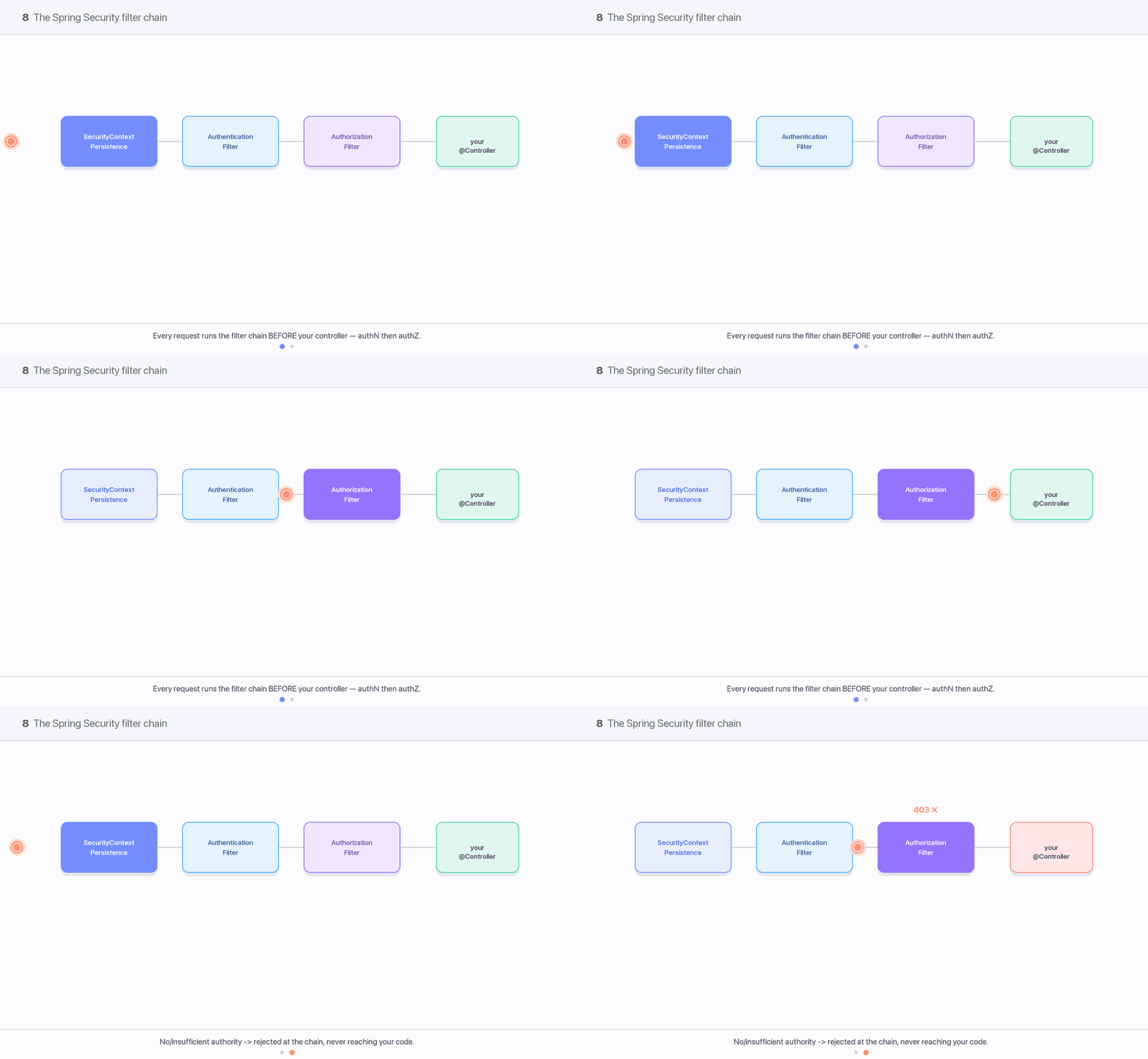
A request traverses the Spring Security filter chain — authentication first, then authorization — and only reaches your controller if both pass.
1. Security runs before your controller: the filter chain
The single most important mental model: Spring Security is a servlet Filter, not something inside Spring MVC. It sits in front of the DispatcherServlet (04 - Building REST APIs), so an unauthenticated or unauthorized request is rejected before your handler method ever runs. There is no @Secured check buried in your controller doing the work — the chain already decided.
The wiring has three layers:
DelegatingFilterProxy— a standard Jakarta servlet filter (jakarta.servlet.Filter) that Boot registers in the container under the namespringSecurityFilterChain. It owns no logic; it delegates to a Spring bean so the real filters can be Spring-managed and dependency-injected.FilterChainProxy— the bean it delegates to. It holds an ordered list ofSecurityFilterChains and, for each request, runs the first chain whose request matcher matches (this ordering matters — see §2).- The ordered filters inside the matched chain, each with one job:
| Order | Filter | Responsibility |
|---|---|---|
| early | SecurityContextHolderFilter | loads any existing Authentication into the SecurityContext (replaced SecurityContextPersistenceFilter in 6.x) |
CsrfFilter | validates the CSRF token for state-changing requests (§8) | |
CorsFilter | applies CORS policy before auth (§9) | |
| auth filters | UsernamePasswordAuthenticationFilter, BearerTokenAuthenticationFilter (JWT), OAuth2 login filters — whichever the config enabled | |
ExceptionTranslationFilter | turns AuthenticationException/AccessDeniedException into a 401/403 or a redirect to login | |
| last | AuthorizationFilter | the final authorization decision (replaced FilterSecurityInterceptor in 6.x) |
The one-sentence framing interviewers want
“Spring Security is a chain of servlet filters in front of the DispatcherServlet —
DelegatingFilterProxyhands off toFilterChainProxy, which picks the first matchingSecurityFilterChainand runs its ordered filters; authentication happens early, authorization is the last filter, and my controller only executes if both pass.” NamingAuthorizationFilter(not the removedFilterSecurityInterceptor) is a current-version signal.
2. Modern component-based configuration
The old WebSecurityConfigurerAdapter base class was deprecated in Spring Security 5.7 and removed in 6.0 — do not use it, and flag it if you see it in a codebase. Modern config is a SecurityFilterChain @Bean built with the lambda DSL (in 7.x the lambda form is the only form; the chained non-lambda methods were removed).
@Configuration
@EnableWebSecurity
public class SecurityConfig {

    @Bean
    SecurityFilterChain api(HttpSecurity http) throws Exception {
        http
            .authorizeHttpRequests(auth -> auth
                .requestMatchers("/actuator/health", "/login").permitAll()
                .requestMatchers("/admin/**").hasRole("ADMIN")
                .anyRequest().authenticated())          // deny-by-default catch-all
            .oauth2ResourceServer(oauth2 -> oauth2       // stateless JWT (§5)
                .jwt(Customizer.withDefaults()))
            .sessionManagement(sm -> sm
                .sessionCreationPolicy(SessionCreationPolicy.STATELESS))
            .csrf(csrf -> csrf.disable());               // SAFE here — token API, no cookies (§8)
        return http.build();
    }
}
You can define multiple SecurityFilterChain beans (e.g. one for /api/**, one for the browser UI), each with a securityMatcher(...) and an @Order. FilterChainProxy uses the first whose matcher matches — so ordering the beans wrong is a real footgun.
Gotcha #1 — request-matcher order: a broad
permitAllshadows a protected routeAuthorization rules are evaluated top to bottom, first match wins. Write
.requestMatchers("/**").permitAll()(or/api/**) above.requestMatchers("/api/admin/**").hasRole("ADMIN")and the admin rule is dead code — every request matches the broad rule first and sails through unauthenticated. Nothing warns you; it compiles, starts, and quietly leaves an endpoint wide open.
Mitigation: order rules most-specific first, broadest last, and always end with.anyRequest().authenticated()(or.denyAll()) so the default is closed, not open. Add a test that hits the protected route unauthenticated and asserts 401/403.
3. Authentication: who are you?
Authentication establishes identity and stores an Authentication in the SecurityContext. The collaborators:
| Component | Role |
|---|---|
AuthenticationManager | entry point; usually a ProviderManager delegating to a list of providers |
AuthenticationProvider | one strategy (DAO/username-password, JWT, LDAP…); the first that supports the token handles it |
UserDetailsService | loads a UserDetails (username, hashed password, authorities) by username — your bridge to the user store |
PasswordEncoder | hashes and verifies passwords (§10) — never compares plaintext |
A username/password provider (DaoAuthenticationProvider) is auto-wired when you expose a UserDetailsService and a PasswordEncoder:
@Bean
UserDetailsService users(UserRepository repo) {
    return username -> repo.findByUsername(username)          // load from your DB
        .map(u -> User.withUsername(u.getUsername())
            .password(u.getPasswordHash())                    // ALREADY a {bcrypt}… hash (§10)
            .authorities(u.getAuthorities())
            .build())
        .orElseThrow(() -> new UsernameNotFoundException("Bad credentials"));  // see gotcha
}

@Bean
PasswordEncoder passwordEncoder() {
    return PasswordEncoderFactories.createDelegatingPasswordEncoder();  // bcrypt by default (§10)
}
Gotcha #2 — user enumeration: leaking whether a username exists
Returning
404 "no such user"for an unknown username but401 "wrong password"for a known one lets an attacker enumerate valid accounts — a reconnaissance step for credential stuffing. The same leak comes from timing (bailing out early when the user is missing) and from a “forgot password” flow that says “no account with that email.”
Mitigation: respond identically for “unknown user” and “wrong password” — one generic Bad credentials / same status code, same body. Keep timing constant by still running a dummy password hash when the user is missing (DaoAuthenticationProviderhashideUserNotFoundExceptions=trueon by default; don’t defeat it). Return neutral “if that account exists, we sent an email” for password reset.
4. Authorization: what may you do?
Once identity is known, authorization decides access. Rules live in authorizeHttpRequests (§2) and match on paths, HTTP methods, or custom RequestMatchers.
Roles vs authorities — the ROLE_ prefix trips everyone up:
hasAuthority("ADMIN")requires aGrantedAuthorityof exactly"ADMIN".hasRole("ADMIN")is a shortcut that requires"ROLE_ADMIN"— Spring adds theROLE_prefix for you.
They are the same mechanism; a “role” is just an authority conventionally prefixed ROLE_. Mismatches (hasRole("ROLE_ADMIN") looking for ROLE_ROLE_ADMIN, or authorities stored without the prefix that hasRole expects) cause silent 403s.
.authorizeHttpRequests(auth -> auth
    .requestMatchers(HttpMethod.GET, "/products/**").permitAll()      // public reads
    .requestMatchers(HttpMethod.POST, "/products/**").hasRole("EDITOR")
    .requestMatchers("/admin/**").hasRole("ADMIN")
    .anyRequest().authenticated())
Deny by default
Authorization should be allowlist, not denylist. End every chain with
.anyRequest().authenticated()or.denyAll(); a route you forgot to list is then closed, and a code review catches the missingpermitAllrather than a pen-tester finding an open endpoint. Fine-grained, data-dependent checks (“is this my order?”) belong in method security (§7), not in path rules.
5. Stateless JWT vs server-side session — the core architectural choice
This is the decision interviewers push on. A session stores auth state server-side (a JSESSIONID cookie points at it); a stateless JWT resource server trusts a signed token on every request and stores nothing.
The JWT side is a few lines — Boot’s oauth2ResourceServer().jwt() validates the token’s signature, exp, and issuer against your identity provider’s JWKS:
// SecurityFilterChain fragment — validate a Bearer JWT on every request
.oauth2ResourceServer(oauth2 -> oauth2
    .jwt(jwt -> jwt.jwtAuthenticationConverter(rolesConverter())))
# application.yml — point at the IdP; Boot builds the JwtDecoder from the JWKS
spring:
security:
oauth2:
resourceserver:
jwt:
issuer-uri: https://idp.example.com/realms/store # discovers jwk-set-uri| Dimension | Stateless JWT | Server-side session | When to pick which |
|---|---|---|---|
| Revocation | hard — token is valid until exp; needs a denylist/short TTL + refresh | trivial — delete the session | need instant logout / ban → session |
| Horizontal scale | trivial — any node validates the signature, no shared state | needs sticky sessions or a shared store (Redis via Spring Session) | stateless microservices / autoscaling → JWT |
| Primary attack surface | XSS (steal a token in JS-readable storage) | CSRF (browser auto-sends the cookie) → §8 | browser app with server rendering → session + CSRF |
| Token/cookie size | larger — full claims sent every request | tiny opaque id | chatty low-latency APIs favor a small id |
| Best fit | SPA/mobile → API, service-to-service | classic server-rendered web app, admin portals | — |
The committed recommendation
For a service or SPA/mobile-facing API, go stateless JWT resource server and accept the revocation cost by keeping access-token TTLs short (minutes) with refresh tokens — it scales horizontally with zero shared state. For a server-rendered browser app (admin console, internal tool), a server-side session is simpler and safer: instant revocation and the mature CSRF defenses of the framework. Don’t put a raw JWT in
localStoragefor a browser app — that trades a solved CSRF problem for an XSS token-theft problem.
6. OAuth2 / OIDC login & client credentials
Spring Security is both a resource server (validates tokens, §5) and an OAuth2 client:
oauth2Login()— OIDC login: users sign in via Google/Okta/Keycloak; Spring runs the authorization-code flow and creates an authenticated session. Configure providers underspring.security.oauth2.client.registration.*.- Client credentials — service-to-service auth with no user; the app fetches its own token. Use an
OAuth2AuthorizedClientManager(or theRestClient/WebClientOAuth2 integration) and grant typeclient_credentials.
// browser login via an OIDC provider
http.oauth2Login(Customizer.withDefaults());
The rule of thumb: resource server = you validate tokens; client = you obtain tokens. Many services are both — accept user tokens on the way in, use client-credentials tokens on the way out to call a downstream service.
7. Method security: @PreAuthorize and the AOP catch
Path rules can’t express “only the owner may edit this order.” Method security puts the check on the method:
@EnableMethodSecurity          // on a @Configuration class; enables the annotations below
public class MethodSecurityConfig { }

@Service
public class OrderService {

    @PreAuthorize("hasRole('ADMIN') or #order.ownerId == authentication.name")
    public void update(Order order) { /* ... */ }

    @PostAuthorize("returnObject.ownerId == authentication.name")
    public Order find(long id) { /* ... */ }
}
@PreAuthorize checks before the method runs (SpEL over arguments); @PostAuthorize checks the return value after. Method security is implemented with Spring AOP proxies — the check lives in a proxy wrapping your bean (02 - IoC Container, Beans & Dependency Injection).
Gotcha #3 —
@PreAuthorizesilently doesn't apply on self-invocationBecause the check is on the proxy, it only fires when the call comes through the proxy — i.e. from another bean. If a method in the same class calls
this.update(order)(self-invocation), the call bypasses the proxy entirely and the@PreAuthorizenever runs. No error, no log — the security check is simply skipped, and the method executes unprotected.
Mitigation: don’t rely on internal self-calls for secured methods — call through an injected reference to the bean, split the secured method into a separate bean, or (last resort) useAopContext.currentProxy(). This is the exact same proxy-boundary trap as@Transactionalself-invocation (02 - IoC Container, Beans & Dependency Injection) — one mental model covers both.
8. CSRF: the most misunderstood setting
CSRF (cross-site request forgery) exploits ambient credentials — anything the browser attaches automatically. A cookie (like JSESSIONID) is sent on every request to your domain, so a malicious page can forge a state-changing request and the browser helpfully authenticates it. Spring Security’s CsrfFilter defends this by requiring a per-session token that a cross-site attacker can’t read.
The decision hinges entirely on how you authenticate:
Gotcha #4 — disabling CSRF on a cookie/session browser app opens a real hole
csrf(csrf -> csrf.disable())is copy-pasted from JWT tutorials into cookie/session apps constantly. If your auth rides on a session cookie, disabling CSRF means any malicious site can submitPOST /transferand the browser will attach the victim’s cookie — a textbook CSRF exploit that moves money or changes settings. This is one of the most common serious misconfigurations in real Spring codebases.
Mitigation: for a cookie/session app, leave CSRF enabled (CookieCsrfTokenRepository.withHttpOnlyFalse()for SPAs reading the token) and mark session cookiesSameSite=Lax/Strict. Only disable CSRF when auth is aAuthorization: Bearertoken that the browser does not send automatically — then there is no ambient credential to forge, and disabling it is correct and expected.
Rule: stateless token API → safe to disable CSRF. Cookie/session browser app → never disable it.
9. CORS: not a security feature, but a security-adjacent one
CORS governs whether a browser lets JavaScript on origin A read a response from origin B. It is enforced by the browser, not your server — it protects users, it does not authorize requests. Configure it explicitly so your SPA can call the API:
http.cors(Customizer.withDefaults());   // picks up the CorsConfigurationSource bean below

@Bean
CorsConfigurationSource corsSource() {
    var cfg = new CorsConfiguration();
    cfg.setAllowedOrigins(List.of("https://app.example.com"));   // NOT "*" with credentials
    cfg.setAllowedMethods(List.of("GET", "POST", "PUT", "DELETE"));
    var source = new UrlBasedCorsConfigurationSource();
    source.registerCorsConfiguration("/api/**", cfg);
    return source;
}
CORS must be wired through Spring Security
Put CORS config in the security chain via
http.cors(...)(backed by aCorsConfigurationSource), not only as an MVC@CrossOrigin. Otherwise the security filters run before MVC and reject the browser’s preflightOPTIONSrequest, and you get mystifying CORS errors that look like an MVC bug but are a filter-order bug. Never combineallowedOrigins("*")withallowCredentials(true)— the browser rejects it, and it would be unsafe anyway.
10. Password storage: DelegatingPasswordEncoder
Never store plaintext or fast hashes (MD5/SHA-256) — those are brute-forced at billions/sec on a GPU. Use an adaptive hash: BCrypt or Argon2. Spring’s default PasswordEncoderFactories.createDelegatingPasswordEncoder() stores an id prefix so you can migrate algorithms without a flag day:
{bcrypt}$2a$10$N9qo8uLOickgx2ZMRZoMy...     ← the prefix tells Spring which encoder verifies it
{argon2}$argon2id$v=19$m=16384,t=2,p=1$...
Gotcha #5 — weak or missing hashing (and the
NoOpPasswordEncodertrap)Storing passwords with no hash, a plain SHA-256, or
NoOpPasswordEncoder(plaintext, deprecated for a reason) means a single database leak exposes every user’s actual password — and because people reuse passwords, your breach becomes their bank’s breach.NoOpPasswordEncodershows up in tutorials and then survives into production.
Mitigation: use the delegating encoder (BCrypt default, or Argon2id for new systems). Because the hash carries its algorithm/cost prefix, you can upgrade cost or algorithm transparently — verify with the old encoder on login, re-hash with the new one. Set a sensible BCrypt strength (10–12) and never log or echo password fields.
11. Securing Actuator
Actuator (12 - Actuator, Metrics & Observability) exposes operational endpoints — /actuator/env, /heapdump, /mappings, /loggers — that leak configuration and secrets or allow live changes. They are not public by default, and must not become public.
@Bean
SecurityFilterChain actuator(HttpSecurity http) throws Exception {
    http
        .securityMatcher(EndpointRequest.toAnyEndpoint())        // this chain owns /actuator/**
        .authorizeHttpRequests(auth -> auth
            .requestMatchers(EndpointRequest.to("health")).permitAll()  // health for k8s probes
            .anyRequest().hasRole("ACTUATOR_ADMIN"));            // everything else locked down
    return http.build();
}
Expose deliberately, protect always
Only expose the endpoints you need —
management.endpoints.web.exposure.include=health,info,metrics, never*in production. Put management on a separate port (management.server.port) that isn’t internet-facing, keepmanagement.endpoint.health.show-details=when-authorized, and require a role for everything except liveness/readiness. See 12 - Actuator, Metrics & Observability for the endpoint catalog.
12. Caveats & risk mitigation (summary)
- Deny by default (§2, §4). End every chain with
anyRequest().authenticated()/denyAll(); order matchers specific-first so a broadpermitAllcan’t shadow a protected route. - CSRF depends on the credential (§8). Disable only for
Bearer-token APIs; keep it on for anything cookie/session-based. - Method security is proxy-based (§7). Self-invocation bypasses
@PreAuthorize— same trap as@Transactional. - Hash adaptively (§10). BCrypt/Argon2 via the delegating encoder; never plaintext, fast hashes, or
NoOpPasswordEncoder. - Don’t leak identity signals (§3). Uniform responses for unknown-user vs wrong-password to prevent enumeration.
- Lock down Actuator (§11). Expose the minimum, protect the rest, prefer a separate management port.
- Version facts are volatile. Spring Boot 4.1.x / Spring Security 7.1.x (7.0.x and 6.5.x also maintained) / Jakarta EE 11 (
jakarta.servlet) / JDK 17 baseline are current as of mid-2026 — re-verify GA versions and DSL details before relying on them; the lambda DSL andSecurityFilterChainbean are the current shape,WebSecurityConfigurerAdapteris gone.
13. In practice
// SecurityConfig.java — a stateless JWT API with a locked-down default
@Configuration
@EnableWebSecurity
@EnableMethodSecurity                                  // turns on @PreAuthorize (§7)
public class SecurityConfig {

    @Bean
    SecurityFilterChain api(HttpSecurity http) throws Exception {
        http
            .authorizeHttpRequests(auth -> auth
                .requestMatchers("/actuator/health").permitAll()
                .requestMatchers(HttpMethod.GET, "/products/**").permitAll()
                .requestMatchers("/admin/**").hasRole("ADMIN")
                .anyRequest().authenticated())          // deny-by-default (§4)
            .oauth2ResourceServer(o -> o.jwt(Customizer.withDefaults()))  // JWT (§5)
            .sessionManagement(s -> s.sessionCreationPolicy(STATELESS))
            .cors(Customizer.withDefaults())            // wire CORS via security (§9)
            .csrf(c -> c.disable());                    // SAFE: Bearer-token API, no cookies (§8)
        return http.build();
    }

    @Bean
    PasswordEncoder passwordEncoder() {                 // BCrypt default, prefix-tagged (§10)
        return PasswordEncoderFactories.createDelegatingPasswordEncoder();
    }
}
Interview talking points to be able to defend:
- “Security is a servlet filter chain in front of the DispatcherServlet —
DelegatingFilterProxy→FilterChainProxy→ the ordered filters; authorization is the last filter, so my controller only runs if auth and authz pass.” - “
WebSecurityConfigurerAdapteris gone since 6.0 — config is aSecurityFilterChainbean with the lambda DSL, and I end withanyRequest().authenticated()so the default is closed.” - “Roles are just authorities with a
ROLE_prefix thathasRoleadds for me —hasAuthoritydoesn’t.” - “Stateless JWT scales without shared state but revocation is hard; sessions revoke instantly but need sticky/shared state — JWT’s surface is XSS, a cookie session’s is CSRF.”
- “I disable CSRF only for Bearer-token APIs; for cookie/session apps disabling it opens a CSRF hole.”
- “
@PreAuthorizeis AOP-proxy-based, so self-invocation silently skips it — same boundary as@Transactional.” - “Passwords go through the delegating encoder (BCrypt/Argon2) so I can upgrade the algorithm transparently; never plaintext or
NoOpPasswordEncoder.”
14. Sources
- Spring Security Reference — Architecture (filter chain, DelegatingFilterProxy, FilterChainProxy)
- Spring Security Reference — Authorize HTTP Requests (
authorizeHttpRequests, roles vs authorities) - Spring Security Reference — OAuth2 Resource Server (JWT)
- Spring Security Reference — Method Security (
@EnableMethodSecurity,@PreAuthorize) - Spring Security Reference — CSRF
- Spring Security Reference — Password Storage (
DelegatingPasswordEncoder, BCrypt/Argon2) - Spring Security Reference — What’s New in 7.1
- Spring Boot Reference — Securing Actuator endpoints (
EndpointRequest) - OWASP — Cross-Site Request Forgery (CSRF) Prevention Cheat Sheet
- OWASP — Password Storage Cheat Sheet
- OWASP — Authentication Cheat Sheet (user enumeration)
- Spring Security 7.0.0 GA announcement (2025-11-17)