The engine underneath every Spring app: the IoC container that reads bean definitions, instantiates them, and injects their collaborators so your code never calls new on its dependencies. We cover ApplicationContext vs BeanFactory, how definitions get registered, the injection styles and why constructor injection wins, @Autowired resolution, scopes and the singleton-holds-a-prototype trap, the full bean lifecycle, circular dependencies, and — the senior differentiator — the AOP proxy model and the self-invocation gotcha that silently disables @Transactional/@Cacheable. This is the container the auto-configured beans from 01 - Spring Boot Fundamentals & Auto-Configuration actually live in; the proxy mechanics here are exactly what power 07 - Transactions & Data Consistency and 09 - Caching.
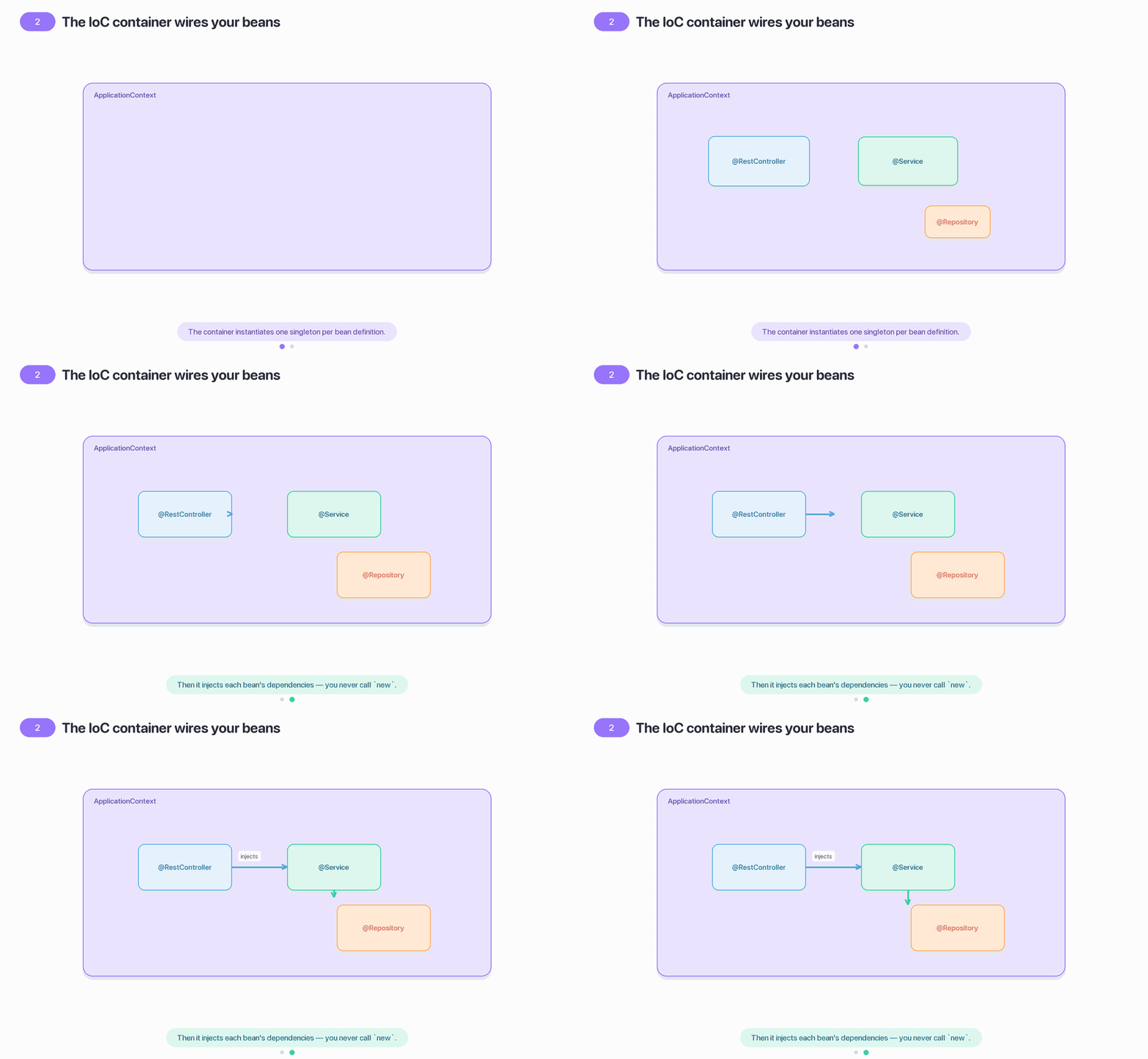
You hand the container bean definitions (via component scan or @Bean methods); it instantiates the singletons in dependency order, then injects each bean’s collaborators — inverting control so objects never construct their own dependencies.
1. Inversion of Control: the one idea
Inversion of Control means an object does not create or look up its collaborators — the container creates them and hands them in. Dependency Injection is the concrete technique Spring uses to do that. The payoff is decoupling: your OrderService declares “I need a PaymentGateway” and never knows which implementation, how it was built, or its lifecycle.
// WITHOUT IoC — the class is welded to a concrete implementation and its constructionclass OrderService { private final PaymentGateway gateway = new StripeGateway(apiKey, httpClient); // rigid, untestable}// WITH IoC — the container supplies a fully-built collaborator; this class only *uses* it@Serviceclass OrderService { private final PaymentGateway gateway; OrderService(PaymentGateway gateway) { this.gateway = gateway; } // "give me one"}
The one-sentence framing interviewers want
“The container owns object creation and wiring; my classes declare what they need, not how to build it. That inversion is what makes the code testable, swappable, and free of new on its dependencies.” Keep the vocabulary straight: IoC is the principle, DI is the mechanism, and the ApplicationContext is the runtime that performs it.
2. The container: ApplicationContext vs BeanFactory
Both are IoC containers, but BeanFactory is the bare interface — lazy bean instantiation and wiring, nothing else. ApplicationContextextends it and is what you actually use.
Use ApplicationContext — the eager-init difference matters
Spring’s own guidance is to “use an ApplicationContext unless you have a good reason not to.” The practical reason is fail-fast: ApplicationContext instantiates all non-lazy singletons during startup, so a misconfigured or missing dependency blows up at boot with a clear stack trace — not on the first request in production. In Boot the context is created for you (AnnotationConfigApplicationContext for a plain app, a servlet/reactive variant for web); you rarely touch BeanFactory directly.
3. How bean definitions get registered
A bean starts life as a BeanDefinition — metadata (class, scope, dependencies, init/destroy methods) registered before any instance exists. There are two idiomatic sources:
(a) Component scanning + stereotypes — Spring scans packages and turns annotated classes into definitions automatically:
@Service // a @Component; scanned and registered as a singleton named "orderService"class OrderService { /* ... */ }
Stereotype
Marks a…
Extra behaviour beyond @Component
@Component
generic Spring-managed bean
none — the base
@Service
business-logic bean
semantic only (readability, aspect targeting)
@Repository
persistence bean
translates native/JPA exceptions into Spring’s DataAccessException
@Controller / @RestController
web endpoint
picked up by Spring MVC handler mapping
They are functionally near-identical, but the labels carry intent and @Repository actually does something (exception translation). Use the specific stereotype that fits the layer.
(b) @Bean methods in a @Configuration class — for beans you can’t annotate (third-party types) or that need construction logic:
@Configurationclass InfraConfig { @Bean RestClient paymentRestClient(PaymentProperties props) { // method name = bean name return RestClient.builder().baseUrl(props.baseUrl()).build(); }}
Gotcha #1 — @Bean inter-method calls and proxyBeanMethods
By default @Configuration runs in “full mode” (proxyBeanMethods = true): Spring generates a CGLIB subclass of the config class so that when one @Bean method calls another (new ServiceB(serviceA())), the call is intercepted and returns the existing singleton. Set proxyBeanMethods = false (“lite mode”) — as Boot’s own auto-config does for speed — and that same serviceA() call is a plain Java call that builds a brand-new instance every time, quietly giving you two ServiceA objects where you expected one shared singleton. Mitigation: never call one @Bean method from another. Express the dependency as a method parameter (ServiceB serviceB(ServiceA a)) — Spring injects the managed singleton regardless of proxy mode, and you can safely keep proxyBeanMethods = false.
4. Injection styles: constructor vs setter vs field
There are three ways the container can inject a collaborator. They are not equal, and the choice is a senior signal.
// CONSTRUCTOR (the standard) — final fields, mandatory deps, no Spring annotation needed@Serviceclass OrderService { private final PaymentGateway gateway; private final InventoryClient inventory; OrderService(PaymentGateway gateway, InventoryClient inventory) { // single ctor → @Autowired implicit this.gateway = gateway; this.inventory = inventory; }}// SETTER — good for genuinely OPTIONAL deps with a sensible default@Serviceclass ReportService { private Formatter formatter = Formatter.DEFAULT; @Autowired(required = false) void setFormatter(Formatter f) { this.formatter = f; }}// FIELD — concise, but avoid (reasons below)@Serviceclass BadService { @Autowired private PaymentGateway gateway; // reflection-set, non-final, hidden dependency}
Style
Fields final?
Deps visible in API?
Testable without Spring?
When to pick
Constructor
yes
yes (in the signature)
yes — just new it with mocks
the default — all mandatory dependencies
Setter
no
yes (setter exists)
yes
genuinely optional deps, or reconfigurable ones
Field
no
no (hidden)
no — needs reflection/Spring
avoid; tolerable only in throwaway @Configuration/tests
Why constructor injection is the standard
Spring’s team “generally advocates constructor injection” for four concrete reasons: (1) immutability — fields can be final; (2) guaranteed non-null — the object cannot exist in a half-wired state, deps are present the instant construction returns; (3) mandatory-by-design — a required collaborator is a required constructor argument, enforced by the compiler; (4) no framework coupling — a single constructor needs no@Autowired at all, so the class is a plain object you can unit-test with new. A bonus: a constructor with too many arguments screams that the class has too many responsibilities — a design smell the other styles hide.
Gotcha #2 — field injection hides dependencies and breaks tests
@Autowired private Foo foo; looks tidy but it is the worst option. The dependency is invisible from the public API, the field cannot be final (so the object is mutable and can sit half-initialised), and — the killer — you cannot instantiate the class in a plain unit test: there is no constructor to pass mocks to, forcing reflection or a full Spring context just to test one method. It also silently permits unlimited dependencies, masking bloated classes. Mitigation: use constructor injection everywhere. With Lombok, @RequiredArgsConstructor generates the constructor from final fields so it is as terse as field injection with none of the cost.
5. @Autowired resolution, @Primary, @Qualifier
Spring resolves an injection point by type first, then disambiguates by name. When exactly one candidate matches, you’re done. When several beans satisfy the same type, resolution fails with NoUniqueBeanDefinitionException unless you break the tie:
interface PaymentGateway {}@Component @Primary class StripeGateway implements PaymentGateway {} // the default winner@Component class PaypalGateway implements PaymentGateway {}@Serviceclass Checkout { Checkout(PaymentGateway gateway, // gets Stripe via @Primary @Qualifier("paypalGateway") PaymentGateway backup) {} // explicitly ask for PayPal}
@Primary marks one bean as the default when multiple candidates exist — set-it-once, applies everywhere.
@Qualifier("name") overrides at a specific injection point — more explicit, wins over @Primary.
Optional dependencies: declare the parameter as Optional<Foo>, @Nullable Foo, or @Autowired(required = false) — absent bean → empty/null instead of a startup failure.
All of them / lazy lookup: inject List<PaymentGateway> (every implementation, order via @Order) or ObjectProvider<PaymentGateway> for lazy, optional, or on-demand retrieval without a hard startup dependency.
@Primary for the common default, @Qualifier for the exception
Set @Primary on the implementation 90% of call sites want, then reach for @Qualifier only at the few places that need the alternative. This keeps most injection points clean while remaining explicit exactly where it matters. ObjectProvider<T> is the modern, null-safe way to express “maybe there’s a bean” — prefer it over required = false.
6. Bean scopes & the prototype-in-singleton trap
A scope controls how many instances the container manages and how long they live.
Scope
One instance per…
Typical use
singleton (default)
container
stateless services, repositories — almost everything
prototype
each injection / lookup
stateful, short-lived helpers you want a fresh copy of
request
HTTP request (web only)
per-request data holder
session
HTTP session (web only)
per-user session state
application / websocket
ServletContext / WebSocket
rarely needed
Gotcha #3 — a prototype injected into a singleton is created once
Scope is resolved at the injection point’s creation time. Inject a prototype bean straight into a singleton, and Spring creates the prototype exactly once — when it builds the singleton — and that same instance is reused for the life of the app. The prototype scope is silently defeated; you think you get a fresh object per call and you don’t.
@Service class Singleton { @Autowired Prototype p; // resolved ONCE — same p forever}
Break the scope mismatch with ObjectProvider (or @Lookup)
To get a genuinely fresh prototype on each use, ask the container each time instead of holding a reference:
@Serviceclass Singleton { private final ObjectProvider<Prototype> provider; Singleton(ObjectProvider<Prototype> provider) { this.provider = provider; } void handle() { Prototype fresh = provider.getObject(); /* new instance per call */ }}
Alternatives: a @Lookup-annotated method (Spring overrides it to return a fresh bean), a JSR-330 jakarta.inject.Provider<T>, or a scoped proxy (@Scope(value = "request", proxyMode = TARGET_CLASS)) — the standard fix for injecting a request/session bean into a singleton, where the proxy fetches the right instance per call.
7. The bean lifecycle
Knowing the ordered phases lets you hook the correct extension point instead of guessing. For a single bean:
1. Instantiate → container calls the constructor (constructor injection happens HERE)2. Populate properties → setter/field dependencies injected3. *Aware callbacks → BeanNameAware, ApplicationContextAware, etc.4. BeanPostProcessor → postProcessBeforeInitialization(...) ← proxies can be created around here5. Initialization → @PostConstruct → InitializingBean.afterPropertiesSet() → @Bean(initMethod)6. BeanPostProcessor → postProcessAfterInitialization(...) ← AOP proxy typically wrapped HERE7. IN USE → the fully-initialised (possibly proxied) bean serves the app8. Destruction → @PreDestroy → DisposableBean.destroy() → @Bean(destroyMethod) (on context close)
@Componentclass ConnectionPool { private DataSource ds; ConnectionPool(DataSource ds) { this.ds = ds; } // (1)+(2) @PostConstruct void warmUp() { /* open a few connections */ } // (5) jakarta.annotation @PreDestroy void drain() { /* close pool cleanly */ } // (8) jakarta.annotation}
BeanPostProcessor is where the "magic" happens — and it explains proxies
@Transactional, @Cacheable, @Async, and security advice are not compiled into your class. A BeanPostProcessor inspects each bean after initialization (step 6) and, if it carries such annotations, replaces the bean in the container with a proxy that wraps it. Prototype beans are the exception: Spring does not manage their full lifecycle, so @PreDestroy never runs on a prototype — the container hands it over and forgets it. Note the namespace: lifecycle annotations are jakarta.annotation.* on Jakarta EE 11, not the old javax.*. [HIGH-CHURN: Jakarta EE 11 / jakarta.* is current as of mid-2026 — verify the namespace before relying on it.]
8. Lazy initialization
By default ApplicationContext instantiates every singleton eagerly at startup (§2). @Lazy defers a bean’s creation until it is first needed:
@Component@Lazy // not built until something asks for itclass ExpensiveReportEngine { /* heavy to construct */ }
Lazy is a scalpel, not a global switch
Use @Lazy for genuinely expensive, rarely-used beans, or to break an occasional cycle (§9). Avoid the global spring.main.lazy-initialization=true: it speeds boot but trades away fail-fast — a misconfigured bean now explodes on first request, in production, instead of at startup. Keep eager init as the default; make individual beans lazy deliberately.
9. Circular dependencies
A cycle is A needs B and B needs A (directly or through a chain). How Spring reacts depends on the injection style:
Constructor ↔ constructor:unresolvable. To build A Spring must first build B, but to build B it must first build A — neither can complete. Spring throws BeanCurrentlyInCreationException at startup.
Setter/field: historically resolvable via Spring’s three-level cache (it injects a partially-constructed reference), but Spring Boot disables this by default since 2.6 — even a setter cycle now fails at startup unless you opt back in.
@Service class A { A(B b) {} } // ↖ needs B@Service class B { B(A a) {} } // ↗ needs A → BeanCurrentlyInCreationException at boot
Gotcha #4 — a constructor cycle is a design smell, not a config bug
The temptation is to reach for spring.main.allow-circular-references=true or sprinkle @Lazy to make the error disappear. That restores the old lenient behaviour and hides the real problem: two beans are mutually entangled, which means the responsibilities are split along the wrong seam. It also produces fragile init ordering and beans that are hard to test in isolation. Mitigation, in order of preference: (1) refactor — extract the shared logic into a third bean both depend on, or merge them if they’re really one concern; (2) invert one direction with an event or a callback interface; (3) as a last resort, break the cycle with @Lazy on one injection point (Spring injects a proxy, deferring the real lookup). Reaching for the global allow-circular-references flag is the answer that fails the interview.
10. The AOP proxy model & self-invocation
This is the topic that separates senior from mid-level, because it explains why@Transactional and @Cacheable sometimes silently do nothing. Spring implements those annotations with proxies (§7): the container gives everyone a proxy that runs the advice (open a transaction, check the cache) before delegating to your real object.
Spring chooses the proxy type automatically:
Proxy
Used when
How it works
Note
JDK dynamic proxy
the bean implements an interface
runtime Proxy implementing the same interface(s)
only interface-declared methods are advised
CGLIB
the bean has no interface (or proxyTargetClass=true)
runtime subclass overriding methods
can’t proxy final classes/methods
@Serviceclass BillingService { @Transactional public void chargeAll(List<Order> orders) { for (Order o : orders) charge(o); // ⚠ SELF-INVOCATION — see gotcha } @Transactional(propagation = REQUIRES_NEW) public void charge(Order o) { /* expected to run in its OWN tx */ }}
The advice lives on the proxy, not on your object. When an external caller invokes chargeAll, it goes through the proxy and the transaction advice runs. But inside chargeAll, the call to charge(o) is this.charge(o) — a direct call on the target object that never touches the proxy. Spring’s own words: “self invocation via an explicit or implicit this reference will bypass the advice.” So charge’s REQUIRES_NEW is ignored, @Cacheable results aren’t cached, @Async runs on the caller’s thread. No error — it just quietly doesn’t happen. This is one of the most-asked senior Spring questions precisely because the code looks correct. Mitigation: (1) move the annotated method to a separate bean so the call crosses a proxy boundary — the cleanest fix; (2) self-inject — inject ObjectProvider<BillingService> (or the bean itself via a setter) and call self.charge(o) so the invocation goes through the proxy; (3) as a last resort ((BillingService) AopContext.currentProxy()).charge(o) with exposeProxy = true — but it couples your code to Spring AOP. Prefer option 1.
11. Caveats & best practices (summary)
Constructor injection, always (§4).final fields, non-null guarantees, plain-new testability, and a constructor that flags bloated classes. Field injection is a code-review reject.
Never call one @Bean method from another (§3). Pass dependencies as parameters so lite-mode config can’t silently double-instantiate.
Watch the scope mismatch (§6). A prototype (or request/session bean) in a singleton needs ObjectProvider/@Lookup/a scoped proxy, or it’s created exactly once.
A circular dependency is a redesign signal (§9) — refactor to a third bean; don’t flip allow-circular-references.
Remember the proxy for @Transactional/@Cacheable/@Async (§10). Self-invocation bypasses it — annotated methods must be reached from outside the bean. Directly relevant to 07 - Transactions & Data Consistency and 09 - Caching.
Version facts are volatile. Jakarta EE 11 (jakarta.* lifecycle annotations), Framework 7 / Boot 4.1.x, JDK 17 baseline are current as of mid-2026 — re-verify before relying on exact names or defaults.
Interview talking points to be able to defend:
“IoC is the principle, DI is the mechanism; the container owns creation and wiring so my classes never new their dependencies.”
“I use constructor injection for immutability, non-null guarantees, and to test with a plain new — field injection hides deps and can’t be unit-tested.”
“@Primary sets the default candidate; @Qualifier overrides at a specific point and wins over @Primary.”
“A prototype injected into a singleton is created once — I use ObjectProvider or a scoped proxy to get a fresh instance.”
“@Transactional is a proxy; calling an annotated method from within the same bean (this.method()) bypasses the proxy and the transaction/cache/async advice silently never runs. I move it to another bean or self-inject.”
“Constructor circular deps throw BeanCurrentlyInCreationException and signal a design smell — I refactor rather than flip allow-circular-references.”
12. In practice
// A clean, testable service: constructor injection, final fields, no field @Autowired@Serviceclass CheckoutService { private final PaymentGateway gateway; // @Primary picks the default impl private final ObjectProvider<AuditContext> auditCtx; // prototype/request-scoped, fetched per call CheckoutService(PaymentGateway gateway, ObjectProvider<AuditContext> auditCtx) { // no @Autowired needed this.gateway = gateway; this.auditCtx = auditCtx; } @Transactional // proxy-driven — call this from OUTSIDE the bean public Receipt checkout(Cart cart) { AuditContext ctx = auditCtx.getObject(); // fresh instance each checkout (§6) return gateway.charge(cart.total(), ctx); }}// Trivial to unit-test WITHOUT Spring — the whole point of constructor injectionclass CheckoutServiceTest { @Test void chargesTheCart() { var gw = mock(PaymentGateway.class); var svc = new CheckoutService(gw, () -> new AuditContext()); // just `new` it // ... verify(gw).charge(...) }}
# application.propertiesspring.main.lazy-initialization=false # keep eager init → fail fast at startup (§8)spring.main.allow-circular-references=false # default since Boot 2.6 — a cycle is a design smell (§9)