05 - Web Layer & Embedded Servers — MVC vs WebFlux
16 min read
Scope
How an HTTP request actually becomes a controller call in Spring Boot — the servlet request lifecycle (filters → DispatcherServlet → handler mapping → controller → message converter), the embedded server that runs it (Tomcat by default), and the two competing concurrency models: Spring MVC (imperative, thread-per-request, servlet) versus Spring WebFlux (reactive, non-blocking, Netty event-loop). We settle the question every senior gets asked — reactive or not? — including why virtual threads now let you keep the simple blocking stack and still scale I/O. For the controllers and DTOs that sit at the top of this stack, see 04 - Building REST APIs; for the AOT/native angle on startup, see 14 - Performance, AOT & Native Images.
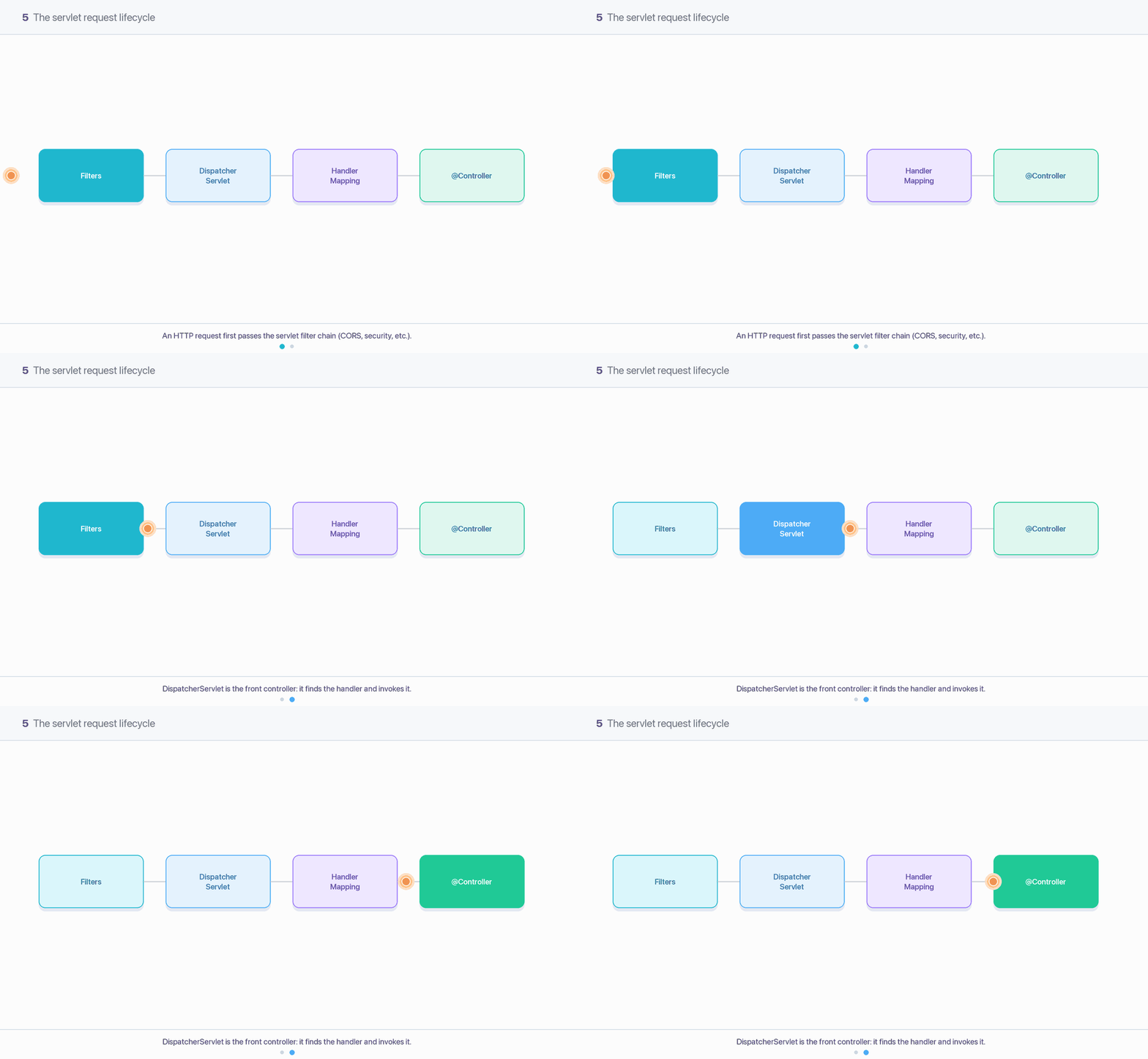
An HTTP request travels the servlet filter chain, reaches the DispatcherServlet front controller, is routed by HandlerMapping to the matching @Controller method, whose return value is serialized back by an HttpMessageConverter.
1. Two web stacks, one Boot
Spring Boot ships two independent web frameworks, and the classpath decides which one you get:
Spring MVC — the mature, imperative, blocking stack built on the Servlet API (jakarta.servlet). One request occupies one thread from start to finish. Pulled in by spring-boot-starter-web.
Spring WebFlux — the reactive, non-blocking stack built on Reactive Streams (Project Reactor’s Mono/Flux), running by default on Reactor Netty with a small event-loop. Pulled in by spring-boot-starter-webflux.
They are not layers of each other — they are alternatives with different programming models, different servers, and different failure modes.
The one-sentence framing interviewers want
“MVC is one-thread-per-request on a servlet container; WebFlux is a handful of event-loop threads that never block. MVC is simpler and correct for the vast majority of services; WebFlux trades a steep complexity increase for constant memory under massive I/O concurrency — and virtual threads now let me get most of that scaling without leaving the blocking model.” Naming that third option is the senior signal.
Gotcha #0 — putting both starters on the classpath does not give you WebFlux
If spring-boot-starter-web and spring-boot-starter-webflux are both present, Boot auto-configures MVC, not WebFlux (many teams add WebFlux only for its reactive WebClient). To actually run the reactive stack you must exclude the servlet starter. Assuming “I added WebFlux so I’m reactive now” is a classic misread — check which ApplicationContext type booted.
2. The servlet request lifecycle (Spring MVC)
This is the single most-probed topic in the module. Spring MVC is a front-controller design: every request funnels through one servlet, the DispatcherServlet, which orchestrates configurable delegates.
HTTP request
  1. Servlet container (Tomcat) accepts the socket, assigns ONE worker thread
  2. Filter chain runs  ── Servlet Filters, in order (auth, CORS, logging, compression, Spring Security)
  3. DispatcherServlet (the front controller) takes over
  4. HandlerMapping     ── resolves the request to a HandlerExecutionChain
                           (the @RequestMapping method + its HandlerInterceptors)
  5. HandlerInterceptor.preHandle()  ── may short-circuit (return false)
  6. HandlerAdapter     ── binds params (@PathVariable/@RequestBody/validation), INVOKES the controller
  7. Controller method returns a value (object, ResponseEntity, view name, …)
  8. HandlerMethodReturnValueHandler picks how to render it
       └─ for @ResponseBody/@RestController → HttpMessageConverter writes the body (Jackson → JSON)
       └─ for a view name → ViewResolver renders a template
  9. HandlerInterceptor.postHandle() / afterCompletion()
 10. Response flows back OUT through the filter chain; the worker thread is RELEASED
The whole chain executes on one thread. That thread is borrowed from the server’s pool at step 1 and returned at step 10 — it is blocked for the entire request, including any time spent waiting on a database or a downstream HTTP call. That single fact drives everything about MVC’s scaling and the entire reactive/virtual-thread debate below.
Exceptions divert to a HandlerExceptionResolver (Boot wires @ExceptionHandler/@ControllerAdvice and the default error page — see 04 - Building REST APIs).
3. Filters vs HandlerInterceptor — when each runs
Both let you run cross-cutting logic around a request, but they live at different altitudes, and picking the wrong one is a common design smell.
Servlet Filter
HandlerInterceptor
Layer
Servlet container — outside Spring MVC
Inside DispatcherServlet, after handler resolution
Sees
Raw ServletRequest/ServletResponse, every request incl. static resources
The resolved handler (controller method), ModelAndView
App concerns needing handler context: auth by annotation, per-endpoint audit
preHandle returning false short-circuits the chain (the controller never runs). A subtle trap: for @ResponseBody/ResponseEntity methods the body is already written and committed before postHandle, so you cannot mutate the response there — use a Filter (or ResponseBodyAdvice) instead.
@BeanFilterRegistrationBean<CorrelationIdFilter> correlationId() { var reg = new FilterRegistrationBean<>(new CorrelationIdFilter()); reg.addUrlPatterns("/api/*"); reg.setOrder(Ordered.HIGHEST_PRECEDENCE); // filters are ORDERED; set it explicitly return reg;}
Rule of thumb
Reach for a Filter when the concern is transport-level and handler-agnostic (security, CORS, tracing, gzip) or needs to touch the raw streams. Reach for a HandlerInterceptor only when you genuinely need to know which controller method is about to run. If you’re unsure, it’s almost always a Filter.
4. Embedded servers & the thread-per-request model
Boot embeds the server in the fat jar, so java -jar is the whole deployment (Spring Boot). For the servlet stack the choices are:
Server
Notes
Starter
Tomcat 11
default; Jakarta EE 11 / jakarta.servlet; battle-tested
spring-boot-starter-tomcat (transitive in -web)
Jetty
lightweight, good for many idle connections
spring-boot-starter-jetty
Undertow
low memory, high throughput, XNIO-based
spring-boot-starter-undertow
Swap by excluding -tomcat and adding another starter (the mechanics are in 01 - Spring Boot Fundamentals & Auto-Configuration §5). [HIGH-CHURN: Tomcat 11 / Jakarta EE 11 are current for Boot 4.1.x on Framework 7 — re-verify the exact server version before relying on it.]
Thread-per-request sizing. Tomcat serves requests from a bounded worker pool (default max 200). Because a thread is held for the request’s entire duration, peak concurrency is capped by pool size, and the sizing is governed by Little’s Law: threads ≈ throughput × average latency. A service doing 500 req/s at 100 ms average needs ~50 busy threads; the same service talking to a downstream that slows to 2 s needs ~1000 — far past the default.
server.tomcat.threads.max=200 # worker threads (peak in-flight requests)server.tomcat.threads.min-spare=10 # kept warmserver.tomcat.accept-count=100 # OS backlog once all threads are busyserver.tomcat.max-connections=8192 # sockets accepted before refusingserver.tomcat.connection-timeout=20s
Gotcha #1 — thread-pool exhaustion under a slow downstream
This is the classic production outage. A downstream API or database slows from 50 ms to 3 s. Each request now pins its worker thread for 3 s; at any real traffic level all 200 threads fill up. New requests queue in accept-count, then the socket is refused — your healthy endpoints start timing out too, because they can’t get a thread. One slow dependency has taken down the whole service. The blocking model couples every endpoint through one shared, finite pool.
Mitigation — timeouts and bulkheads, not a bigger pool
Bumping threads.max to 2000 just delays the cliff and burns ~1 MB of stack per platform thread. The real fixes: aggressive client-side timeouts on every downstream call (a call with no timeout is a latent outage), circuit breakers / bulkheads to isolate a failing dependency (14 - Performance, AOT & Native Images and resilience patterns), and — the structural answer — virtual threads (§8) so “held for 3 s” costs kilobytes instead of a scarce platform thread.
5. Spring MVC in practice
Imperative, blocking, and — for most services — exactly right. The code reads top-to-bottom; a stack trace points at your line; a debugger steps through it.
@RestController@RequestMapping("/api/orders")class OrderController { private final OrderService orders; // constructor injection (§[[02 - IoC Container, Beans & Dependency Injection]]) OrderController(OrderService orders) { this.orders = orders; } @GetMapping("/{id}") ResponseEntity<OrderView> get(@PathVariable long id) { return orders.find(id) // BLOCKING JDBC call — thread waits here .map(o -> ResponseEntity.ok(OrderView.from(o))) .orElseGet(() -> ResponseEntity.notFound().build()); } @PostMapping ResponseEntity<OrderView> create(@Valid @RequestBody CreateOrder cmd) { // validation (§[[04 - Building REST APIs]]) Order saved = orders.place(cmd); // blocks on the DB; that's fine on this stack return ResponseEntity.created(URI.create("/api/orders/" + saved.id())) .body(OrderView.from(saved)); }}
The blocking orders.find(...) call is not a bug here — on the servlet stack the thread is supposed to block. The @Valid body binding, HttpMessageConverter JSON (de)serialization, and ResponseEntity status handling are all the lifecycle from §2 doing their job.
6. Spring WebFlux — the reactive stack
WebFlux is also a front-controller design (a reactive DispatcherHandler with the same HandlerMapping → HandlerAdapter → result-handler shape), but the programming model and the runtime are fundamentally different:
Return a publisher, not a value.Mono<T> = 0..1 element, Flux<T> = 0..N. You compose a pipeline that describes the work; nothing runs until something subscribes (the framework subscribes for you).
A tiny event-loop, not a big pool. Reactor Netty runs roughly one event-loop thread per CPU core. Those threads must never block — they hand off between many in-flight requests.
Backpressure is built in. Reactive Streams lets a slow subscriber signal demand (request(n)) upstream, so a fast producer can’t overwhelm it — the property MVC’s blocking streams lack.
@RestController@RequestMapping("/api/orders")class ReactiveOrderController { private final ReactiveOrderRepository orders; // e.g. R2DBC — non-blocking all the way down ReactiveOrderController(ReactiveOrderRepository orders) { this.orders = orders; } @GetMapping("/{id}") Mono<ResponseEntity<OrderView>> get(@PathVariable long id) { return orders.findById(id) // returns Mono immediately; NOTHING blocks .map(OrderView::from) .map(ResponseEntity::ok) .defaultIfEmpty(ResponseEntity.notFound().build()); } @GetMapping(value = "/stream", produces = MediaType.TEXT_EVENT_STREAM_VALUE) Flux<OrderView> stream() { return orders.findAll().map(OrderView::from); // streamed with backpressure, constant memory }}
The payoff is real only when the whole chain is non-blocking: reactive driver (R2DBC, reactive Mongo/Redis), WebClient for downstream HTTP, no blocking library anywhere in the pipeline. One blocking Repository call in that get() method and the benefit evaporates — worse, it becomes the disaster in §7.
7. The cardinal sin — blocking the event loop
Gotcha #2 — a blocking call inside a reactive pipeline is catastrophic
On MVC, a blocking call ties up one of 200 threads. On WebFlux, a blocking call — a JDBC query, a RestTemplate call, Thread.sleep, a synchronized bottleneck, even heavy CPU work — parks one of your handful of event-loop threads. With ~8 loop threads on an 8-core box, eight concurrent slow calls freeze the entire server: every connection multiplexed onto those threads stalls, throughput collapses to zero, and health checks fail. It is far more dangerous than the same mistake on MVC, and it hides — it looks fine under light load and detonates under concurrency.
@GetMapping("/bad")Mono<String> bad() { String s = jdbcTemplate.queryForObject(sql, String.class); // ☠ BLOCKS an event-loop thread return Mono.just(s);}
Mitigation — offload, time-box, or don't go reactive at all
Three tiers, cheapest first:
Offload unavoidable blocking work to Schedulers.boundedElastic() — a bounded, elastic pool meant exactly for wrapping legacy blocking calls, keeping them off the loop threads.
Time-box every async step with .timeout(Duration.ofSeconds(2)) and a fallback, so a stalled dependency can’t hang a subscription forever.
Detect it in tests with BlockHound, which instruments the JVM to throw the moment blocking code runs on a non-blocking thread.
return Mono.fromCallable(() -> jdbcTemplate.queryForObject(sql, String.class))
           .subscribeOn(Schedulers.boundedElastic())     // off the event loop
           .timeout(Duration.ofSeconds(2))               // bounded wait
           .onErrorResume(ex -> Mono.just("fallback"));
But note what tier 1 really is: a thread pool bolted onto a thread-free model. If most of your stack is blocking anyway, that’s the loud signal you wanted MVC + virtual threads (§8), not WebFlux.
8. Virtual threads — high I/O concurrency without reactive
Virtual threads (Project Loom, Java 21+) are the pragmatic answer that reshaped this whole debate. A virtual thread is a lightweight thread the JVM parks/unparks on a small pool of carrier platform threads whenever it blocks on I/O. You keep the simple, imperative, debuggable §5 code — but a blocked “thread” now costs kilobytes, not a megabyte of stack, so a service can carry hundreds of thousands of concurrent blocked requests.
# One line. Tomcat serves each request on a fresh virtual thread instead of a pooled platform thread.spring.threads.virtual.enabled=true
@SpringBootApplicationpublic class StoreApplication { public static void main(String[] args) { SpringApplication.run(StoreApplication.class, args); // With virtual threads on, the §5 blocking controller now scales like a reactive one for I/O. }}
This directly dissolves the §4 exhaustion trap: with virtual threads there is no fixed 200-thread ceiling, so a slow downstream inflates cheap virtual threads instead of exhausting a scarce pool (you still need timeouts and circuit breakers — virtual threads make blocking cheap, not free).
Gotcha #3 — adopting reactive when virtual threads would do
The most expensive architecture mistake of the last decade of Spring: choosing WebFlux for a plain CRUD-over-JDBC service “to scale.” You inherit Mono/Flux everywhere, unreadable stack traces, a hostile debugger, a reactive-driver requirement for every data store, and the §7 landmine — to solve a problem you didn’t have. Since Java 21, MVC + virtual threads gives you comparable I/O concurrency on ordinary blocking code.
Two virtual-thread caveats to state in an interview
Pinning: on Java 21–23 a virtual thread blocked inside a synchronized block or a native framepins its carrier thread, defeating the benefit under contention — Java 24 largely removed the synchronized pin, which is why Java 24+ is now strongly recommended. Lifecycle: virtual threads are daemon threads, so a purely @Scheduled app can exit early; set spring.main.keep-alive=true. Also, thread-pool size properties stop applying once virtual threads are on. [HIGH-CHURN: pinning behavior and the recommended JDK move fast — re-verify against the current JDK/Boot notes.]
9. Graceful shutdown, CORS & static resources
Graceful shutdown lets in-flight requests finish when the process gets SIGTERM (a rolling deploy, a Kubernetes pod eviction) instead of severing them mid-response. The framework supports it on all three servers, but the default mode is immediate — you must opt in:
server.shutdown=graceful # drain in-flight requests (default is 'immediate')spring.lifecycle.timeout-per-shutdown-phase=30s # grace period before forcing termination
On shutdown the server stops accepting new connections, lets active requests complete within the timeout, then stops. Pair it with a readiness probe flip so the load balancer stops routing first (14 - Performance, AOT & Native Images).
CORS is a browser security control, configured declaratively — per-endpoint with @CrossOrigin, or globally via WebMvcConfigurer#addCorsMappings. Prefer the global registry so policy lives in one auditable place, and never pair allowCredentials(true) with a wildcard origin.
Static resources are served automatically from classpath:/static, /public, /resources, /META-INF/resources, with index.html as the welcome page — tune via spring.web.resources.* and spring.mvc.static-path-pattern. For SPAs, static assets and the API happily coexist under one Boot app.
10. Choosing the stack: MVC vs MVC + virtual threads vs WebFlux
Dimension
MVC (thread-per-request)
MVC + virtual threads
WebFlux (reactive)
Concurrency model
1 platform thread / request, bounded pool (~200)
1 virtual thread / request, effectively unbounded
~1 event-loop thread / core, many requests multiplexed
I/O throughput ceiling
pool size ÷ latency — exhausts under slow downstreams
very high — blocked threads are cheap
very high — nothing blocks
Memory under load
~1 MB stack × threads; heavy at high concurrency
low — KB per parked virtual thread
lowest — constant, few threads
Complexity
lowest — imperative, real stack traces, easy debugging
lowest — same code, one property
highest — Mono/Flux, reactive drivers, hard debugging
Backpressure
none
none
first-class (Reactive Streams demand)
Blocking calls
fine (expected)
fine (expected)
forbidden on the event loop (§7)
When to pick
default for most services; teams new to Spring
I/O-bound service needing high concurrency on Java 21+
true streaming, SSE/WebSocket at scale, end-to-end reactive stack, or backpressure is a hard requirement
The committed recommendation
Default to Spring MVC. For an I/O-bound service that must handle high concurrency, turn on virtual threads — one property, same code, no reactive tax. Choose WebFlux deliberately, only when you have a real reactive need: streaming large or infinite datasets, huge numbers of long-lived connections (SSE/WebSocket), genuine backpressure requirements, or an already-reactive data layer end-to-end. “We might need to scale someday” is not that need — virtual threads cover it. And never mix a blocking call into a reactive pipeline; if your stack is mostly blocking, that’s the tell you should have stayed on MVC.
Committed best practices
Blocking stack for blocking work — use reactive only when the whole chain is non-blocking; anything less is worse than MVC.
Timeouts on every downstream call, on any stack — a call without a timeout is a latent outage (§4).
Enable virtual threads for I/O-bound MVC services on Java 21+ instead of inflating threads.max.
Never block the event loop (§7); guard it with boundedElastic, timeouts, and BlockHound in tests.
Opt into graceful shutdown (server.shutdown=graceful) — it is not on by default.
Global CORS config, no allowCredentials(true) with a wildcard origin.
11. In practice + interview talking points
# application.properties — a pragmatic high-concurrency MVC service in 2026server.port=8080spring.threads.virtual.enabled=true # Java 21+: cheap blocking, no reactive tax (§8)spring.main.keep-alive=true # virtual threads are daemons (§8 caveat)server.tomcat.threads.max=200 # still a safety net for non-virtual paths (§4)server.tomcat.connection-timeout=20sserver.shutdown=graceful # drain in-flight requests on SIGTERM (§9)spring.lifecycle.timeout-per-shutdown-phase=30s
Interview talking points to be able to defend:
“MVC is thread-per-request on a servlet container; the thread blocks for the whole request, so peak concurrency is pool size ÷ latency — which is exactly why a slow downstream exhausts the pool and takes down healthy endpoints too.”
“The request path is filters → DispatcherServlet → HandlerMapping → HandlerAdapter → controller → HttpMessageConverter; filters are container-level and handler-agnostic, interceptors run inside MVC and know the handler.”
“WebFlux runs ~one event-loop thread per core and must never block; a stray JDBC or RestTemplate call parks a loop thread and can freeze the whole server — offload to boundedElastic, time-box it, or don’t go reactive.”
“Since Java 21 I reach for MVC + virtual threads first: I get reactive-like I/O concurrency on plain blocking code with one property and full debuggability. I pick WebFlux only for streaming, massive long-lived connections, or real backpressure.”
“Graceful shutdown isn’t on by default — I set server.shutdown=graceful and a shutdown-phase timeout, and flip readiness first for clean rolling deploys.”