Scope
How a Spring Boot app reads configuration from outside the jar — the ordered property-source precedence,
application.ymlvs.properties, the type-safe@ConfigurationPropertiesmodel (and why it beats@Value), relaxed binding, constructor-bound immutable records, fail-fast validation, profiles (@Profile, active/include/groups, profile-specific files), the ConfigData API withspring.config.import(config trees for Kubernetes ConfigMaps/Secrets), and 12-factor secret externalization. This is the property system that 01 - Spring Boot Fundamentals & Auto-Configuration reads to decide what to wire; it is also what you tune per-environment when you package and deploy in 15 - Packaging, Containers & Deployment.
Related: Spring Boot, 01 - Spring Boot Fundamentals & Auto-Configuration, 15 - Packaging, Containers & Deployment
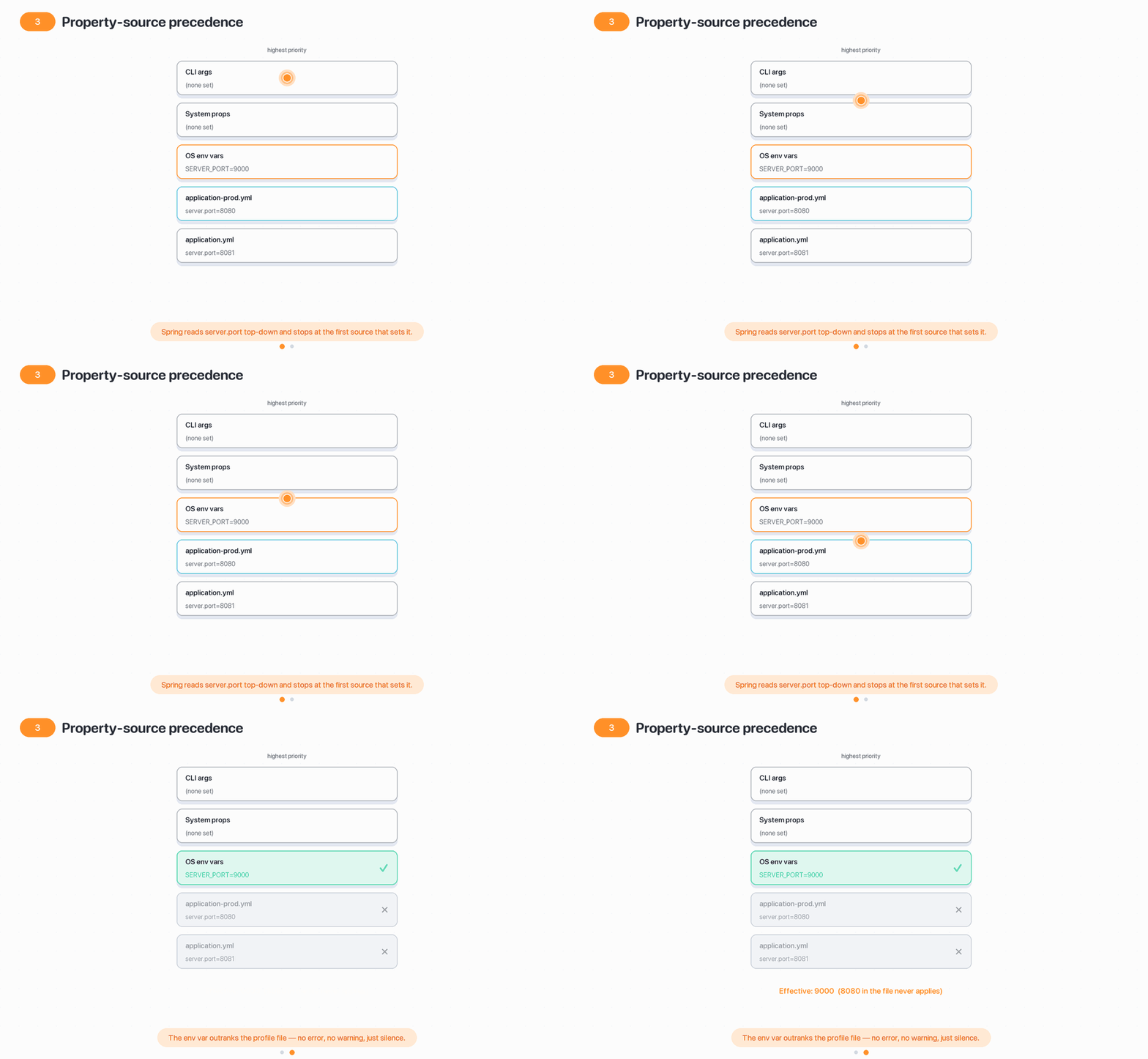
Property-source precedence: Spring checks each source top-down and stops at the first one that sets the key — an OS env var beats a profile file every time, silently.
| Concern | @Value("${...}") | @ConfigurationProperties |
|---|---|---|
| Binding | one key → one field | a whole prefix → a typed object graph |
| Type safety | string-ish, coerced per use | strongly typed, validated at bind time |
| Relaxed binding | placeholder must match a resolvable key | full relaxed binding (kebab/camel/underscore/UPPER) |
| Nested / lists / maps | painful | first-class |
| Validation | none | @Validated + jakarta.validation, fail-fast at startup |
| IDE metadata / autocomplete | no | yes (via the annotation processor) |
| Immutability | no | yes (constructor binding / records) |
The two ways to read a property. The table’s last column in §4 tells you when each is the right tool — but the short version is: reach for @ConfigurationProperties by default, keep @Value for one-off SpEL or a single ad-hoc key.
1. Why externalize — the 12-factor line
The same jar must run unchanged in dev, staging, and prod; only the configuration differs. That is factor III of the 12-factor app: strict separation of config from code, config supplied by the environment. Spring Boot’s whole externalized-config machinery exists to serve that rule — you build one artifact, then feed it a database URL, a log level, or a feature flag from a file, an environment variable, or a command-line argument at launch.
Two consequences drive everything below:
- Config is layered, not single-sourced. A value can come from a dozen places, so there must be a deterministic precedence (§3) — otherwise “which value wins?” is a coin toss.
- Secrets are config too, but special. They must never live in the artifact or in version control (§10). The mechanisms that inject config from the environment are exactly the mechanisms that inject secrets safely.
The framing interviewers want
“One immutable artifact, configuration supplied from outside per environment, with a well-defined precedence so overrides are predictable — and secrets injected the same way but never committed.” If you can also name where in the order an environment variable sits relative to
application.yml, that’s the senior signal.
2. application.properties vs application.yml
Boot reads either from src/main/resources (or an external location, §9). They are functionally equivalent for simple keys; YAML wins for hierarchy and lists.
# application.properties — flat, one key per line
spring.datasource.url=jdbc:postgresql://localhost/store
spring.datasource.hikari.maximum-pool-size=10
app.features[0]=search
app.features[1]=recommend
# application.yml — hierarchical; the same shape, far less repetition
spring:
datasource:
url: jdbc:postgresql://localhost/store
hikari:
maximum-pool-size: 10
app:
features: [search, recommend].properties | .yml | |
|---|---|---|
| Structure | flat, dotted keys | nested, indentation-based |
| Lists / maps | index syntax [0] | native sequences / maps |
| Multi-document | #--- separator | --- separator |
| Type surprises | few (all strings) | many (see gotcha below) |
| When to pick | tiny/flat config, ops familiarity | anything hierarchical (the common case) |
Gotcha #1 — YAML silently coerces types (the "Norway problem")
YAML infers types from unquoted scalars. The classic bite: a country code
NO(Norway) is read as the booleanfalse;on/off/yes/nolikewise become booleans. Unquoted numbers with a leading zero can be read as octal (0755≠ 755), a version string1.10loses its trailing zero, and a large account number becomes alongyou didn’t want. None of this errors — you just get the wrong value at runtime.
Mitigation: quote every string value that could look like something else —"NO","0755","1.10","on". When binding to a typed field via@ConfigurationProperties(§4), the declared Java type disambiguates for you — another reason to prefer it over stringly@Value.
Gotcha #2 — precedence:
.propertieswins over.ymlIf both
application.propertiesandapplication.ymlexist in the same location, the.propertiesfile takes precedence, so a stray leftover.propertiescan silently shadow your carefully edited YAML.
Mitigation: pick one format per project and delete the other; don’t keep both insrc/main/resources.
3. The ordered property-source precedence
This is the most-probed topic. A property is resolved by consulting sources highest-priority first; the first source that has the key wins. The full order (highest → lowest), keeping the sources you actually reason about in bold:
| # | Source | Example |
|---|---|---|
| 1 | Command-line arguments | --server.port=9000 |
| 2 | SPRING_APPLICATION_JSON (inline JSON in an env var / system prop) | SPRING_APPLICATION_JSON='{"server":{"port":9000}}' |
| 3 | ServletConfig / ServletContext init params | (traditional servlet deploys) |
| 4 | JNDI attributes (java:comp/env) | (app-server deploys) |
| 5 | Java System properties | -Dserver.port=9000 |
| 6 | OS environment variables | SERVER_PORT=9000 |
| 7 | RandomValuePropertySource | ${random.uuid} |
| 8 | application-{profile}.yml (profile-specific; outside-jar beats inside) | application-prod.yml |
| 9 | application.yml / .properties (outside-jar beats inside) | application.yml |
| 10 | @PropertySource on a @Configuration class | @PropertySource("classpath:legacy.properties") |
| 11 | SpringApplication.setDefaultProperties(...) | code-supplied fallbacks |
Two nuances worth stating precisely, because both surprise people:
- Java system properties (
-D…) outrank OS environment variables. A-Dspring.profiles.active=…beats an exportedSPRING_PROFILES_ACTIVE. - Within files, profile-specific beats plain, and outside-the-jar beats inside-the-jar — so an ops-supplied external
application.ymloverrides the one you baked in.
Gotcha #3 — the prod override that never applied
You set
server.portinapplication-prod.yml, deploy, and the app still binds the default port. Cause: an OS environment variableSERVER_PORT(or a--server.portin the launch script, or a-Dflag) sits above file config in the order, so the file value can never win. Teams burn hours “fixing the YAML” when the file was never the effective source.
Mitigation: treat the precedence table as canonical. To see the effective value and its origin at runtime, hit the Actuator/actuator/envendpoint (12 - Actuator, Metrics & Observability) — it shows every source and which one supplied each key. Debug the order, don’t edit blindly.
4. @Value vs @ConfigurationProperties — and why the latter wins
@Value injects a single resolved placeholder; @ConfigurationProperties binds an entire prefix to a typed bean.
// @Value — fine for a single ad-hoc key, but note the failure modes
@Component
class LegacyClient {
    @Value("${app.timeout-ms:5000}")   // ':5000' = default if the key is absent
    private long timeoutMs;
}
// @ConfigurationProperties — the preferred model: typed, grouped, validated
@ConfigurationProperties(prefix = "app.payment")
@Validated // turn on jakarta.validation (§7)
public class PaymentProperties {
@NotBlank private String baseUrl; // fail-fast if missing/blank
@Min(1) private int retries = 3; // field default
private Duration timeout = Duration.ofSeconds(5); // "5s"/"500ms" parsed for you
// getters/setters …
}@SpringBootApplication
@ConfigurationPropertiesScan // scans for @ConfigurationProperties beans
public class StoreApplication { /* … */ }
// (or, for finer control: @EnableConfigurationProperties(PaymentProperties.class))app:
payment:
base-url: https://payments.acme.internal # kebab-case → baseUrl (relaxed binding, §5)
retries: 5
timeout: 750msWhy @ConfigurationProperties is preferred — five concrete wins: (1) type-safe binding to real Java types (Duration, DataSize, enums, List/Map) instead of stringly values; (2) relaxed binding (§5) so the YAML and the field can differ in case/style; (3) validation via @Validated + jakarta.validation, failing fast at startup (§7); (4) IDE metadata — the spring-boot-configuration-processor generates spring-configuration-metadata.json, giving autocomplete and docs for your keys; (5) grouping — related keys bind to one cohesive object you inject as a unit, instead of scattering @Values across the codebase.
| Question | Answer |
|---|---|
| Multiple related keys under a prefix? | @ConfigurationProperties |
| Nested objects, lists, or maps? | @ConfigurationProperties |
| Want validation / fail-fast / IDE autocomplete? | @ConfigurationProperties |
| Immutable config object? | @ConfigurationProperties with constructor binding (§6) |
A single one-off key, or a SpEL expression (#{…})? | @Value |
| Injecting into a bean you don’t own / can’t add a prefix to? | @Value |
Gotcha #4 — a
@Valueplaceholder typo
@Value("${app.timout-ms}")(note the missinge) with no default throwsIllegalArgumentException: Could not resolve placeholder 'app.timout-ms'at startup — annoying but at least loud. The nastier variant: write@Value("app.timeout-ms")without the${…}and Spring injects the literal string"app.timeout-ms", which then blows up as aNumberFormatExceptionon alongfield, or worse, silently is the literal on aStringfield. There is no compile-time check on placeholder names.
Mitigation: prefer@ConfigurationProperties(a wrong key just leaves the field at its default, and the generated metadata catches typos in the IDE); when you must use@Value, always include a default (${key:fallback}) and always wrap in${…}.
Committed best practice
Default to
@ConfigurationPropertiesfor anything that is a group of settings for a component; it is the type-safe, validatable, discoverable, immutable-capable model. Keep@Valuefor genuine one-offs and SpEL. This is a real signal in code review — a class with six@Valuefields should almost always be one@ConfigurationPropertiesrecord.
5. Relaxed binding
@ConfigurationProperties does not require the source key to match the field name exactly. Boot canonicalises both sides, so one field binds from several spellings — which is what lets an environment variable (screaming-snake, the only form most OSes allow) map to a camelCase field.
Field baseUrl under prefix app.payment binds from… | Where you’d use it |
|---|---|
app.payment.base-url (kebab-case) | .yml / .properties — the recommended canonical form |
app.payment.baseUrl (camelCase) | properties files |
app.payment.base_url (underscore) | properties files |
APP_PAYMENT_BASEURL (UPPER + underscore) | OS environment variables |
The env-var rule specifically: uppercase the canonical name, replace . and - with _. So spring.datasource.url ← SPRING_DATASOURCE_URL, and spring.profiles.active ← SPRING_PROFILES_ACTIVE. This is the bridge between container/Kubernetes env injection and your typed config.
Write kebab-case, only kebab-case
Relaxed binding is a reader convenience; don’t rely on it for style consistency in your files. Standardise on kebab-case in every
.yml/.propertiesfile (base-url, notbaseUrl) — it’s the canonical form Boot’s own docs and the metadata use, and it reads consistently. Reserve the UPPER_SNAKE form for the env vars that must use it.
6. Constructor binding & immutable records
Setter binding needs a mutable bean. Constructor binding gives you an immutable config object — ideal for records. Boot infers constructor binding from a single constructor, so a record just works:
@ConfigurationProperties(prefix = "app.payment")
@Validated
public record PaymentProperties(
        @NotBlank String baseUrl,
        @DefaultValue("3") @Min(1) int retries,     // @DefaultValue supplies binder defaults
        @DefaultValue("5s") Duration timeout,
        Security security) {                         // nested record binds too

    public record Security(@NotBlank String apiKey) {}
}
Key rules, verified against the Boot 4.1 reference:
- Records work out of the box — no annotation needed as long as there is a single constructor.
@ConstructorBindingis only required to disambiguate when a class/record has multiple constructors; put it on the constructor to select.- Defaults come from
@DefaultValue(constructor binding can’t use field initializers, since the fields arefinaland set by the constructor). - Requires parameter names at runtime — compile with
-parameters(thespring-boot-starter-parentand Boot Gradle plugin set this for you). [HIGH-CHURN: verify the-parametersdefault in your build tooling.]
Immutable config is safer config
A
record-based@ConfigurationPropertiescan’t be mutated after startup, is trivially thread-safe, and documents its shape in one line. Prefer it over the setter-based JavaBean style for new code.
7. Validation — fail fast at startup
Add @Validated to a @ConfigurationProperties class and annotate fields with jakarta.validation constraints (Jakarta EE 11 — jakarta.*, not the removed javax.*). Requires a validator on the classpath (spring-boot-starter-validation, which brings Hibernate Validator).
@ConfigurationProperties(prefix = "app.pool")
@Validated
public class PoolProperties {
    @Min(1) @Max(100) private int size = 10;
    @NotNull private Duration idleTimeout;          // no default → must be supplied
    @Email  private String alertEmail;
    // getters/setters …
}
If any constraint fails, Boot throws and the application refuses to start, with a report naming the offending property, the invalid value, and the constraint. That is the point: a bad config is caught at boot, in the deploy pipeline, not as a NullPointerException under load three hours later.
Fail-fast beats defensive nulls
Validating config at startup converts a whole class of “misconfigured in prod” incidents into a failed deploy. Put
@NotNull/@NotBlankon anything that has no safe default (credentials, URLs, required timeouts) and let the app fail loudly rather than boot in a broken half-state.
8. Profiles
A profile is a named condition; beans and configuration can be scoped to it, so one artifact behaves differently per environment.
Scoping beans with @Profile:
@Configuration(proxyBeanMethods = false)
@Profile("prod")                       // this config loads only when 'prod' is active
class ProdMailConfig { /* real SMTP sender */ }

@Configuration(proxyBeanMethods = false)
@Profile("!prod")                      // everything except prod
class DevMailConfig { /* logging no-op sender */ }
Activating profiles — spring.profiles.active (comma-separated), set anywhere in the precedence order:
java -jar app.jar --spring.profiles.active=prod         # CLI
export SPRING_PROFILES_ACTIVE=prod                      # env var
Profile-specific files load automatically on top of the base file: application-prod.yml, application-dev.properties, etc. Profile groups (spring.profiles.group) expand one profile into several; spring.profiles.include always-adds profiles on top of the active set:
# application.yml
spring:
  profiles:
    group:
      prod: ["prod-db", "prod-mq", "metrics"]   # activating 'prod' turns on all three
    include: ["logging-common"]                  # added regardless of active profiles
Gotcha #5 — the active profile was never set, so the profile file never loaded
application-prod.ymlexists, looks right, and is completely ignored — because nothing setspring.profiles.active=prodin that environment. Profile-specific files load only when their profile is active; there is no error, the app just runs on defaults. A close cousin: you cannot putspring.profiles.active(orinclude/group) inside a profile-specific document — Boot ignores it there by design, soapplication-prod.ymlcan’t activateprod.
Mitigation: set the active profile from the environment (env var / CLI / deployment manifest), never from a profile-specific file. Verify it landed via the startup log lineThe following profiles are active: prodor/actuator/env. In containers, setSPRING_PROFILES_ACTIVEin the manifest so it’s visible and reviewable.
9. The ConfigData API & spring.config.import
Since Boot 2.4 the ConfigData API replaced the old bootstrap-context config loading and made spring.config.import the uniform way to pull in additional config locations — files, directories, config trees, or third-party sources (Vault, Consul) via extensions. It is processed as part of the normal environment preparation, so imported values slot into the precedence order (§3) predictably.
# application.yml
spring:
  config:
    import:
      - optional:file:./local-overrides.yml        # optional: = don't fail if absent
      - configtree:/etc/config/                      # Kubernetes ConfigMap mounted as files
      - configtree:/etc/secrets/                     # Kubernetes Secret mounted as files
Config trees (configtree:) are the Kubernetes-native pattern: a mounted ConfigMap or Secret becomes a directory where each file’s name is a property key and its content is the value. A Secret mounted at /etc/secrets/ with a file app.payment.api-key binds straight to that property — the secret never appears in any committed file or env var dump.
/etc/secrets/
  spring.datasource.password      ← file content is the value
  app.payment.api-key
Other prefixes you’ll use: optional: (tolerate a missing location), file: / classpath: (explicit locations), and — for pointing at an entirely different config file — spring.config.location (replaces defaults) or spring.config.additional-location (adds to them).
spring.config.importover the legacy bootstrapIf you still have
spring-cloud-starter-bootstrapor abootstrap.ymlpulling config from Vault/Consul, migrate tospring.config.import=vault://…/consul:…. The ConfigData approach is the supported path on Boot 2.4+ and slots cleanly into the documented precedence instead of the separate, surprising bootstrap context. [HIGH-CHURN: confirm the exact import URL scheme for your Spring Cloud version.]
10. Secrets & the 12-factor discipline
Secrets are config, but they must never be baked into the artifact or committed. The mechanisms above are exactly how you keep them out.
- Never put a real credential in
application.yml/.propertiesin the repo. Use a placeholder that resolves from the environment:spring.datasource.password=${DB_PASSWORD}. - Inject at runtime via OS environment variables (
SPRING_DATASOURCE_PASSWORD), a mounted Secret config tree (§9), or a secrets manager (HashiCorp Vault viaspring.config.import=vault://…, AWS Secrets Manager, etc.). - Rotate without redeploying — a Vault/Secret-backed value can change with a pod restart, not a rebuild.
Gotcha #6 — a secret committed in
application.ymlA password or API key checked into
application.ymlis in git history forever — rotating the key doesn’t un-leak it, and anyone with repo (or fork, or CI-log) access has it. This is the single most common security finding in a Spring codebase review.
Mitigation: keep only placeholders in committed files (${DB_PASSWORD}); supply real values from env vars, config trees, or Vault. Add a secret-scanner (gitleaks / GitHub secret scanning) to CI to block commits. If one already leaked, rotate the credential — deleting the line is not enough. See 15 - Packaging, Containers & Deployment for wiring secrets into containers.
11. Caveats & risk mitigation (summary)
- Know the order (§3). Env vars and
-Doutrank files; an external file outranks the baked-in one. Debug effective values with/actuator/env, don’t edit blindly. - Quote ambiguous YAML scalars (§2).
NO,0755,1.10,on— or bind them through a typed@ConfigurationPropertiesfield. - Prefer
@ConfigurationProperties(§4). Type-safe, validated, discoverable, immutable. Keep@Valuefor one-offs/SpEL and always give it a default. - Validate and fail fast (§7).
@Validated+jakarta.validationturns misconfiguration into a failed deploy. - Set the active profile from the environment (§8). Never from a profile-specific file; verify it in the startup log.
- Externalize every secret (§10). Placeholders in the repo, real values from env/config-tree/Vault, rotate on leak.
- Version facts are volatile. Boot 4.1.x on Framework 7.0, Jakarta EE 11 (
jakarta.validation), JDK 17 baseline are current as of mid-2026 — re-verify exact versions and the-parametersbuild default before relying on them.
12. In practice
// PaymentProperties.java — typed, immutable, validated config for one component
@ConfigurationProperties(prefix = "app.payment")
@Validated
public record PaymentProperties(
        @NotBlank String baseUrl,
        @DefaultValue("5s") Duration timeout,
        @DefaultValue("3") @Min(1) int retries) {}
# application.yml — base config, secrets as placeholders only
spring:
config:
import: "optional:configtree:/etc/secrets/" # prod secrets mounted here
app:
payment:
base-url: https://payments.acme.internal
timeout: 750ms
--- # ---------- dev profile document ----------
spring:
config:
activate:
on-profile: dev
app:
payment:
base-url: http://localhost:8081 # dev points at a stub# launch — profile + secret supplied by the environment, never the repo
SPRING_PROFILES_ACTIVE=prod \
APP_PAYMENT_BASE_URL=https://payments.prod.acme.com \ # env var beats the file (§3)
java -jar store.jarInterview talking points to be able to defend:
- “Config precedence, top to bottom: command-line args,
SPRING_APPLICATION_JSON, then system properties, then OS env vars, then profile-specific files, thenapplication.yml, then@PropertySource, then coded defaults — and env vars beat files, which is why prod overrides sometimes don’t apply.” - “I default to
@ConfigurationProperties— type-safe, relaxed-bound, validatable, immutable as a record — and keep@Valuefor one-off keys or SpEL.” - “Relaxed binding is what lets
SPRING_DATASOURCE_URLbind tospring.datasource.url; I write kebab-case in files.” - “
@Validated+jakarta.validationon a properties class fails the app at startup on bad config — fail fast in the pipeline, not under load.” - “Profiles are activated from the environment, never from a profile-specific file, and I verify via the startup log; groups expand one profile into many.”
- “Secrets are placeholders in the repo and real values from env vars, a Kubernetes Secret config tree (
configtree:), or Vault viaspring.config.import— never committed, and rotated on leak.”
13. Sources
- Spring Boot Reference — Externalized Configuration (precedence, relaxed binding,
@ConfigurationProperties, ConfigData,spring.config.import) - Spring Boot Reference — Profiles (
@Profile, active/include/group, profile-specific files) - Spring Boot Reference — Type-safe config properties & validation
@ConfigurationPropertiesJavadoc (Boot 4.1)@ConstructorBindingJavadoc (Boot 4.1)- Spring Boot 4.0.0 available now (GA announcement, 2025-11-20)
- The Twelve-Factor App — III. Config