Scope
How Spring Data JPA turns an interface into a working repository, and — more importantly — the ORM machinery underneath it that every senior must be able to reason about: the persistence context (Hibernate’s first-level cache), the entity lifecycle, dirty checking and flush timing, and the performance traps (N+1,
LazyInitializationException, open-session-in-view, unboundedfindAll()) that separate “it works on my laptop” from “it survives production.” The beans and starter wiring come from 01 - Spring Boot Fundamentals & Auto-Configuration; the transaction boundary that scopes the persistence context is in 07 - Transactions & Data Consistency.
Related: Spring Boot, 07 - Transactions & Data Consistency, 09 - Caching, 11 - Testing Spring Boot Applications
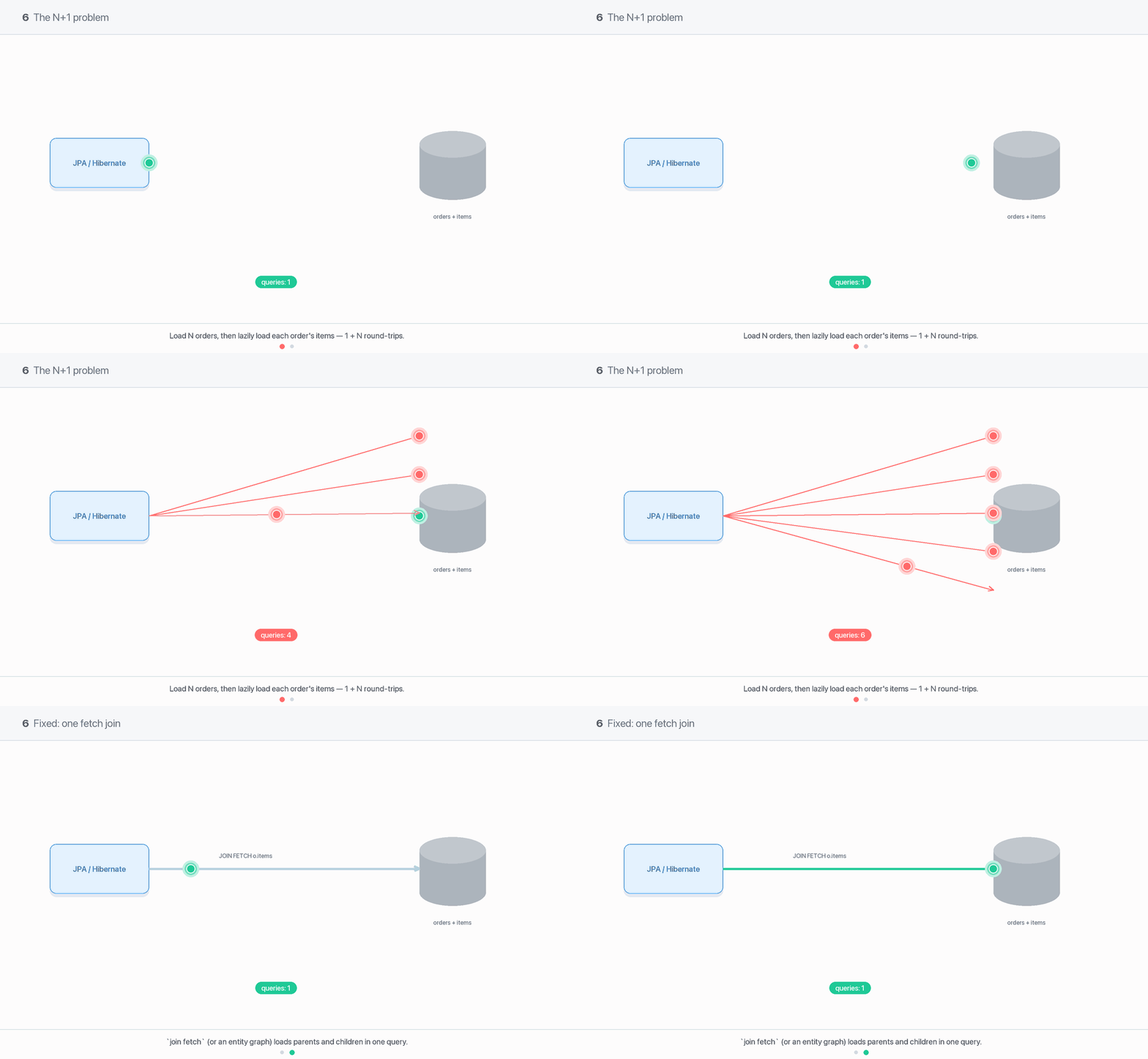
The N+1 problem: one query loads the parents, then each lazy collection fires its own query (N of them) — collapsed back to a single round-trip by a fetch join.
1. The repository abstraction: an interface you never implement
You declare an interface; Spring Data generates the implementation at runtime as a proxy backed by SimpleJpaRepository, delegating to an EntityManager. There is no code generation on disk and no class you write — the proxy is built when the context starts, and repository method calls are intercepted and routed to a query.
The interface hierarchy — pick the narrowest one that exposes only what a caller should be able to do:
| Interface | Adds | Notes |
|---|---|---|
Repository<T, ID> | nothing — pure marker | expose only the methods you hand-pick; safest for a domain-driven design |
CrudRepository<T, ID> | save, findById, findAll, count, delete, existsById | returns Iterable from findAll |
ListCrudRepository<T, ID> | same CRUD but returns List | the ergonomic default since Spring Data 3 |
PagingAndSortingRepository<T, ID> | findAll(Sort), findAll(Pageable) | does not extend CrudRepository — compose both if you need both |
ListPagingAndSortingRepository<T, ID> | List-returning paging/sorting | list-flavoured variant |
JpaRepository<T, ID> | JPA extras: flush(), saveAndFlush, getReferenceById, batch deletes | the fullest, JPA-specific surface |
public interface OrderRepository extends JpaRepository<Order, Long> {
    // methods added below
}
Expose less, not more
extends JpaRepositoryhands every callerdeleteAll()and an unboundedfindAll(). For a domain aggregate, preferextends Repository<Order, Long>and declare only the methods the domain actually needs. It is a one-line change that prevents a service from ever callingorderRepository.findAll()on a 40-million-row table.
2. Query methods: derived, @Query, and native
Derived queries — Spring parses the method name into a query. Great for simple predicates, and self-documenting.
List<Order> findByCustomerIdAndStatus(Long customerId, OrderStatus status);
Optional<Order> findFirstByCustomerIdOrderByCreatedAtDesc(Long customerId);
long countByStatus(OrderStatus status);
boolean existsByReference(String reference);
The grammar supports And/Or, Between, LessThan, Like, In, IgnoreCase, OrderBy, and findFirst/findTop. Its limit is complexity: three joins and a subquery become an unreadable 90-character method name. That is where @Query takes over.
@Query("""
       select o from Order o
       where o.status = :status and o.total > :min
       """)                                            // JPQL — operates on entities, not tables
List<Order> findExpensive(@Param("status") OrderStatus status, @Param("min") BigDecimal min);

@Query(value = "select * from orders where created_at > now() - interval '7 days'",
       nativeQuery = true)                             // raw SQL — dialect-specific, bypasses JPQL
List<Order> findRecentNative();

@Modifying                                             // required for UPDATE/DELETE bulk statements
@Query("update Order o set o.status = :s where o.createdAt < :cutoff")
int bulkExpire(@Param("s") OrderStatus s, @Param("cutoff") Instant cutoff);
@Modifyingbulk statements bypass the persistence contextA bulk
update/deleteis issued straight to the database — it does not update managed entities already loaded in the first-level cache (§3), and it does not run entity callbacks or optimistic-lock version bumps. Entities you loaded before the bulk update are now silently stale.
Mitigation: add@Modifying(clearAutomatically = true, flushAutomatically = true), or run bulk statements in their own transaction before you load the affected rows.
3. The persistence context: first-level cache & entity lifecycle
This is the concept most candidates hand-wave and most bugs trace back to. The persistence context is the EntityManager’s working set for one transaction — a map of managed entities keyed by identity. It is also the first-level cache: within one transaction, a second findById for the same id returns the same object instance with no second query.
Every entity is in one of four states:
| State | Meaning | How it got there |
|---|---|---|
| transient | new object, no identity, unknown to JPA | new Order() |
| managed | tracked by the persistence context; changes are watched | save(), findById(), persist() |
| detached | has identity but context is closed/cleared; changes ignored | transaction ended, EntityManager closed |
| removed | scheduled for DELETE at flush | delete() |
Dirty checking is the payoff: for every managed entity, Hibernate keeps a snapshot taken at load time. At flush it compares current fields to the snapshot and issues UPDATE for whatever changed — you never call save() to persist a modification inside a transaction.
@Transactional
public void rename(Long id, String name) {
    Order order = orderRepository.findById(id).orElseThrow();  // now MANAGED
    order.setName(name);                                       // just a setter
    // NO save() call — dirty checking issues the UPDATE at flush/commit
}
Flush timing: the SQL is not sent when you call the setter. Hibernate flushes (a) automatically before a query that might be affected, and (b) at transaction commit. FlushMode.AUTO is the default. This deferral is what lets Hibernate batch and order statements (§9).
"save() does nothing" is often correct, not a bug
Calling
repository.save(managedEntity)inside the same transaction that loaded it is usually redundant — dirty checking already schedules theUPDATE.save()matters for transient (new) entities and for detached ones you are merging back. Understanding why the setter alone persists a change is a reliable senior signal.
4. The N+1 problem and every way to fix it
The single most common JPA performance bug (see the GIF). You load N parents in one query, then touch a lazy association on each — firing one extra query per parent. A list page of 50 orders each with line items becomes 1 + 50 = 51 round-trips, none of which show up in a single-row test.
List<Order> orders = orderRepository.findAll();      // 1 query
for (Order o : orders) {
    o.getLineItems().size();                          // +1 query EACH → N+1
}
Gotcha — N+1 is invisible until load
A unit test with two rows issues three queries and passes in milliseconds. The same code against 10k rows issues 10k+1 queries and melts the connection pool under real traffic. N+1 rarely fails a test; it fails a Black Friday. Assume every lazy collection accessed in a loop is an N+1 until proven otherwise — turn on
spring.jpa.properties.hibernate.generate_statistics=truein test to count queries.
The fixes, in order of preference:
| Fix | How | Best for |
|---|---|---|
JOIN FETCH | JPQL join fetch — one query with a join | a specific query that always needs the association |
@EntityGraph | declarative fetch plan on a repository method | reusing an entity graph across derived queries |
@BatchSize | fetch lazy collections in batches of N | many parents, don’t want a giant cartesian join |
| DTO projection | select only the columns you need (§6) | read-only views; avoids loading entities at all |
@Query("select distinct o from Order o join fetch o.lineItems where o.status = :s")
List<Order> findWithItems(@Param("s") OrderStatus s);   // 1 query, association pre-loaded

@EntityGraph(attributePaths = "lineItems")              // same effect, declaratively
List<Order> findByStatus(OrderStatus s);
JOIN FETCH+ pagination = fetch-in-memoryCombining
join fetchon a collection with aPageablemakes Hibernate load all matching rows and paginate in memory — logged asHHH000104: firstResult/maxResults specified with collection fetch; applying in memory. On a large result set this is an OOM waiting to happen.
Mitigation: use@EntityGraphon a paged query, or fetch ids first (paged) then fetch entities+collection by id list; or use@BatchSizeinstead of a fetch join for the paginated case.
5. FetchType defaults, lazy everything, and the OSIV footgun
Jakarta Persistence defaults are a trap: @ManyToOne and @OneToOne are EAGER; @OneToMany and @ManyToMany are LAZY. Eager @ManyToOne means every load of a child silently drags its parent — and chains: an eager graph can pull half your schema on one findById.
@Entity
public class Order {
    @Id @GeneratedValue(strategy = GenerationType.IDENTITY)
    private Long id;

    @Version                                            // optimistic lock (§8)
    private long version;

    @ManyToOne(fetch = FetchType.LAZY)                  // override the EAGER default
    private Customer customer;

    @OneToMany(mappedBy = "order", fetch = FetchType.LAZY)
    private List<LineItem> lineItems = new ArrayList<>();
}
Make everything LAZY, then fetch explicitly
Set
fetch = FetchType.LAZYon every association, including@ManyToOne/@OneToOne. You lose nothing — you fetch exactly what a use case needs withJOIN FETCH/@EntityGraph(§4). Eager fetching is a global decision made at mapping time for a local need known only at query time; it is almost always wrong.
Lazy has its own hazard. A LAZY association accessed after the transaction (and thus the EntityManager) closes throws LazyInitializationException — the entity is now detached (§3) and cannot load anything.
Gotcha —
LazyInitializationExceptionin the view/controllerReturning a JPA entity from a
@RestControllerand letting Jackson serialize a lazy collection after the service transaction committed throwsLazyInitializationException(or, worse, is masked — see below). The entity detached the moment the transaction ended.
Mitigation: never serialize entities across a transaction boundary. Map to a DTO inside the transaction, or fetch the association eagerly for that query with a fetch join / entity graph.
Open-Session-in-View is Spring Boot’s default “fix” — and a footgun. spring.jpa.open-in-view=true (the default) keeps the EntityManager open for the entire HTTP request, including view/JSON rendering, so lazy loads never throw. Boot even warns about it at startup:
WARN JpaBaseConfiguration$JpaWebConfiguration :
  spring.jpa.open-in-view is enabled by default. Therefore, database queries may be
  performed during view rendering. Explicitly configure spring.jpa.open-in-view to disable this warning
Gotcha — OSIV masks N+1 in dev, then perf-bombs prod
With OSIV on, the N+1 from §4 works — the session is still open during serialization, so each lazy access quietly fires a query while Jackson walks the object graph. It passes every test and demo. In production it holds a database connection for the whole request (including slow rendering and network write-back), throttling the HikariCP pool (§9) and firing N+1 storms you never saw locally.
Mitigation: setspring.jpa.open-in-view=false. This forces the correct architecture — fetch what you need inside the service transaction and return DTOs. AnyLazyInitializationExceptionit surfaces is a real bug OSIV was hiding.
6. Pagination and projections
Pagination — never return an unbounded list. Pass a Pageable; Spring adds LIMIT/OFFSET and ORDER BY.
Page<Order> findByStatus(OrderStatus status, Pageable pageable);
// caller: PageRequest.of(0, 20, Sort.by("createdAt").descending())
Page vs Slice is a senior distinction:
| Type | Knows total count? | Extra query | Use when |
|---|---|---|---|
Page<T> | yes (getTotalElements, getTotalPages) | runs a second COUNT(*) query | UI needs “page 7 of 210” |
Slice<T> | no — only “is there a next page?“ | none (fetches size + 1) | infinite scroll / “load more” |
Gotcha —
Page's count query is not freeEvery
Pageresult triggers a separateSELECT COUNT(*)against the (often complex, joined) query. On a large, heavily-filtered table that count can cost more than the page fetch itself and does not benefit fromLIMIT. If the caller does not need an exact total, useSlice; if it needs a rough total, cache it or use an estimate.
Gotcha —
findAll()with noPageable
repository.findAll()selects the entire table into the heap. It is fine on a 100-row lookup table and catastrophic onorders. Treat any argument-lessfindAll()as a code-review red flag; require aPageableor an explicit bounded query.
Projections fetch only the columns you need — cheaper than hydrating full entities, and immune to lazy-loading issues since they are read-only.
public interface OrderSummary {           // interface projection — Spring proxies it
    Long getId();
    BigDecimal getTotal();
}
List<OrderSummary> findByStatus(OrderStatus status);

// DTO / constructor expression — explicit, no proxy, works great with native SQL
@Query("select new com.acme.OrderSummaryDto(o.id, o.total) from Order o where o.status = :s")
List<OrderSummaryDto> summaries(@Param("s") OrderStatus s);
7. Schema management: ddl-auto and migrations
spring.jpa.hibernate.ddl-auto controls whether Hibernate touches your schema at startup: none, validate, update, create, create-drop.
| Value | Effect | Where |
|---|---|---|
validate | checks entities match schema, changes nothing | production |
none | Hibernate ignores schema entirely | production (with migrations owning schema) |
update | tries to alter the schema to match entities | never in prod |
create / create-drop | drops & recreates on startup | throwaway tests only |
Gotcha —
ddl-auto=updatein production
updateis a best-effort diff: it adds columns/tables but never drops or safely alters them, cannot rename, ignores data migration, and its output is non-deterministic across Hibernate versions. Teams reach for it for convenience and then discover it silently left the schema half-migrated, or held a lock that stalled a deploy. It is not a migration tool.
Mitigation: own your schema with Flyway or Liquibase (both Boot-auto-configured — drop the starter in and put versioned scripts indb/migration). Setddl-auto=validateso the app refuses to start if entities and the migrated schema disagree — a fast, loud failure instead of a silent drift.
8. Concurrency (locking) and auditing
Optimistic locking assumes conflicts are rare. Add a @Version column; Hibernate appends where version = ? to every UPDATE and increments it. A concurrent writer whose version no longer matches gets zero rows updated → OptimisticLockException. No database locks are held; ideal for web apps.
@Version
private long version;      // Hibernate manages it; adds `and version=?` to UPDATEs
Pessimistic locking takes an actual database lock (SELECT ... FOR UPDATE) for the transaction. Use it only for genuine hot-row contention (e.g. inventory decrement) — it serializes access and risks deadlocks.
@Lock(LockModeType.PESSIMISTIC_WRITE)
@Query("select i from Inventory i where i.sku = :sku")
Optional<Inventory> findForUpdate(@Param("sku") String sku);
Auditing — annotate timestamp/user fields and enable it once:
@EntityListeners(AuditingEntityListener.class)
@Entity
public class Order {
    @CreatedDate  private Instant createdAt;
    @LastModifiedDate private Instant updatedAt;
}
// @EnableJpaAuditing on a @Configuration class turns it on
Prefer optimistic locking by default
Reach for
@Versionfirst — it costs one column and no held locks, and it turns lost-update bugs into a catchable exception you can retry. Escalate to pessimistic locking only when you have measured contention on a specific row and can accept the serialization cost. Pair@Versionwith a retry (@Retryable) onOptimisticLockExceptionfor a clean concurrency story.
9. Connection pool sizing and JDBC batching
HikariCP is Boot’s default pool. The counter-intuitive rule: small pools are faster. A pool larger than the database can service just queues context-switching and lock contention onto the DB.
spring.datasource.hikari.maximum-pool-size=10   # default; right-size, don't inflate
spring.datasource.hikari.minimum-idle=10
spring.datasource.hikari.connection-timeout=3000
Size the pool to the database, not the app
A useful starting formula (PostgreSQL wiki):
connections ≈ (core_count * 2) + effective_spindle_count. A pool of 10 often out-throughputs a pool of 100. Remember every instance/replica has its own pool, and OSIV (§5) holds a connection for the whole request — a double reason to disable it.maximum-pool-sizemust stay well under the database’smax_connections.
Batch inserts — by default Hibernate sends one INSERT per entity. For bulk writes, enable JDBC batching so many rows go in one round-trip:
spring.jpa.properties.hibernate.jdbc.batch_size=50
spring.jpa.properties.hibernate.order_inserts=true    # group same-table INSERTs so they batch
spring.jpa.properties.hibernate.order_updates=true
Gotcha —
GenerationType.IDENTITYdisables insert batchingWith
IDENTITYid generation, Hibernate must execute eachINSERTimmediately to read back the generated key, so batching is silently disabled no matter whatbatch_sizeyou set. For high-volume inserts use aSEQUENCE(with a pooled optimizer) instead ofIDENTITY; the ids can then be assigned before flush and rows batched.
10. Alternatives & trade-offs
Spring Data JPA is the default, not the only choice. The full ORM (managed entities, dirty checking, lazy loading) is exactly what you want for complex write-heavy domains and exactly the overhead you don’t want for reporting and high-throughput reads.
| Tool | Model | Strengths | When to pick it |
|---|---|---|---|
| Spring Data JPA / Hibernate | full ORM: managed entities, dirty checking, lazy graphs | rich domain mapping, caching, portability | complex write-heavy domains; the default JVM choice |
| JdbcClient / Spring Data JDBC | thin, no persistence context; you write SQL / simple aggregates | predictable SQL, no N+1/lazy surprises, fast | read-heavy paths, simple aggregates, when you want SQL control |
| jOOQ | typesafe SQL DSL generated from the schema | compile-checked SQL, superb for complex queries/reporting | analytics, heavy SQL, teams that think in SQL |
| MyBatis | SQL mapper (XML/annotation) | full SQL control with mapping convenience | legacy SQL, stored-proc-heavy shops |
| R2DBC | reactive, non-blocking driver | backpressure, high concurrency on few threads | fully reactive WebFlux stacks (05 - Web Layer & Embedded Servers - MVC vs WebFlux) |
The committed recommendation
Default to Spring Data JPA for the transactional domain model, and reach for
JdbcClientor jOOQ for read-heavy/reporting endpoints in the same app — mixing is a feature, not a defeat. JPA earns its complexity when you have a real object graph with invariants; for a flat “select these columns and page them,” a thin SQL layer is simpler and faster and cannot N+1. Avoid R2DBC unless the whole stack is reactive — a reactive data layer under a blocking web layer buys nothing.
11. Caveats & risk mitigation (summary)
- Disable open-in-view (§5).
spring.jpa.open-in-view=false— it masks N+1 in dev and starves the pool in prod. Return DTOs from inside the transaction. - Assume N+1 until proven otherwise (§4). Count queries in tests (
generate_statistics); fix with fetch joins /@EntityGraph/@BatchSize. - Make associations LAZY (§5), fetch explicitly per query. EAGER is a mapping-time answer to a query-time question.
- Never
findAll()unbounded (§6); always paginate. PreferSlicewhen you don’t need an exact count. ddl-auto=validatein prod (§7); migrations own the schema (Flyway/Liquibase).update/createare for throwaway databases only.- Optimistic
@Versionfirst (§8); pessimistic locks only for measured hot-row contention. - Right-size the pool small (§9);
IDENTITYids silently kill insert batching — use a sequence for bulk writes. - Version facts are volatile. Spring Boot 4.1.x / Spring Data (current) / Hibernate ORM 7 / Jakarta Persistence (
jakarta.persistence, notjavax.persistence) / JDK 17 baseline are current mid-2026 — re-verify exact GA versions before relying on them.
12. In practice
// A read endpoint done right: LAZY entity, fetch join for the graph it needs,
// paginated, mapped to a DTO INSIDE the transaction. No OSIV, no N+1, no LazyInit.
@Service
class OrderQueryService {

    private final OrderRepository orders;

    @Transactional(readOnly = true)                       // read-only tx → Hibernate skips dirty-check flush
    public Page<OrderSummaryDto> recentByStatus(OrderStatus status, Pageable pageable) {
        return orders.findByStatus(status, pageable)      // @EntityGraph pre-loads lineItems (§4)
                     .map(o -> new OrderSummaryDto(o.getId(), o.getTotal()));  // map before tx closes
    }
}

public interface OrderRepository extends Repository<Order, Long> {   // narrow surface (§1)
    @EntityGraph(attributePaths = "lineItems")
    Page<Order> findByStatus(OrderStatus status, Pageable pageable);
}
# application.properties — the senior defaults
spring.jpa.open-in-view=false # §5 — the most important line here
spring.jpa.hibernate.ddl-auto=validate # §7 — Flyway/Liquibase owns the schema
spring.jpa.properties.hibernate.jdbc.batch_size=50 # §9
spring.jpa.properties.hibernate.order_inserts=true # §9
spring.datasource.hikari.maximum-pool-size=10 # §9 — small, sized to the DB
# spring.jpa.properties.hibernate.generate_statistics=true # §4 — turn on in test to count queriesInterview talking points to be able to defend:
- “A repository is an interface Spring proxies onto
SimpleJpaRepositoryat startup — I expose the narrowest one and avoid unboundedfindAll().” - “The persistence context is Hibernate’s first-level cache; inside a transaction I mutate a managed entity and dirty checking issues the UPDATE — I don’t call
save().” - “N+1 is my first suspicion on any list endpoint; I fix it with a fetch join or
@EntityGraph, and I disable open-in-view so it can’t hide in dev then bomb prod.” - “Everything is LAZY and I fetch per query; entities never cross the transaction boundary — I return DTOs mapped inside the transaction.”
- “
ddl-auto=validatein prod with Flyway owning the schema;updateis not a migration tool.” - “Optimistic
@Versionby default, pessimistic locks only for measured contention; andIDENTITYids silently disable insert batching.”
13. Sources
- Spring Data JPA Reference — Core concepts & repository interfaces
- Spring Data JPA Reference — Defining query methods (derived &
@Query) - Spring Data JPA Reference — Entity graphs & fetch plans
- Spring Data — Paging, sorting & Page vs Slice
- Spring Boot Reference — SQL databases (open-in-view, ddl-auto, Hibernate, Flyway/Liquibase)
- Hibernate ORM 7 User Guide (persistence context, fetching, batching, locking)
- Jakarta Persistence Specification (jakarta.persistence, FetchType,
@Version, LockModeType) - HikariCP — Pool sizing