How Spring turns @Transactional into an atomic unit of work — the AOP proxy that wraps your bean (see 02 - IoC Container, Beans & Dependency Injection), the propagation and isolation knobs, the rollback rules that surprise everyone, and the proxy-shaped gotchas (self-invocation, checked exceptions, UnexpectedRollbackException) that make a transaction silently do nothing. We finish at the hard edge: why single-database transactions don’t extend across services, and the saga and transactional outbox patterns that do the job instead (10 - Messaging, Events & Async). Persistence context mechanics live in 06 - Data Access with Spring Data JPA.
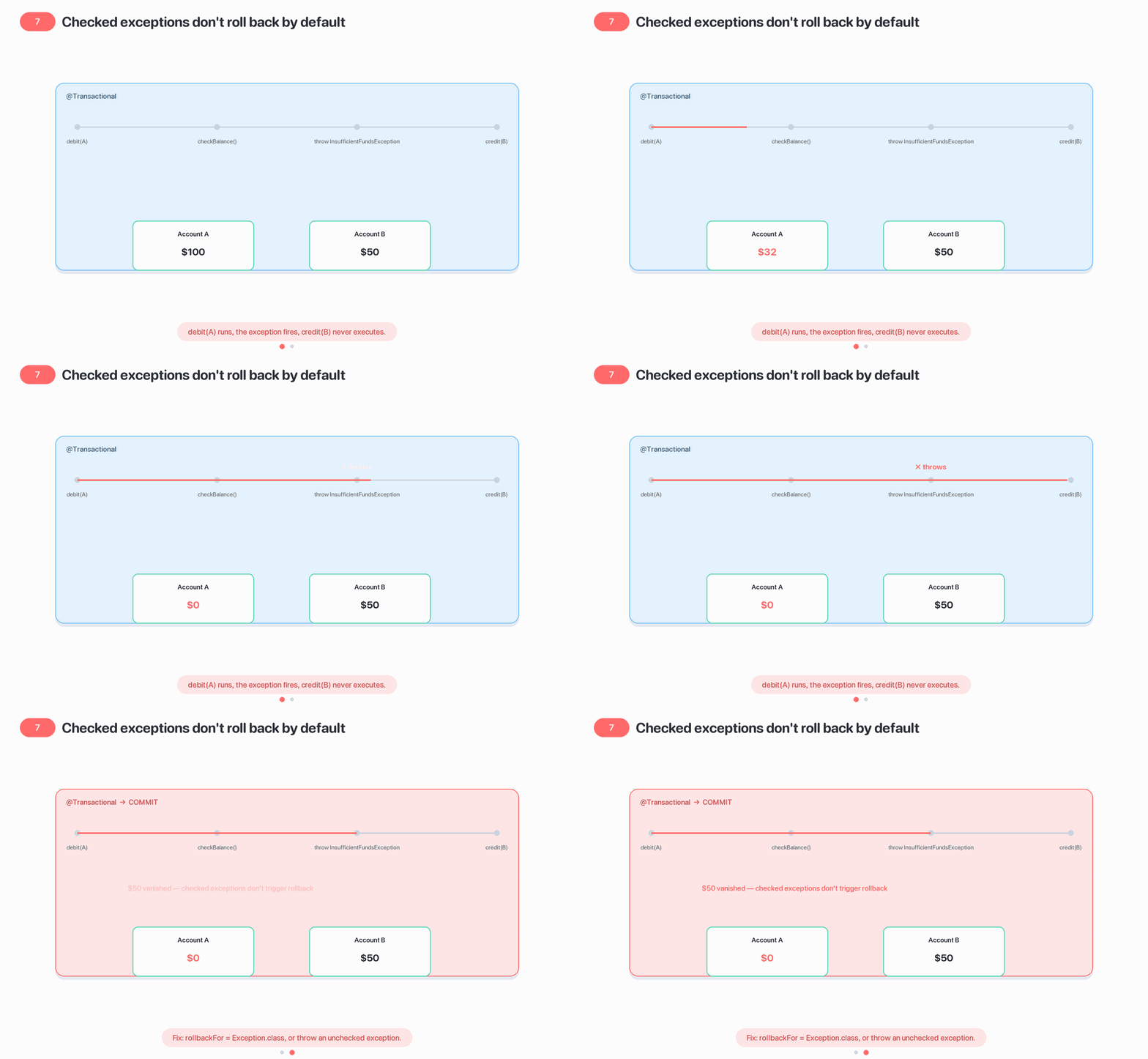
A checked exception thrown mid-method does not roll back by default — the debit commits, the credit never runs, and the money is simply gone.
1. What a transaction is, and where its boundary belongs
A transaction is a unit of work that is all-or-nothing: either every write commits, or none does. Spring doesn’t invent this — it delegates to a TransactionManager (for JPA, JpaTransactionManager; for plain JDBC, DataSourceTransactionManager) which drives the underlying database’s BEGIN/COMMIT/ROLLBACK and manages the connection and the persistence context for the duration.
The senior decision is where the boundary sits, and there is one right answer for the common case:
Layer
Should own the transaction?
Why
Controller
No
HTTP concerns only; a transaction open across request parsing/serialization is a leak
Service
Yes
A service method is the business use case — the natural atomic unit
Repository
No
Too fine-grained; one save() per transaction defeats atomicity across multiple writes
The boundary is the use case, not the query
Put @Transactional on the service method that represents one business operation (“place order” = insert order + decrement stock + write ledger). If you push it down to the repository, each write commits independently and a mid-operation failure leaves the database half-updated with no way back. If you push it up to the controller, you hold a database connection while serializing JSON. The service layer is the Goldilocks boundary.
2. How @Transactional works: an AOP proxy around the bean
@Transactional is metadata, not behavior. It works because @EnableTransactionManagement (auto-enabled by Spring Boot) registers a TransactionInterceptor and Spring AOP wraps your bean in a proxy — exactly the proxy mechanism from 02 - IoC Container, Beans & Dependency Injection. Callers get the proxy from the container, never the raw object.
caller ──▶ [ proxy ]  ── begin tx (TransactionInterceptor) ─────────┐
                          │  yourService.placeOrder(...)  ← real bean │
                          └── commit on normal return / rollback on ex ┘
When a call enters through the proxy, the interceptor asks the TransactionManager for a transaction (per the propagation rule), invokes your method, and then commits on normal return or rolls back on a qualifying exception. Two consequences follow directly from “it’s a proxy,” and both are exam favourites (§7):
Only calls that cross the proxy boundary are advised. An internal this.method() call is not.
The proxy can only override methods it can see — so private and final methods can’t be advised.
One-sentence framing
“@Transactional is declarative AOP: the container hands callers a proxy that opens a transaction before my method and commits or rolls back after it. Everything surprising about transactions — self-invocation, private methods, rollback rules — falls out of it’s a proxy driven by an interceptor, not magic on the method itself.”
3. Declarative vs programmatic
Declarative (@Transactional) is the default and covers ~95% of cases. Programmatic — TransactionTemplate (imperative) or the raw PlatformTransactionManager — is for when the transaction boundary is narrower than a method or is conditional.
@Serviceclass OrderService { private final TransactionTemplate tx; // built from a PlatformTransactionManager OrderService(PlatformTransactionManager txManager) { this.tx = new TransactionTemplate(txManager); } void process(Order order) { doExpensiveNonTransactionalPrep(order); // OUTSIDE the tx — no connection held tx.executeWithoutResult(status -> { // tight, explicit boundary orderRepo.save(order); stockRepo.decrement(order.items()); if (order.isSuspicious()) status.setRollbackOnly(); // conditional rollback }); }}
Approach
API
When to pick which
Declarative
@Transactional on a service method
Default. The whole method is the unit of work; clean, no Spring API in your logic
Programmatic — template
TransactionTemplate.execute(...)
You need a sub-method boundary, or want to keep slow prep outside the transaction, or roll back conditionally
Framework/library code, or multiple transactions with hand-managed lifecycles. Rare in app code
Reach for the template only when the annotation can't express the boundary
Prefer @Transactional; it keeps Spring’s API out of your business logic. Drop to TransactionTemplate specifically to shrink the boundary — e.g. do a slow computation or an external call before opening the transaction (§8). Never use the raw PlatformTransactionManager in ordinary service code; that’s a code-review flag.
4. Propagation: what happens when a transaction meets a transaction
Propagation decides what the interceptor does when a @Transactional method is called while a transaction may or may not already be active. REQUIRED is the default and correct choice almost always.
Propagation
Behavior (exact)
When to use
REQUIRED(default)
Join the current transaction; create one if none exists
The default — one logical unit that may be called standalone or nested
REQUIRES_NEW
Suspend the current transaction and run in a brand-new independent one
Work that must commit regardless of the outer outcome — audit log, failed-attempt counter
NESTED
Run in a savepoint inside the current transaction; inner rollback rewinds to the savepoint, outer can still commit
Partial rollback of a sub-step (JDBC savepoints only; not all setups support it)
SUPPORTS
Join a transaction if one exists, else run non-transactionally
Read methods that are fine either way; avoids forcing a transaction
MANDATORY
Join the current one; throw if none exists
Method that must only ever be part of a larger unit — enforces “call me inside a tx”
NOT_SUPPORTED
Suspend any current transaction; run non-transactionally
Long non-transactional work you don’t want holding a connection
NEVER
Throw if a transaction exists
Guard code that must never run transactionally
REQUIRES_NEW and NESTED are not the same, and mixing them up corrupts data
REQUIRES_NEW opens a second physical transaction on a second connection — the outer one is suspended. The inner commit is permanent even if the outer rolls back. NESTED uses a savepoint on the same connection — an inner rollback rewinds to the savepoint but the outer transaction (and connection) is shared. Choosing REQUIRES_NEW for an audit row is correct (you want it kept); choosing it for a sub-step you expect to roll back with its parent will leave orphaned committed rows.
5. Isolation levels and the anomalies they prevent
Isolation controls what one transaction sees of other concurrent transactions. Higher isolation prevents more anomalies but costs concurrency (more/longer locks). DEFAULT delegates to the database (PostgreSQL & Oracle default to READ_COMMITTED; MySQL/InnoDB to REPEATABLE_READ).
Isolation
Dirty read
Non-repeatable read
Phantom read
When to pick which
READ_UNCOMMITTED
possible
possible
possible
Almost never — you can read another tx’s uncommitted, later-rolled-back writes
READ_COMMITTED
prevented
possible
possible
The sane default for most OLTP; you only see committed data
REPEATABLE_READ
prevented
prevented
possible
A transaction that reads the same row(s) twice and needs a stable answer
SERIALIZABLE
prevented
prevented
prevented
Full correctness for critical invariants; expect contention/serialization failures
Dirty read — reading another transaction’s uncommitted change (which may be rolled back).
Non-repeatable read — re-reading a row you already read and getting a different value (someone updated + committed in between).
Phantom read — re-running a range query and getting new rows that appeared (someone inserted + committed).
isolation and timeout apply only to REQUIRED / REQUIRES_NEW
Setting isolation or timeout on a method that joins an existing transaction (e.g. a REQUIRED call nested inside another) is silently ignored — the outer transaction’s settings win, because you can’t change the isolation of a transaction that’s already running. Set isolation at the point the transaction is actually created, or Spring will (in strict validation modes) reject the mismatch. Prefer the database default unless a specific anomaly forces your hand.
6. Rollback rules: the gotcha that eats data
This is the single most-tested transaction fact. By Spring’s default rule:
Any RuntimeException or Error triggers rollback. Any checked Exception does not — the transaction commits.
@Transactionalpublic void transfer(Long from, Long to, BigDecimal amt) throws InsufficientFundsException { debit(from, amt); if (balanceOf(from).signum() < 0) throw new InsufficientFundsException(); // CHECKED → Spring COMMITS the debit! 💥 credit(to, amt);}
A checked exception silently commits a half-done transaction
The code above throws after the debit but before the credit. Because InsufficientFundsException is a checked exception, Spring’s default rule does not roll back — the debit is committed and the money vanishes. Nothing warns you; the method “failed” from the caller’s view but the database kept the partial write. This surprises nearly everyone, because “it threw, so surely it rolled back” is the natural assumption.
Make rollback semantics explicit
Either declare @Transactional(rollbackFor = Exception.class) on methods that throw checked exceptions, or — cleaner for consistency across a service — use @Transactional(rollbackFor = Exception.class) as a convention, or set rollbackOn/ALL_EXCEPTIONS semantics so any thrown exception rolls back. The Spring team itself advises switching to all-exception rollback unless you deliberately rely on EJB-style “commit on business exception” behavior. Reserve noRollbackFor for exceptions you genuinely want to swallow-and-commit.
Two more attributes worth setting deliberately:
readOnly = true — a hint the transaction won’t write. Lets Hibernate skip dirty-checking/flush and lets the driver/DB optimize (and route to read replicas in some setups). Use it on every query-only service method; it’s free performance and documents intent.
timeout = N (seconds) — abort a transaction that runs too long, releasing its locks and connection. A backstop against a runaway query holding resources.
7. The proxy gotchas: self-invocation, visibility, and rollback-only
Everything here is a direct consequence of §2 — it’s a proxy.
Self-invocation makes @Transactional a silent no-op
Because only calls through the proxy are advised, one method of a bean calling another method of the same bean bypasses the interceptor entirely — the inner @Transactional does nothing.
@Serviceclass ReportService { public void run() { generate(); // internal call → NO transaction is opened } @Transactional public void generate() { ... } // annotation ignored on the self-call }
Mitigation: move generate() to a separate bean and inject it (so the call crosses a proxy), or self-inject the proxy, or use TransactionTemplate. Also note: @Transactional on private or final methods is ignored — the proxy can’t override them. (Since Spring 6.0, class-based proxies can advise protected/package-private methods; interface-based proxies still require public.)
Catching an exception inside a rollback-only transaction → UnexpectedRollbackException
If an inner call marks the transaction rollback-only (e.g. an inner REQUIRED method threw, so Spring flags the shared transaction) and you catch that exception in the outer method and try to continue/commit, Spring refuses at commit time and throws UnexpectedRollbackException (“Transaction silently rolled back because it has been marked as rollback-only”). The transaction is already doomed; catching the exception doesn’t un-doom it. Mitigation: don’t swallow exceptions from a joined (REQUIRED) inner transactional call and expect to commit. If a sub-step is genuinely optional and may fail independently, give it REQUIRES_NEW so its rollback is isolated from the outer transaction, then catching its exception is safe.
8. Keep transactions short: hold the connection for microseconds, not seconds
An open transaction pins a database connection from the pool for its entire duration. Long transactions starve the pool and, under load, cause Connection is not available timeouts that look like a database outage but are self-inflicted.
Never call a slow external API inside a transaction
@Transactionalpublic void checkout(Order o) { orderRepo.save(o); paymentGateway.charge(o); // network call: 200ms–30s, holding a DB connection the whole time 💥 o.markPaid();}
The HTTP call to the payment gateway can hang for seconds; meanwhile a pooled connection is held open and idle. A few concurrent checkouts exhaust the pool and the whole service stalls. The same applies to sending an email, calling another microservice, or any I/O that isn’t the database.
Do slow work outside the boundary; commit local state, then react
Split it: persist and commit local state in a short transaction, then do the external call after commit — ideally via a @TransactionalEventListener on AFTER_COMMIT (§9) or an async message (10 - Messaging, Events & Async). Structure the code so the transaction contains only database work. If prep is expensive, compute it before opening the transaction (use TransactionTemplate, §3). Rule of thumb: no network calls, no user waits, no Thread.sleep, inside @Transactional.
Ordinary @EventListeners fire synchronously inside the publisher’s transaction. @TransactionalEventListener binds the handler to a transaction phase — by default AFTER_COMMIT — so side-effects fire only if (and after) the transaction actually commits.
@Transactionalpublic void placeOrder(Order o) { orderRepo.save(o); events.publishEvent(new OrderPlaced(o.getId())); // published now, HANDLED after commit}@TransactionalEventListener // default phase = AFTER_COMMITvoid onCommitted(OrderPlaced e) { emailService.sendConfirmation(e.orderId()); // only if the order truly committed}
This is the clean answer to §8’s “don’t do slow work in the transaction” and the natural building block for the outbox pattern below.
AFTER_COMMIT runs after the transaction closed — new DB writes won't commit
By default, if no transaction is active when the event is published, the listener doesn’t run at all (unless fallbackExecution = true). And in the AFTER_COMMIT phase the original transaction is already committed, so any new database write you attempt there participates in a transaction that will never be committed — it silently disappears. Use the phase for external side-effects (email, message publish), not for more database writes; for those, publish an outbox row inside the original transaction instead.
10. Distributed consistency: why not 2PC, and what to do instead
A single @Transactional guarantees consistency within one database. The moment a business operation spans two services (or a database and a message broker), you have no shared transaction — and reaching for a distributed transaction is usually the wrong move.
Approach
Mechanism
Trade-off / when to pick which
2PC / XA
A coordinator runs prepare→commit across all resources (JtaTransactionManager)
Avoid. Synchronous locking across services, the coordinator is a SPOF, poor scalability, brittle under partitions. Only for legacy XA resources you truly can’t avoid
Saga
A sequence of local transactions, each publishing an event that triggers the next; failures trigger compensating actions
Cross-service business flows (order → payment → shipping). Eventually consistent; you must design compensations. Choreography (events) or orchestration (a coordinator)
Transactional outbox
Write the domain change and an “outbox” row in the same local transaction; a relay polls the outbox and publishes to the broker
The reliable bridge from DB to broker — guarantees at-least-once publish with no 2PC. Almost always the right way to emit events (10 - Messaging, Events & Async)
The dual-write problem is why the outbox exists
“Save to the DB, then publish to Kafka” is two writes to two systems with no shared transaction. If the process dies between them, you’ve either lost the event (saved, not published) or published a lie (published, DB rolled back). The outbox collapses this to a single local transaction: the domain row and the outbox row commit atomically, and a separate relay (polling or CDC/Debezium) publishes the outbox row afterward. Combined with idempotent consumers, this gives reliable eventual consistency without any distributed transaction.
Default recommendation for cross-service consistency
Reach for outbox + saga + idempotent consumers, not XA. Model the business flow as local transactions linked by events (saga), emit those events reliably via the outbox, and make every consumer idempotent (dedupe on a message/business key). Accept eventual consistency as the price — it’s the honest trade for availability and scale, and it’s the answer interviewers want over “I’d use a distributed transaction.”
11. In practice
@Serviceclass CheckoutService { // Transaction boundary = the business use case, at the SERVICE layer (§1) @Transactional(rollbackFor = Exception.class, timeout = 10) // roll back on ANY exception (§6) public OrderId checkout(Cart cart) throws PaymentDeclinedException { Order order = orderRepo.save(Order.from(cart)); // DB work only, no external calls (§8) stockRepo.decrement(cart.items()); // same tx: atomic with the order events.publishEvent(new OrderPlaced(order.getId())); // outbox/notify AFTER commit (§9) return order.getId(); } @Transactional(readOnly = true) // query path: no flush (§6) public OrderView view(OrderId id) { return orderRepo.findView(id).orElseThrow(); }}@TransactionalEventListener // AFTER_COMMIT — external side-effect, outside the tx (§8, §9)void onOrderPlaced(OrderPlaced e) { notifier.sendConfirmation(e.orderId());}
Interview talking points to be able to defend:
“@Transactional is an AOP proxy driven by a TransactionInterceptor — every surprise (self-invocation, private methods, rollback rules) falls out of it’s a proxy.”
“Boundary belongs at the service layer; a service method is one business use case, which is the natural atomic unit.”
“Default rollback is RuntimeException/Erroronly — checked exceptions commit. I set rollbackFor so a thrown exception never leaves a half-written transaction.”
“REQUIRES_NEW is a new physical transaction on a new connection; NESTED is a savepoint on the same one — I pick by whether the inner work should survive an outer rollback.”
“I keep transactions short — no external API calls inside @Transactional — and push side-effects to AFTER_COMMIT or an outbox.”
“Across services I use outbox + saga + idempotent consumers, never 2PC; the dual-write problem is exactly what the outbox solves.”