Scope
How to build correct, defensible REST endpoints with Spring MVC: mapping requests, binding and validating input at the edge, shaping output through DTOs (never JPA entities), and returning consistent errors as RFC 9457 Problem Details. We finish with the API-evolution questions seniors are expected to answer — versioning (including the new first-class support in Framework 7 / Boot 4), pagination, OpenAPI, and idempotency. For the servlet/reactive machinery underneath, see 05 - Web Layer & Embedded Servers - MVC vs WebFlux; for locking these endpoints down, see 08 - Spring Security.
Related: Spring Boot, 05 - Web Layer & Embedded Servers - MVC vs WebFlux, 08 - Spring Security, 13 - Resilience & Production Readiness
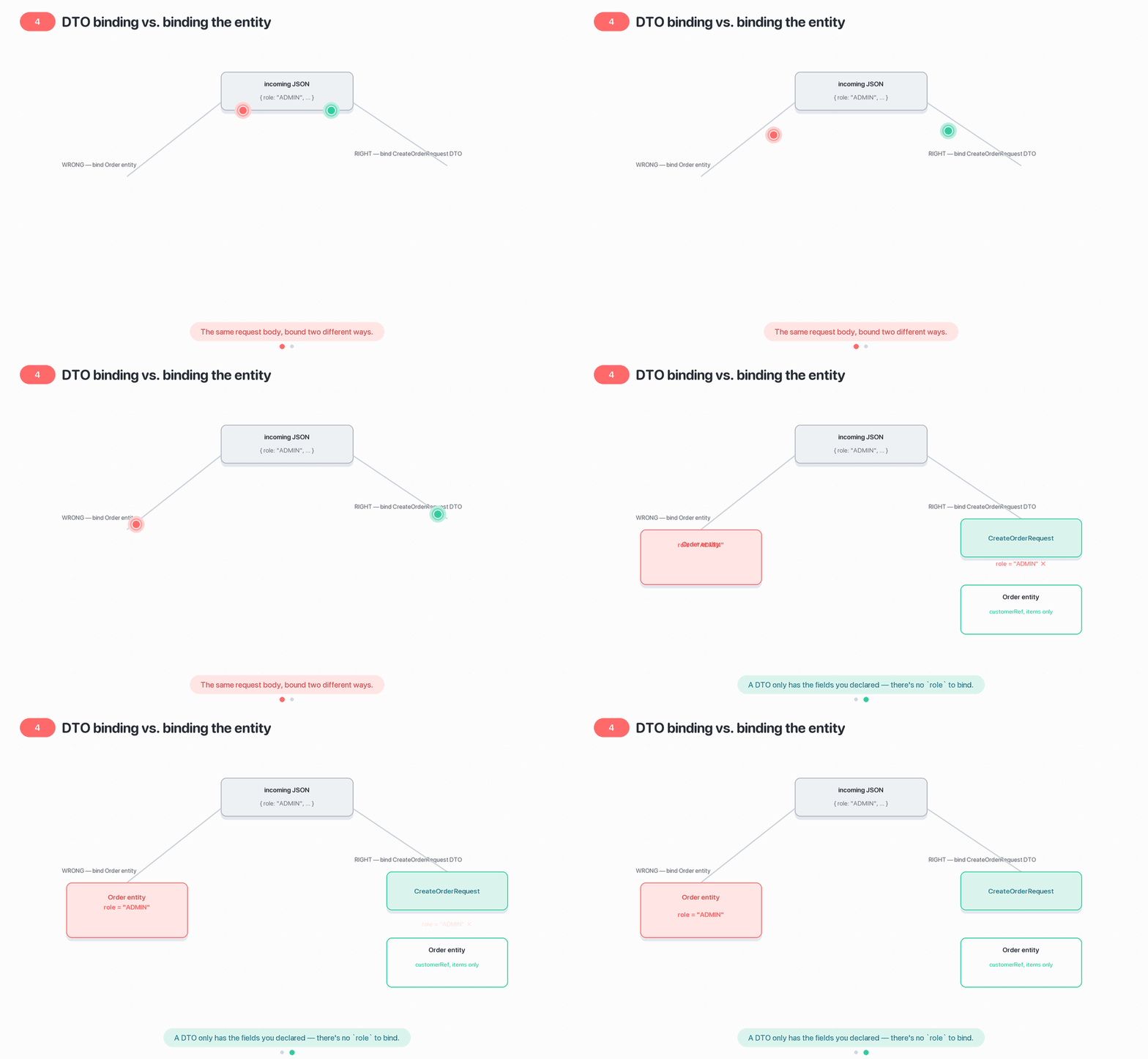
The same request body bound two ways: an entity has no defense against an over-posted field, a DTO simply doesn’t have one to bind.
1. @RestController vs @Controller + @ResponseBody
A classic @Controller returns a view name — a string the ViewResolver maps to a template (Thymeleaf, JSP). To return data instead, each method needs @ResponseBody, which tells Spring to run the return value through an HttpMessageConverter (Jackson for JSON) and write it straight to the response body.
@RestController                       // = @Controller + @ResponseBody on every method
@RequestMapping("/api/orders")
public class OrderController { ... }
@RestController is a meta-annotation that composes @Controller and @ResponseBody, so every handler serializes its return value by default. Use @Controller only when the same class also renders views; for a JSON/XML API, @RestController is the correct and idiomatic choice.
The framing interviewers want
“
@RestControllermeans every method is@ResponseBody— I’m returning a representation, not a view name. That one distinction is why I don’t accidentally return the string"order"and get a 404 from a view resolver looking for anorder.html.”
2. Request mapping & binding
The @RequestMapping family maps HTTP verbs to methods; the parameter annotations bind parts of the request into typed arguments.
@GetMapping("/{id}")                                   // path + verb
public OrderResponse get(@PathVariable Long id) { ... }

@GetMapping                                            // /api/orders?status=OPEN&page=0
public Page<OrderResponse> list(
        @RequestParam(defaultValue = "OPEN") Status status,
        @RequestParam(required = false) String q,
        Pageable pageable) { ... }                     // §10

@PostMapping                                           // create
@ResponseStatus(HttpStatus.CREATED)
public OrderResponse create(@Valid @RequestBody CreateOrderRequest body) { ... }

@PutMapping("/{id}")                                   // full replace (idempotent)
public OrderResponse replace(@PathVariable Long id,
                             @Valid @RequestBody UpdateOrderRequest body) { ... }

@DeleteMapping("/{id}")
@ResponseStatus(HttpStatus.NO_CONTENT)
public void delete(@PathVariable Long id) { ... }| Annotation | Binds from | Notes |
|---|---|---|
@PathVariable | a {template} segment in the URI | identity of a resource (/orders/42) |
@RequestParam | query string or form field | filters, flags; supports defaultValue, required |
@RequestBody | the deserialized request body | one per method; the payload DTO |
@RequestHeader / @CookieValue | a header / cookie | e.g. Idempotency-Key (§12) |
Verb semantics are part of the contract
Map verbs to intent, not convenience: GET never mutates (safe, cacheable), PUT replaces and is idempotent (same call twice = same state), PATCH partially updates, POST creates and is not idempotent. Interviewers probe this because getting it wrong breaks caching, retries, and client expectations.
3. Content negotiation & Jackson 3
Spring picks a representation by matching the request’s Accept header against each handler’s produces, and validates the request body against consumes. Serialization runs through HttpMessageConverters — for JSON that is Jackson, now Jackson 3 in Boot 4.
@PostMapping(consumes = MediaType.APPLICATION_JSON_VALUE,   // reject anything but JSON → 415
             produces = MediaType.APPLICATION_JSON_VALUE)   // Accept mismatch → 406
public OrderResponse create(@Valid @RequestBody CreateOrderRequest body) { ... }- A body whose
Content-Typeisn’t inconsumes→ 415 Unsupported Media Type. - An
Acceptthe endpoint can’t satisfy viaproduces→ 406 Not Acceptable. - Shape the JSON with Jackson annotations (
@JsonProperty,@JsonIgnore,@JsonView,@JsonFormat) on the DTO, never on the entity (§4).
Jackson 3 is a breaking upgrade — high-churn
Boot 4 ships Jackson 3, whose core/databind types moved to the new
tools.jacksonnamespace (the annotations remain undercom.fasterxml.jackson.annotation), and several defaults changed (e.g. stricter handling of unknown properties). CustomObjectMapper/JsonMapperbeans, mixins, and third-party libraries (springdoc has had a Jackson 2↔3 lag) can break on upgrade.
Mitigation: rely on Boot’s auto-configured mapper where you can, keep Jackson customization in a singleJackson2ObjectMapperBuilderCustomizer/JsonMapperbean, and re-verify against the current reference. [HIGH-CHURN: confirm Jackson 3 package/defaults for your exact Boot version.]
4. DTOs vs entities — never expose your JPA entities
The single most important design rule in this module. A DTO (Data Transfer Object) is a purpose-built class for one request or response shape. A JPA entity is a persistence-mapped, mutable, proxied object tied to a Hibernate Session. Binding requests to and serializing responses from entities directly is a recipe for three concrete, painful bugs.
public record CreateOrderRequest(                      // INPUT DTO — only client-settable fields
        @NotBlank String customerRef,
        @NotEmpty @Valid List<LineItemRequest> items) {}

public record OrderResponse(                           // OUTPUT DTO — only what the client may see
        Long id, String customerRef, Status status,
        BigDecimal total, Instant createdAt) {

    static OrderResponse from(Order e) {               // explicit mapping — the boundary
        return new OrderResponse(e.getId(), e.getCustomerRef(),
                e.getStatus(), e.getTotal(), e.getCreatedAt());
    }
}
Three ways exposing entities bites you
- Lazy-load serialization failures. Jackson walks a
@ManyToOne/@OneToManylazy proxy after the transaction closed →LazyInitializationException, or it eagerly serializes the whole object graph and leaks unrelated data (and N+1 queries). See 06 - Data Access with Spring Data JPA.- Over-posting / mass assignment. If you bind
@RequestBody Order, a malicious client can set fields you never intended —role,status,balance,id— and yoursave()persists them. This is a real vulnerability class, not a style nit.- Coupled contract. Every schema change now leaks into your API and vice-versa; you can’t rename a column without breaking clients.
Best practice — DTOs at both edges, mapped explicitly
Accept an input DTO carrying only client-settable fields, and return an output DTO carrying only what the client may see. Map between DTO and entity in one place (a factory method, or MapStruct). This kills over-posting by construction (the entity’s
id/statussimply aren’t bindable), avoids lazy-loading surprises, and lets the persistence model and the API evolve independently. Treat “we return entities directly” as an automatic code-review block.
5. Bean Validation at the edge
Validate untrusted input before it reaches your service layer, using Jakarta Bean Validation (jakarta.validation, not the old javax) with Hibernate Validator 9 as the implementation (pulled in by spring-boot-starter-validation).
public record CreateOrderRequest(
        @NotBlank                         String customerRef,
        @Email                            String notifyEmail,
        @NotEmpty @Valid                  List<LineItemRequest> items,   // @Valid → cascade
        @Size(max = 280)                  String note) {}

public record LineItemRequest(
        @NotNull  Long sku,
@Positive @Max(999) int quantity) {}@PostMapping
public OrderResponse create(@Valid @RequestBody CreateOrderRequest body) { ... } // triggers it@Valid vs @Validated:
@Valid (jakarta) | @Validated (Spring) | |
|---|---|---|
| Origin | Bean Validation standard | Spring |
On a @RequestBody param | triggers body validation | also works |
| Validation groups | not supported | supported — @Validated(OnCreate.class) |
Method-level (on @RequestParam/@PathVariable) | — | enable by putting @Validated on the class |
Validation groups let one DTO carry different rules per operation (e.g. id required on update but not create):
public interface OnCreate {}
public interface OnUpdate {}

public record OrderPayload(
        @Null(groups = OnCreate.class) @NotNull(groups = OnUpdate.class) Long id,
        @NotBlank(groups = {OnCreate.class, OnUpdate.class}) String customerRef) {}

@PostMapping public OrderResponse create(@Validated(OnCreate.class) @RequestBody OrderPayload p) { ... }
@PutMapping("/{id}") public OrderResponse update(@Validated(OnUpdate.class) @RequestBody OrderPayload p) { ... }
Custom constraint (business rules the built-ins can’t express):
@Documented
@Constraint(validatedBy = SkuExistsValidator.class)
@Target(ElementType.FIELD) @Retention(RetentionPolicy.RUNTIME)
public @interface SkuExists {
    String message() default "unknown SKU";
    Class<?>[] groups() default {};
    Class<? extends Payload>[] payload() default {};
}

@Component
class SkuExistsValidator implements ConstraintValidator<SkuExists, Long> {
    private final CatalogClient catalog;
    SkuExistsValidator(CatalogClient catalog) { this.catalog = catalog; }   // DI works here
    public boolean isValid(Long sku, ConstraintValidatorContext ctx) {
        return sku != null && catalog.exists(sku);
    }
}
Gotcha — forget
@Validand validation silently does nothingConstraint annotations on a DTO are inert unless something triggers validation. Omit
@Valid/@Validatedon the@RequestBodyparameter and the framework binds the body and calls your method with an invalid object — no error, no 400 — and the bad data flows into your service. This is a favourite interview trap because the annotations look like they’re doing their job.
Mitigation: the@Validon the parameter is mandatory; make it a review checklist item, and write a test that posts an invalid body and asserts 400.
6. Centralized error handling with @RestControllerAdvice
Never try/catch in every handler. Put one @RestControllerAdvice bean (a @ControllerAdvice + @ResponseBody) with @ExceptionHandler methods that translate exceptions into responses application-wide.
@RestControllerAdvice
class ApiExceptionHandler {

    @ExceptionHandler(OrderNotFoundException.class)
    ProblemDetail handleNotFound(OrderNotFoundException ex) {              // §7
        ProblemDetail pd = ProblemDetail.forStatusAndDetail(HttpStatus.NOT_FOUND, ex.getMessage());
        pd.setType(URI.create("https://api.acme.com/errors/order-not-found"));
        pd.setTitle("Order not found");
        return pd;                                                         // → 404, application/problem+json
    }

    @ExceptionHandler(MethodArgumentNotValidException.class)               // thrown by @Valid failure
    ProblemDetail handleValidation(MethodArgumentNotValidException ex) {
        ProblemDetail pd = ProblemDetail.forStatus(HttpStatus.BAD_REQUEST);
        pd.setTitle("Validation failed");
        pd.setProperty("errors", ex.getBindingResult().getFieldErrors().stream()
                .map(fe -> Map.of("field", fe.getField(), "reason", fe.getDefaultMessage()))
                .toList());                                                // structured, non-standard field
        return pd;
    }
}
Gotcha — leaking internals, wrong status, and the un-handled
MethodArgumentNotValidExceptionThree failures cluster here: (a) returning
ex.getMessage()or a stack trace to the client — leaking table names, SQL, internal hostnames; (b) letting everything fall through to a generic 500 when the real answer is 400/404/409 — a validation failure returned as 500 tells the client to retry, which never helps; (c) forgetting that a failed@ValidthrowsMethodArgumentNotValidException(query/path constraint failures throwHandlerMethodValidationException) — leave it unhandled and the client gets an opaque 500 or Spring’s default body instead of a clean 400 with field details.
Mitigation: map each exception to its correct status; return a generic client-safe message and log the detail server-side with a correlation id; always add an explicit handler for the validation exceptions above (or let Boot’s Problem Details support handle them — §7).
7. RFC 9457 Problem Details — the standard error body
Ad-hoc error JSON ({"error": "..."}) differs per endpoint and per team. RFC 9457 Problem Details for HTTP APIs standardizes it, and Spring implements it as ProblemDetail with the media type application/problem+json.
{
  "type": "https://api.acme.com/errors/order-not-found",
  "title": "Order not found",
  "status": 404,
  "detail": "No order with id 42",
  "instance": "/api/orders/42",
  "errors": [ { "field": "quantity", "reason": "must be greater than 0" } ]
}
Standard fields are type, title, status, detail, instance; anything extra goes into the properties map (via setProperty) and Jackson unwraps it to top-level JSON through the registered ProblemDetailJacksonMixin.
Turn on the built-in handling so Spring renders its own exceptions (validation, 404, 405, 415…) as Problem Details, not just yours:
spring.mvc.problemdetails.enabled=true # auto-configures a ResponseEntityExceptionHandler
ErrorResponse/ErrorResponseExceptionandResponseEntityExceptionHandler
ErrorResponseis the contract (status + headers +ProblemDetailbody) that every built-in Spring MVC exception implements;ErrorResponseExceptionis a ready base class for your own exceptions. ExtendResponseEntityExceptionHandlerin your advice to inherit correct Problem Detail handling for all framework exceptions and override only the hooks you care about. This is the committed 2026 pattern: standard body, standard media type, minimal custom code. [HIGH-CHURN: verify the default value ofspring.mvc.problemdetails.enabledfor your Boot version — historically off by default.]
8. ResponseEntity vs @ResponseStatus
Two ways to control the status line and headers.
@ResponseStatus(HttpStatus.CREATED) | ResponseEntity<T> | |
|---|---|---|
| Where | annotation on method / exception | value returned from method |
| Status | fixed at compile time | chosen at runtime |
| Headers/body control | none (body is the return value) | full — Location, ETag, cache headers, body or none |
| When to pick | the status is always the same (e.g. create always 201) | status/headers depend on logic, or you must set headers |
@PostMapping
public ResponseEntity<OrderResponse> create(@Valid @RequestBody CreateOrderRequest body,
                                            UriComponentsBuilder uri) {
    Order saved = service.create(body);
    URI location = uri.path("/api/orders/{id}").buildAndExpand(saved.getId()).toUri();
    return ResponseEntity.created(location)            // 201 + Location header — the correct create response
            .body(OrderResponse.from(saved));
}
Gotcha — wrong or lazy status codes
Returning 200 for a create (should be 201 +
Location), 200 with an empty body for a not-found (should be 404), or 500 for a client mistake (should be 400/409) all break clients and monitoring. APOSTthat “succeeds” with an error message in a 200 body is invisible to every alerting rule watching 5xx/4xx rates.
9. API versioning — including Framework 7’s built-in support
APIs must evolve without breaking existing clients. There are three classic transport strategies, and — new in Spring Framework 7 / Boot 4 — first-class support that works across all of them.
| Strategy | Example | Pros | Cons | When to pick which |
|---|---|---|---|---|
| URI path | GET /api/v2/orders | dead-simple, visible, cache/log-friendly, easy to browse | ”version” isn’t really a resource; duplicated routes; ugly across many resources | public APIs, broad third-party audiences, when discoverability & curl-ability matter most |
| Request header | API-Version: 2 | clean URIs; resource identity stays stable | invisible in a browser/logs; easy for clients to forget; harder to cache | internal / first-party clients you control, service-to-service |
| Media-type (content negotiation) | Accept: application/vnd.acme.order.v2+json | most “RESTful”; per-representation versioning | steepest client learning curve; awkward tooling | hypermedia/HATEOAS-mature APIs, fine-grained representation control |
The new built-in (Framework 7 / Boot 4). Instead of hand-rolling any of the above, declare a version on the mapping and choose once where the version is read from:
@Configuration
class WebConfig implements WebMvcConfigurer {
    @Override
    public void configureApiVersioning(ApiVersionConfigurer configurer) {
        configurer.useRequestHeader("API-Version");    // or useQueryParam / usePathSegment(int) / useMediaTypeParameter
        // .addSupportedVersions("1.1", "1.2")          // else detected from @RequestMapping(version=...)
        // .setVersionRequired(true) / .setDefaultVersion("1.2")
    }
}

@RestController
@RequestMapping("/api/orders")
class OrderController {
    @GetMapping("/{id}")                                 // matches any version (fallback)
    OrderResponse v0(@PathVariable Long id) { ... }

    @GetMapping(path = "/{id}", version = "1.1")         // exact version 1.1
    OrderResponseV11 v11(@PathVariable Long id) { ... }

    @GetMapping(path = "/{id}", version = "1.2+")        // baseline: 1.2 and any supported version above
    OrderResponseV12 v12(@PathVariable Long id) { ... }
}
Version parsing defaults to SemanticApiVersionParser (major.minor.patch); a missing required version raises MissingApiVersionException (400) and an unknown one InvalidApiVersionException (400). Deprecations can emit RFC 9745 Deprecation/Sunset headers via StandardApiVersionDeprecationHandler.
Prefer the built-in, and pin one strategy — high-churn
Framework 7’s versioning decouples the strategy (header/query/path/media-type — swappable in
configureApiVersioning) from the mapping (version="1.2+"), which is exactly the flexibility hand-rolled solutions lacked. Adopt it, and pick a single strategy org-wide — mixing them fractures your clients. Because this API landed in Framework 7 and is still settling, [HIGH-CHURN: verifyApiVersionConfigurermethod names, theversionattribute, and defaults against the currentdocs.spring.ioreference before relying on them.]
10. Pagination & sorting with Pageable
Never return an unbounded list — one GET /orders on a large table can OOM the server and the client. Accept a Pageable and return a Page.
@GetMapping
public Page<OrderResponse> list(
        @RequestParam(required = false) Status status,
        @PageableDefault(size = 20, sort = "createdAt", direction = Sort.Direction.DESC) Pageable pageable) {
    return service.find(status, pageable).map(OrderResponse::from);   // Page<Entity> → Page<DTO>
}
Spring resolves ?page=0&size=20&sort=createdAt,desc into the Pageable automatically. The response carries content, totalElements, totalPages, etc.
Cap the page size and map to DTOs
Set a hard server-side maximum (
spring.data.web.pageable.max-page-size) so a client can’t requestsize=1000000. Always.map()thePage<Entity>to aPage<DTO>— the paging must not leak entities any more than a single response does (§4). For cursor/keyset pagination on very large or infinite feeds, prefer a keyset approach overOFFSET(see 06 - Data Access with Spring Data JPA).
11. Documenting with OpenAPI (springdoc)
Add springdoc-openapi-starter-webmvc-ui and you get a generated OpenAPI 3 spec at /v3/api-docs and interactive Swagger UI at /swagger-ui.html, derived from your controllers, DTOs, and validation annotations.
@Operation(summary = "Create an order")
@ApiResponse(responseCode = "201", description = "Created")
@ApiResponse(responseCode = "400", description = "Validation failed",
             content = @Content(schema = @Schema(implementation = ProblemDetail.class)))
@PostMapping
public ResponseEntity<OrderResponse> create(@Valid @RequestBody CreateOrderRequest body) { ... }
Gotcha — springdoc / Jackson 3 lag on Boot 4
springdoc is a third-party project on its own release cadence; around the Boot 4 / Jackson 3 transition there were version-alignment gaps. Mitigation: pin the springdoc version its release notes state is compatible with your exact Boot version, and don’t upgrade Boot and springdoc blindly. [HIGH-CHURN: verify the compatible springdoc version.]
12. Idempotency & ETags (briefly)
Two production concerns interviewers like to see you mention:
- Idempotency for POST. Retries (client timeout, gateway retry) can create duplicate resources. Accept an
Idempotency-Keyheader, persist the key with the result of the first call, and on a repeat key return the original result instead of creating again. (PUT/DELETEare already idempotent by verb semantics;POSTneeds help.) - ETags & conditional requests. Return an
ETag(a version/hash of the resource); clients sendIf-None-Matchon GET (get 304 Not Modified, saving bandwidth) orIf-Matchon PUT to get optimistic concurrency — a 412 Precondition Failed instead of silently overwriting a concurrent change. Spring’sShallowEtagHeaderFiltercovers the simple GET case; use entity version fields for write concurrency (see 06 - Data Access with Spring Data JPA).
13. Caveats & risk mitigation (summary)
- DTOs at both edges, always (§4). Never bind or serialize JPA entities — it invites over-posting, lazy-load failures, and a coupled contract. This is the non-negotiable one.
- Validate at the edge and don’t forget
@Valid(§5). The annotation on the parameter is what runs the constraints; without it validation is silent. - One error strategy: Problem Details (§6–§7). Central
@RestControllerAdvice, RFC 9457 bodies, correct statuses, generic client messages, detail logged server-side. - Right verbs, right status codes (§2, §8). 201+
Locationfor create, 404 for missing, 400/409 for client faults — not a blanket 200 or 500. - Bound your collections (§10). Paginate and cap page size; nothing returns an unbounded list.
- Version facts are volatile. Boot 4.1.x / Framework 7 / Jakarta EE 11 / Jackson 3 / JDK 17 baseline are current as of mid-2026 — re-verify the API versioning API, Jackson 3 packages, Problem Details defaults, and springdoc compatibility before relying on them.
14. In practice
@RestController
@RequestMapping("/api/orders")
@Validated                                              // enables method-level validation on params
class OrderController {

    private final OrderService service;
    OrderController(OrderService service) { this.service = service; }

    @GetMapping("/{id}")
    OrderResponse get(@PathVariable Long id) {
        return OrderResponse.from(service.getOrThrow(id));   // throws OrderNotFoundException → §6 → 404
    }

    @GetMapping
    Page<OrderResponse> list(@RequestParam(defaultValue = "OPEN") Status status,
                             @PageableDefault(size = 20) Pageable pageable) {
        return service.find(status, pageable).map(OrderResponse::from);
    }

    @PostMapping
    ResponseEntity<OrderResponse> create(@Valid @RequestBody CreateOrderRequest body,   // §5
                                         UriComponentsBuilder uri) {
        Order saved = service.create(body);                                             // §4 mapping inside
        URI location = uri.path("/api/orders/{id}").buildAndExpand(saved.getId()).toUri();
        return ResponseEntity.created(location).body(OrderResponse.from(saved));         // 201 + Location
    }
}
Interview talking points to be able to defend:
- “I never expose JPA entities — input and output DTOs stop over-posting by construction and avoid lazy-loading serialization failures; I map at the boundary.”
- “Validation runs at the edge with Jakarta Bean Validation; the
@Validon the@RequestBodyparameter is mandatory, and a failed one throwsMethodArgumentNotValidException, which my advice turns into a 400 Problem Detail.” - “All errors are RFC 9457
ProblemDetailfrom one@RestControllerAdvice; I return generic client-safe messages and log the detail with a correlation id — no stack traces on the wire.” - “
@ResponseStatusfor fixed statuses,ResponseEntitywhen I need runtime status or headers likeLocation/ETag; create returns 201 + Location.” - “For versioning I’d standardize on one strategy; Framework 7’s built-in
@RequestMapping(version=...)plusconfigureApiVersioningdecouples the transport from the mapping, so I’d adopt that — flagging it’s a new, still-settling API.”
15. Sources
- Spring Framework Reference — Error Responses / RFC 9457 Problem Details
- Spring Framework Reference — API Versioning (Web MVC)
- Spring Framework Reference — MVC Config: API Version (
ApiVersionConfigurer) - Spring Framework Reference —
@RequestMapping(version attribute) - Spring Framework API —
ProblemDetail - Spring Boot Reference — Developing web applications (Spring MVC)
- Spring Boot Reference — JSON (Jackson)
- Spring blog — API Versioning in Spring (2025-09-16)
- RFC 9457 — Problem Details for HTTP APIs
- springdoc-openapi documentation