Spring’s cache abstraction — a provider-agnostic layer that turns “check the cache, call the method on a miss, store the result” into three annotations (@Cacheable/@CachePut/@CacheEvict) driven by the same proxy machinery as 02 - IoC Container, Beans & Dependency Injection. We cover how keys are generated, how Spring Boot auto-selects a provider (ConcurrentMap → Caffeine → Redis), the local vs distributed trade-off, TTL/eviction, invalidation strategies, and the failure modes that separate a cache that helps from one that leaks data, blows up memory, or serves stale results. For the data layer it usually sits in front of, see 06 - Data Access with Spring Data JPA; for its role in keeping a service responsive under load, see 13 - Resilience & Production Readiness.
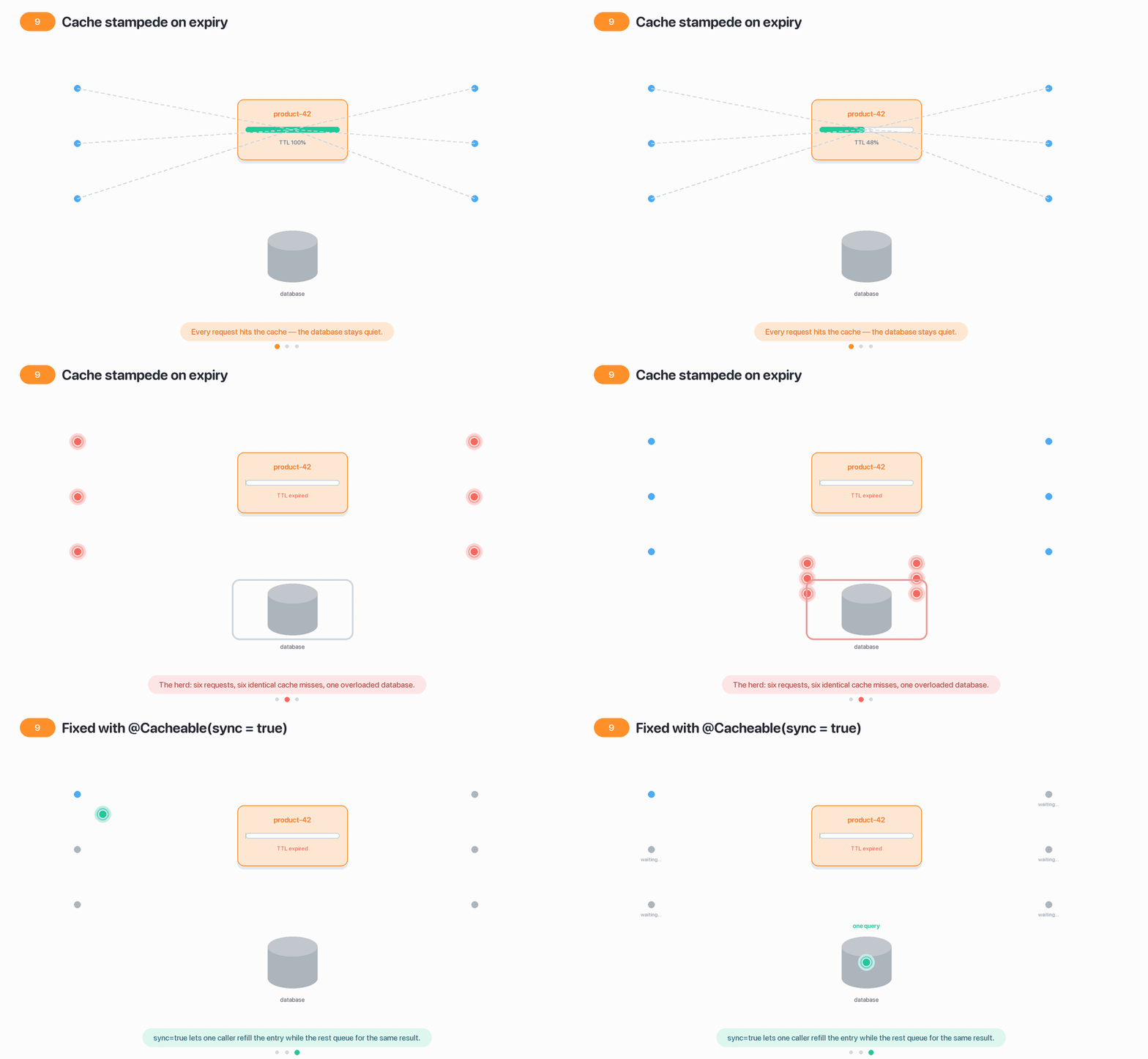
A hot key’s TTL expires and every concurrent reader falls through at once — the stampede sync = true prevents by letting one caller refill it while the rest wait.
1. The abstraction: caching as an aspect, not a data structure
The cache abstraction (in Spring Framework since 3.1) is deliberately not a cache. It is a thin, provider-agnostic SPI plus an AOP interceptor that applies caching declaratively to method calls — the same way transactions are applied. You annotate a method; a proxy wraps it; on each call the proxy consults a Cache, and only invokes your method on a miss. Your business code never touches the store.
Two interfaces are the entire SPI:
SPI type
Role
CacheManager
resolves a named cache — cacheManager.getCache("books")
Cache
one named region: get(key), put(key, value), evict(key), clear()
Everything else — Caffeine, Redis, Hazelcast, a ConcurrentHashMap — is a backend behind those two interfaces. That is the point: switch providers by changing a dependency and a property, not your code.
@Configuration@EnableCaching // turns on the caching interceptor (proxy) — REQUIREDpublic class CacheConfig { }
The one-sentence framing interviewers want
“Spring caching is an AOP aspect over method calls, not a cache implementation — @Cacheable means memoize this method keyed by its arguments, and the abstraction lets me swap Caffeine for Redis without touching the annotated code.” Naming that the annotations do nothing without @EnableCaching (there’s no proxy otherwise) is the first senior signal.
2. The annotation vocabulary
Three verbs cover almost everything; two helpers compose and share config.
Annotation
Behaviour
Method invoked?
@Cacheable
look up by key; on hit return cached value, on miss call the method and store the result
only on a miss
@CachePut
always call the method, then store the result under the key
always
@CacheEvict
remove one key (or allEntries=true to clear the region)
always
@Caching
group several of the above on one method (e.g. evict two regions)
—
@CacheConfig
class-level defaults (cacheNames, keyGenerator) shared by all methods
—
@Service@CacheConfig(cacheNames = "books")public class BookService { @Cacheable(key = "#isbn") // read-through: cache on miss public Book findByIsbn(String isbn) { return repo.load(isbn); } @CachePut(key = "#book.isbn") // write-through: refresh the entry public Book update(Book book) { return repo.save(book); } @CacheEvict(key = "#isbn") // invalidate on delete public void delete(String isbn) { repo.remove(isbn); }}
@CachePut and @Cacheable on the same method are a bug
@Cacheable skips the method on a hit; @CachePut always runs it. Put both on one method and their behaviours contradict — the method may or may not run depending on interceptor ordering, giving nondeterministic results. Use @Cacheable for reads and @CachePut only to refresh an entry you’re also persisting.
beforeInvocation on eviction
@CacheEvict evicts after the method returns by default, so if the method throws, the stale entry survives. For a delete/invalidate where you must clear the cache even on failure, set @CacheEvict(beforeInvocation = true).
3. Keys, conditions, and sync
Default key. With no key, Spring’s SimpleKeyGenerator builds the key from the method arguments: no args → a shared SimpleKey.EMPTY; one arg → that argument itself; several → a SimpleKey wrapping them all. This works only if every argument has correct equals/hashCode.
Custom key (SpEL).key is a SpEL expression evaluated against a root that exposes #root.methodName, #root.target, #root.args, the argument names (#isbn, or #p0/#a0 by index), and — in unless and key expressions after invocation — #result.
condition vs unless.condition (evaluated before the call) decides whether caching applies at all; unless (evaluated after, sees #result) vetoes storing a particular result.
Custom KeyGenerator. For composite or normalized keys, implement KeyGenerator and reference it by bean name (keyGenerator = "...") instead of hand-writing fragile SpEL everywhere.
Gotcha #1 — per-user data under a shared key → cross-user leak
The single most dangerous caching bug: caching user-scoped data without the user in the key.
@Cacheable("profile") // key = SimpleKey.EMPTY — ONE entry for EVERYONEpublic Profile currentProfile() { return lookup(SecurityContextHolder...); }
The first user populates the cache; every subsequent user gets that user’s profile. This is a data-breach-class bug that passes every functional test run by a single user. Mitigation: include the principal in the key — key = "#userId" — or, better, do not cache request/security-scoped results at method level at all. If the cache key can’t fully identify the value, it is the wrong key.
Gotcha #2 — caching a mutable object, then mutating it
@Cacheable stores a reference for in-memory providers (Caffeine, ConcurrentMap). A caller that mutates the returned object mutates the cached object — every later reader sees the change, and it was never persisted. Mitigation: cache immutable values (records, defensive copies), or use a serializing provider (Redis) where each get deserializes a fresh instance. Treat cached objects as read-only by contract.
sync = true for expensive misses
@Cacheable(sync = true) tells the provider to lock the key while one thread computes the value; concurrent callers for the same key wait for that single computation instead of all stampeding the method (§8). Support is provider-dependent (Caffeine yes; the simple provider yes; not every JCache backend). Use it on hot, expensive keys.
4. Providers & how Spring Boot auto-selects one
You do not build a CacheManager by hand unless you need to. If you don’t define one, Boot detects a provider from the classpath and configures it. Detection runs in a fixed priority order — Generic → JCache (EhCache/Hazelcast/Infinispan) → Hazelcast → Infinispan → Couchbase → Redis → Caffeine → Cache2k → Simple — and stops at the first available. With no cache library present, the Simple provider (a ConcurrentHashMap) wins as the fallback.
spring.cache.type forces or disables a provider explicitly:
# Force a specific backend (values: generic, jcache, hazelcast, infinispan,# couchbase, redis, caffeine, cache2k, simple, none)spring.cache.type=redis# spring.cache.type=none # no-op cache — handy to disable caching in testsspring.cache.cache-names=books,authors # pre-create these caches at startup
Provider
Backing store
Character
simple (default)
ConcurrentHashMap
zero-config, unbounded, no TTL — dev/test only
caffeine
in-process Caffeine cache
local, size- and time-bounded, fastest
redis
external Redis
distributed, shared across instances, network-bound
Gotcha #3 — the default simple cache is unbounded → OutOfMemory
The ConcurrentHashMap behind the default provider has no maximum size and no TTL. Cache a method keyed by something high-cardinality (user IDs, search queries) and the map grows without limit until the heap dies with OutOfMemoryError — typically in production, under real traffic, long after tests passed. Mitigation: never ship the simple provider for anything user-facing. Move to Caffeine with an explicit maximumSize/expireAfter (§6), or Redis with a TTL. Treat “unbounded cache” as a memory leak, because it is one.
5. Local (Caffeine) vs distributed (Redis) vs no cache
This is the core design decision, and the comparison interviewers push on.
data shared across instances, must be consistent, or too large for heap (sessions, API responses, expensive aggregates)
writes ≈ reads, strong-consistency required, or the source is already fast (§10)
The committed recommendation
Default to Caffeine for local, read-mostly reference data — it’s the lowest-latency, lowest-ops option and needs no infrastructure. Reach for Redis the moment the cached value must be consistent across instances (you’d otherwise get different answers per node) or is too big for the heap. A common senior pattern is two tiers: Caffeine as an L1 in front of Redis as an L2 — but only add the second tier when profiling shows the network hop is the bottleneck, not by default.
6. TTL, eviction & size limits
An in-memory cache without a bound is a leak (§4); the provider is where you set the bound.
Caffeine — configure via one spec string or a Caffeine builder bean:
Redis — TTL and null-handling via properties, or a RedisCacheConfiguration bean for per-cache tuning:
spring.cache.redis.time-to-live=10mspring.cache.redis.cache-null-values=true # see §9spring.cache.redis.key-prefix=app:: # namespace keys to avoid collisionsspring.cache.redis.use-key-prefix=true
Two eviction axes to keep straight: size-based (Caffeine’s maximumSize, evicts least-valuable entries when full) and time-based (expireAfterWrite/time-to-live, entries die after a fixed age). expireAfterWrite bounds staleness; expireAfterAccess keeps hot keys alive and drops idle ones. Redis TTL additionally frees memory server-side.
Always bound both size and time
Set a maximumSize (or Redis maxmemory + eviction policy) and a TTL. Size alone lets a stale entry live forever if it stays hot; TTL alone lets an unbounded key space exhaust memory before anything expires. Every production cache needs both a ceiling and an expiry.
7. Invalidation strategies & consistency
A cache is a copy; correctness is entirely about when the copy is refreshed or discarded. Two patterns dominate:
Cache-aside (lazy / read-through): on read, check cache → on miss load from source and populate. On write, evict the key so the next read reloads. This is the default @Cacheable + @CacheEvict shape — simple, and the cache only holds what’s actually read.
Write-through: on write, update the source and the cache in the same operation (@CachePut). The cache is always warm for that key, at the cost of caching data that may never be read.
@CachePut(key = "#book.isbn") // write-through: DB + cache updated togetherpublic Book update(Book book) { return repo.save(book); }@CacheEvict(key = "#isbn") // cache-aside invalidation on deletepublic void delete(String isbn) { repo.remove(isbn); }
Gotcha #4 — stale reads because nothing invalidates
@Cacheable on the read path with no @CacheEvict/@CachePut on the write path (or writes that bypass the service — direct SQL, another service, a batch job) means the cache never learns the source changed. Reads serve the stale value until the TTL expires — minutes or hours of wrong data, and it looks like a “database bug.” Mitigation: pair every cached read with an invalidation on every write path, and treat any out-of-band writer as a reason to shorten the TTL or publish an eviction event. If you cannot invalidate, a short TTL is your only bound on staleness — choose it deliberately.
Accept staleness explicitly
A cache trades freshness for latency. Decide the acceptable staleness window per use case and encode it as the TTL: a currency rate might tolerate 60s, a product catalogue an hour, a user’s permissions perhaps nothing (don’t cache it). “How stale can this be?” is a design input, not an afterthought.
8. The self-invocation gotcha (again)
Caching is proxy-based, exactly like @Transactional (02 - IoC Container, Beans & Dependency Injection). The interceptor lives on the proxy Spring injects into other beans. A call from inside the same bean goes through this, not the proxy — so the caching advice never runs.
@Servicepublic class ReportService { public Report daily(String id) { return computeExpensive(id); // internal call via `this` — NOT cached! } @Cacheable("reports") public Report computeExpensive(String id) { ... } // proxy bypassed}
daily() recomputes every time; the @Cacheable on computeExpensive is silently dead because the call never left the object to pass through the proxy.
Gotcha #5 — internal calls silently skip the cache
This is identical to the @Transactional self-invocation trap and just as invisible — no error, the method simply runs uncached every time, and you “discover” it when the cache hit-rate metric is zero. Mitigation: call the cached method from a different bean, or split the cached method into its own service. Last resort: inject a self-reference / use AopContext.currentProxy(). The clean fix is almost always to move the cached method to the boundary where callers are external.
9. Failure modes on the hot path: stampede & penetration
Cache stampede (thundering herd). A hot key expires; N concurrent requests all miss simultaneously and all hit the database (or downstream service) at once — the load spike the cache existed to prevent, delivered precisely when the cache is empty.
Cache penetration. Requests for keys that don’t exist (missing IDs, garbage from a scanner) always miss and always hit the source, because a miss isn’t cached — the cache provides zero protection against lookups for absent data.
Gotcha #6 — a hot key expires and the herd hits the database
On a high-traffic key, TTL expiry turns one cache miss into thousands of simultaneous source calls. Under load this cascades into connection-pool exhaustion and timeouts — the classic “the site fell over at exactly the top of the hour when everything expired together.”
Stampede mitigations, in order of reach-for
sync = true (§3): one thread computes, the rest wait — the simplest fix for a single instance.
TTL jitter: add a random spread (e.g. 10m ± 90s) so keys don’t expire in lockstep; prevents synchronized mass-expiry.
Distributed lock (Redis): across instances, let one node recompute while others serve the old value or wait — needed when sync (per-JVM) isn’t enough.
Refresh-ahead: Caffeine’s refreshAfterWrite reloads a hot key in the background before it expires, so readers never see a miss.
Negative caching defeats penetration
Cache the absence of a value — store a null/sentinel for missing keys with a short TTL. Spring Boot’s Redis cache does this by default (spring.cache.redis.cache-null-values=true); combine with unless = "#result == null" only when you deliberately don’t want to cache nulls. Keep the negative TTL short so a later-created entity isn’t masked by a cached “not found.”
10. Redis serialization concerns
Redis stores bytes, so every cached object is serialized on put and deserialized on get — a source of subtle production breakage that in-memory providers don’t have.
By default, RedisCacheConfiguration.defaultCacheConfig() serializes keys with StringRedisSerializer and values with JdkSerializationRedisSerializer (Java native serialization). JDK serialization requires every cached type to implement Serializable, produces opaque binary blobs, and — worst of all — breaks across class changes: add or rename a field and old cached entries fail to deserialize.
Gotcha #7 — a deploy changes a class and cached entries won't deserialize
Whether JDK- or JSON-serialized, entries written by the old code can fail to deserialize under the new class shape after a rolling deploy — throwing SerializationException on read, often only for a subset of keys, until the TTL flushes them. JDK serialization is especially brittle (it keys on serialVersionUID). Mitigation: prefer a JSON serializer (GenericJackson2JsonRedisSerializer) for readability and looser compatibility; make DTOs additive (don’t rename/remove fields); version the cache key or key-prefix on breaking model changes so new code reads a fresh namespace; and cache purpose-built DTOs, not JPA entities (whose lazy proxies serialize terribly). [HIGH-CHURN: Spring Data Redis 4.x is renaming/deprecating some Jackson serializer classes — verify the exact serializer type name against the current reference before relying on it.]
11. When NOT to cache & caveats (summary)
Don’t cache write-heavy or rapidly-changing data. If writes rival reads, you spend more on invalidation than you save on hits, and staleness risk dominates.
Don’t cache when the source is already fast. An indexed single-row primary-key lookup is often cheaper than a Redis round-trip; measure before adding a cache.
Don’t cache security-scoped data under a shared key (§3). Get the key wrong and it’s a data breach, not a bug.
Bound every cache — size and time (§6). Unbounded is a memory leak (§4).
Pair every cached read with invalidation on every write path (§7); account for out-of-band writers.
Cache immutable DTOs, not mutable entities (§3, §10). Reference sharing and lazy proxies both bite.
Version facts are volatile. Spring Boot 4.1.x / Framework 7.0 / Spring Data Redis 4.1.x / Jakarta EE 11 / JDK 17 baseline are current as of mid-2026 — re-verify exact property keys and serializer class names before relying on them.
12. In practice
// A caching service done right: bounded, invalidated, stampede-safe, DTO-based.@Service@CacheConfig(cacheNames = "products")public class ProductService { @Cacheable(key = "#id", sync = true, // §8 stampede guard on a hot key unless = "#result == null") // §9 don't cache misses here public ProductDto find(String id) { // returns an immutable DTO (§3) return mapper.toDto(repo.findById(id).orElse(null)); } @CachePut(key = "#dto.id") // §7 write-through keeps entry warm public ProductDto update(ProductDto dto) { return mapper.toDto(repo.save(...)); } @CacheEvict(key = "#id", beforeInvocation = true) // §2 evict even if delete throws public void delete(String id) { repo.deleteById(id); }}
# application.properties — Redis-backed, bounded, JSON-serialized (via a config bean)spring.cache.type=redisspring.cache.cache-names=products,catalogspring.cache.redis.time-to-live=10mspring.cache.redis.key-prefix=app::# For local reference data instead, swap to Caffeine:# spring.cache.type=caffeine# spring.cache.caffeine.spec=maximumSize=10000,expireAfterWrite=10m,recordStats
Interview talking points to be able to defend:
“Spring caching is an AOP aspect over method calls — @Cacheable memoizes by arguments, and nothing works without @EnableCaching because there’s no proxy otherwise.”
“Boot auto-selects a provider by classpath priority; the default simpleConcurrentHashMap is unbounded, so it’s dev-only — production needs Caffeine or Redis with a size and time bound.”
“Caffeine when it’s local, hot, read-mostly and per-node staleness is fine; Redis when the value must be consistent across instances or is too big for the heap.”
“The self-invocation trap is identical to @Transactional: an internal call skips the proxy, so the cache silently never fires.”
“The scary bugs are per-user data under a shared key (cross-user leak) and a stampede when a hot key expires — I mitigate with correct keys, sync=true, TTL jitter, and negative caching.”
“Redis serializes entries, so I cache DTOs not entities, prefer JSON over JDK serialization, and version the key-prefix on breaking model changes.”