Scope
How a Spring Boot service survives the failure of its dependencies instead of amplifying it — the layered controls (timeouts, retries, circuit breakers, bulkheads, rate limiters, fallbacks), where they live now that Spring Framework 7 ships
@Retryable/@ConcurrencyLimitin the core, and how the process behaves under a rolling deploy (graceful shutdown, draining, readiness flip). The through-line is a single senior instinct: make failure fast, bounded, and local. For the async work these controls wrap, see 10 - Messaging, Events & Async; for the probes and metrics that observe them, see 12 - Actuator, Metrics & Observability.
Related: Spring Boot, 10 - Messaging, Events & Async, 12 - Actuator, Metrics & Observability, 05 - Web Layer & Embedded Servers - MVC vs WebFlux
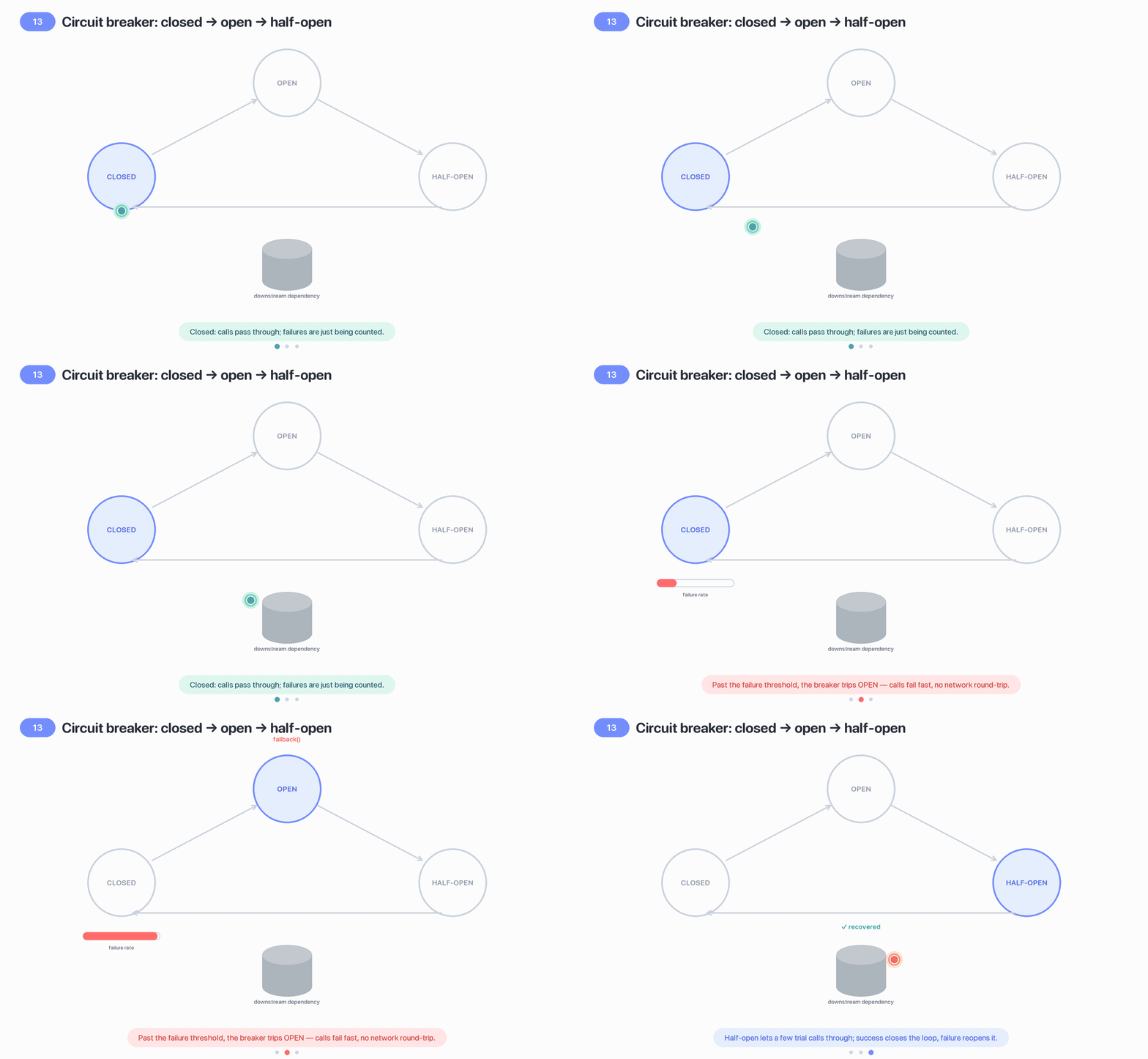
Closed counts failures and lets calls through; past the threshold it trips open and fails fast; half-open lets a few trial calls decide whether to close the loop again.
1. The concept: control failure, don’t inherit it
Every remote call — a REST hop, a DB query, a queue publish — can be slow, wrong, or dead. Without controls, a slow dependency is the dangerous case: your threads block waiting on it, the pool fills, and a downstream problem becomes your outage that propagates further upstream. Resilience is the discipline of bounding that blast radius. Two postures sit at the ends of a spectrum:
- Fail fast — reject or error immediately when a dependency is unhealthy, freeing the caller’s resources. Correct for internal, latency-sensitive paths where a wrong-but-fast answer beats a right-but-hung one.
- Graceful degradation — serve a reduced answer (a cached value, a default, a partial page) instead of an error. Correct where a degraded experience beats no experience (a product page that hides “recommendations” but still sells).
The framing interviewers want
“Resilience isn’t about never failing — it’s about failing fast, bounded, and locally, and choosing per-call between failing fast and degrading gracefully. The controls stack: a timeout bounds one call, a retry rides out a blip, a circuit breaker stops hammering a dead dependency, a bulkhead stops one sick dependency from starving the rest, and a fallback decides what the user sees when all of that gives up.”
2. Timeouts — the most important and most-forgotten control
A timeout is the only thing that turns an unbounded wait into a bounded failure. Every blocking client needs two: a connect timeout (how long to wait for a TCP/TLS connection) and a read/response timeout (how long to wait for bytes once connected). The JDK/HTTP-client defaults are usually infinite — which is the trap.
@Bean
RestClient inventoryClient(RestClient.Builder builder) {
    var settings = ClientHttpRequestFactorySettings.defaults()
            .withConnectTimeout(Duration.ofSeconds(2))   // wait for the connection
            .withReadTimeout(Duration.ofSeconds(3));      // wait for the response
    return builder
            .baseUrl("https://inventory.internal")
            .requestFactory(ClientHttpRequestFactoryBuilder.detect().build(settings))
            .build();
}
For WebClient the equivalent lives on the reactive connector (HttpClient.responseTimeout(...) on Reactor Netty); reactive code should also wrap the call in .timeout(Duration) so a stalled stream is cancelled. Behind a blocking client sits a connection pool — size it deliberately (Apache HttpClient 5: max-total and max-per-route). A pool that is too small serialises calls; one that is too large lets a slow dependency consume every connection.
Gotcha #1 — no timeout → thread-pool exhaustion that cascades upstream
A dependency slows from 50 ms to 30 s but doesn’t error. With no read timeout, each request thread blocks for 30 s. Under load the Tomcat worker pool (default 200) fills; new requests queue, then time out at the client’s client, and the slowness you inherited is now an outage you emit — to every caller upstream. The dead dependency took down healthy services.
Mitigation: set a read timeout on every blocking client, shorter than the caller-facing SLA and shorter than your own request timeout budget. A timeout you didn’t set isDuration.INFINITE— assume it and fix it.
Timeouts are a budget, not a number
If your endpoint must answer in 800 ms and it calls two services, those calls cannot each be given 3 s. Allocate a latency budget down the call tree so the sum of downstream timeouts is less than the caller’s timeout. Otherwise the caller gives up first and your own timeout never fires — wasting the work and confusing the metrics.
3. Retries — exponential backoff, jitter, and idempotency
A retry re-issues a failed call in the hope the failure was transient (a dropped connection, a brief 503, a leader election). It is the most misused pattern because a naive retry amplifies the very outage it was meant to survive.
Three rules make retries safe:
- Only retry transient, retryable failures — connection resets, timeouts, HTTP 429/503. Never retry a 400/404/422 (the answer won’t change) or a business-rule rejection.
- Back off exponentially, with jitter — space attempts out with a growing delay (
base · 2ⁿ) and add randomness so a thousand clients that failed together don’t retry in lockstep. - Only retry idempotent operations — a retry of a non-idempotent call risks executing the side-effect twice.
Gotcha #2 — retry without backoff → a retry storm that amplifies the outage
A dependency hiccups; every client instantly retries 3×. You have just tripled the traffic to a service that was already struggling, guaranteeing it stays down. Fixed-interval retries across a fleet are worse — they synchronise into a thundering herd that hammers the recovering service in waves.
Mitigation: exponential backoff plus jitter, a smallmaxAttempts(2–3, not 10), and a circuit breaker in front (§5) so retries stop entirely once the dependency is declared dead.
Gotcha #3 — retrying a NON-idempotent call → duplicate side-effects
POST /paymentstimes out. The response was lost, but the server did charge the card. Your retry charges it again. The same trap hits “send email”, “publish event”, and “insert order”. A timeout tells you nothing about whether the work happened.
Mitigation: make the operation idempotent before you make it retryable (see below). If you can’t, don’t retry it — fail fast and reconcile.
Idempotency is the precondition for safe retries. The standard technique is an idempotency key: the client sends a unique key per logical operation; the server records it and, on a duplicate, returns the original result instead of re-executing. This is the same de-duplication contract as at-least-once messaging — the consumer-side idempotency discussed in 10 - Messaging, Events & Async is exactly what makes a producer-side retry safe. GET/PUT/DELETE are idempotent by HTTP contract; POST is not until you add a key.
4. Circuit breaker — closed / open / half-open
A retry survives a blip; a circuit breaker survives an outage. It is a state machine wrapped around a dependency that stops calls entirely once failures cross a threshold — letting the dependency recover and failing callers instantly instead of making them wait for a timeout.
| State | Behaviour | Transition |
|---|---|---|
| Closed | calls pass through; failures are counted in a sliding window | → Open when the failure rate exceeds the threshold |
| Open | calls are rejected immediately (no call made, fallback invoked) | → Half-open after waitDurationInOpenState elapses |
| Half-open | a limited number of trial calls are allowed through | → Closed if they succeed, → Open if they fail |
The payoff is the Open state: while the dependency is down, callers get an instant rejection (and their fallback) instead of blocking on a doomed call until the timeout — which is precisely what prevents the thread-pool exhaustion of §2 from ever starting.
A breaker without a timeout is half a breaker
A circuit breaker counts failures; a call that hangs forever never fails and never trips the breaker. Timeouts (§2) are what produce the failures the breaker measures. The two are a pair — always configure them together.
5. Bulkhead, rate limiter, load shedding & fallbacks
Bulkhead — resource isolation. Named after a ship’s watertight compartments: give each dependency its own bounded pool (of threads or of concurrent permits) so that when one dependency goes slow and saturates its compartment, the threads serving other dependencies are untouched. Without bulkheads, one sick downstream drowns the whole shared pool — the cascade again.
Rate limiter — protect the callee (and yourself). Caps calls per unit time. Client-side it keeps you a polite consumer of a quota’d API; server-side it protects you from a caller (or a retry storm) that would otherwise overwhelm you.
Load shedding — fail fast under overload. When the process is past its safe capacity (queue depth, in-flight count), reject new work immediately with 503/429 rather than accepting it into a queue that only grows. Shedding a fraction of load keeps the rest healthy; accepting everything makes everything slow. @ConcurrencyLimit (§7) and a bulkhead are the mechanisms.
Fallbacks — what the user sees when a control gives up. A fallback is the graceful-degradation branch: a cached value, a sensible default, an empty list, or a fast error. Keep fallbacks cheap and local — a fallback that calls another remote service just moves the failure.
Gotcha #4 — a fallback that hides a systemic failure
Returning an empty recommendations list on failure is graceful. Returning
balance = 0orpermissions = noneon failure is a correctness incident dressed as resilience. And a fallback with no metric behind it turns a loud outage into a silent one — the dashboards look green while every user gets the degraded path.
Mitigation: fall back only where a degraded answer is safe, never for authoritative data; and emit a metric/log on every fallback so degradation is visible (12 - Actuator, Metrics & Observability).
6. Resilience4j — annotations, config & aspect order
Resilience4j is the de-facto library (the successor to Netflix Hystrix, which is in maintenance). Its Spring Boot starter exposes one annotation per pattern, each taking a named instance and an optional fallbackMethod. The fallback must have the same signature plus a trailing Throwable.
@Service
class InventoryService {

    @CircuitBreaker(name = "inventory", fallbackMethod = "stockFallback")
    @Retry(name = "inventory")                       // transient blips only
    public StockLevel getStock(String sku) {
        return inventoryClient.get()                 // the RestClient from §2 (has timeouts!)
                .uri("/stock/{sku}", sku)
                .retrieve()
                .body(StockLevel.class);
    }

    // same signature + Throwable — invoked when the breaker is open or retries are exhausted
    StockLevel stockFallback(String sku, Throwable ex) {
        return StockLevel.unknown(sku);              // cheap, local, degraded answer
    }
}resilience4j:
circuitbreaker:
instances:
inventory:
sliding-window-type: COUNT_BASED
sliding-window-size: 20
failure-rate-threshold: 50 # % of calls that fail → open
wait-duration-in-open-state: 10s
permitted-number-of-calls-in-half-open-state: 5
retry:
instances:
inventory:
max-attempts: 3
wait-duration: 200ms
enable-exponential-backoff: true
exponential-backoff-multiplier: 2
enable-randomized-wait: true # THE jitter switch — do not omit
retry-exceptions: [ java.io.IOException, java.util.concurrent.TimeoutException ]
timelimiter:
instances:
inventory:
timeout-duration: 3sThe aspect order is fixed and it matters. Resilience4j applies its aspects in a hardcoded nesting regardless of the annotation order you write on the method:
Retry ( CircuitBreaker ( RateLimiter ( TimeLimiter ( Bulkhead ( yourMethod ) ) ) ) )
So by default Retry wraps CircuitBreaker — each retry attempt is seen by the breaker, and one logical failure that is retried 3× records 3 failures in the breaker’s window, tripping it faster than you intended. Reorder via the *AspectOrder properties (higher value = outer) if you need the breaker to wrap the retries instead.
Gotcha #5 — nested retries multiply attempts
A
@Retry(maxAttempts=3)method that calls another@Retry(maxAttempts=3)method yields 9 attempts per logical call; add a client-library retry underneath and it is 27. Layered retries across a call chain multiply into a self-inflicted DDoS.
Mitigation: retry at one layer only — usually the outermost caller of a logical operation. Turn off retries in inner clients, or budget them so the product across the chain stays ≤ 2–3.
Spring Cloud Circuit Breaker is a thin abstraction (CircuitBreakerFactory) over a provider (Resilience4j by default) for teams that want to swap implementations without touching call sites; most services use the Resilience4j annotations directly.
7. Spring Framework 7 built-in resilience (@Retryable, @ConcurrencyLimit)
HIGH-CHURN — verify against docs.spring.io before relying on this
New in Spring Framework 7.0 / Spring Boot 4.x. Details below reflect the current reference (
docs.spring.io/spring-framework/reference/core/resilience.html, verified mid-2026). Re-check attribute names and defaults before committing to them.
Spring 7 pulls a minimal set of resilience primitives down into the core (spring-core / spring-context, package org.springframework.resilience.annotation) — inspired by the old Spring Retry project but redesigned. This means retry and concurrency throttling with no extra dependency. Enable it with @EnableResilientMethods on a @Configuration class, then:
@Retryable(                       // NOTE: total attempts = 1 + maxRetries
    includes = MessageDeliveryException.class,
    maxRetries = 3,               // core uses maxRetries, NOT Resilience4j's maxAttempts
    delay = 100, multiplier = 2, maxDelay = 1000,   // exponential backoff
    jitter = 10)                  // milliseconds of randomness — jitter is first-class
public void sendNotification() { ... }

@ConcurrencyLimit(10)             // at most 10 concurrent invocations (a lightweight bulkhead)
public void callRateLimitedApi() { ... }
@Retryable also supports reactive return types (it decorates the Reactor pipeline) and String variants (maxRetriesString, delayString) for property/SpEL binding; RetryTemplate + RetryPolicy give the programmatic equivalent. @ConcurrencyLimit(1) effectively serialises access to the bean — a cheap throttle that pairs well with virtual threads (05 - Web Layer & Embedded Servers - MVC vs WebFlux).
When the built-in is enough — and when it isn't
The core primitives cover the two most common needs (retry, concurrency cap) without a dependency. But there is no circuit breaker, bulkhead-as-thread-pool, or rate-limiter in core Spring 7 — for those, reach for Resilience4j. Watch the attribute mismatch: core
@RetryablecountsmaxRetries(retries after the first call), while Resilience4j and Spring Retry countmaxAttempts(total). Mixing them up silently changes your attempt count.
8. Graceful shutdown & draining in-flight requests
When Kubernetes rolls a deployment it sends SIGTERM and the pod stops receiving new traffic — but requests already in flight must be allowed to finish, or users see errors mid-deploy. Spring Boot’s graceful shutdown does exactly this: on shutdown the server stops accepting new connections and waits (up to a grace period) for active requests to complete.
server.shutdown=graceful                              # stop accepting, drain in-flight (default is IMMEDIATE)
spring.lifecycle.timeout-per-shutdown-phase=30s       # max drain time before forceful stop

management.endpoint.health.probes.enabled=true        # expose liveness/readiness groups
management.endpoint.health.group.readiness.include=readinessState
The mechanism ties directly to 12 - Actuator, Metrics & Observability: when shutdown begins, Spring Boot flips the readiness state to REFUSING_TRAFFIC, so /actuator/health/readiness returns OUT_OF_SERVICE (503). Kubernetes sees the failing readiness probe and removes the pod from the Service endpoints — then the drain runs, and no new request is routed to a pod that is on its way out.
Gotcha #6 — not draining → dropped requests and 502s on every rolling deploy
With the default immediate shutdown,
SIGTERMkills the server while requests are mid-flight. The load balancer, which hasn’t yet noticed the pod is gone, keeps routing to it — clients get connection resets and 502/504s on every deploy. It looks like a flaky app; it’s an un-drained shutdown.
Mitigation: setserver.shutdown=graceful; make the grace period longer than your longest request but shorter than Kubernetes’terminationGracePeriodSeconds(else the pod isSIGKILLed mid-drain). Add a smallpreStopsleep so the endpoint deregistration propagates before draining begins.
Idempotency closes the loop with retries (§3)
Graceful shutdown reduces dropped requests but can’t eliminate them; combined with client retries, a request cut off at shutdown will be retried against another pod. That is only safe if the operation is idempotent — the same precondition from §3 and the consumer-side de-dup in 10 - Messaging, Events & Async. Resilience patterns reinforce each other; none stands alone.
9. Where to put resilience: library vs framework vs mesh
The same timeout/retry/breaker can live in the application code, the framework, or the network. They are complementary layers, not competitors.
| Approach | What it covers | Strengths | When to pick which |
|---|---|---|---|
| Resilience4j (library, in-app) | full set: CB, retry, bulkhead, rate limiter, time limiter, fallback | richest features; business-aware fallbacks; per-method tuning; works everywhere the JVM runs | any non-trivial service; when you need circuit breakers or fallbacks that return a meaningful degraded answer |
Spring Framework 7 built-in (@Retryable/@ConcurrencyLimit) | retry + concurrency cap only | zero extra dependency; core-supported; reactive-aware; simplest | simple retry/throttle needs; libraries that must not impose a resilience dependency; before reaching for R4j |
| Service mesh (Istio/Envoy sidecar) | timeouts, retries, CB, rate limiting at the network layer | language-agnostic; uniform policy across a polyglot fleet; changed via config, no redeploy | platform-wide L7 defaults (mTLS, coarse timeouts/retries) across many services and languages; ops-owned policy |
The committed recommendation
Put resilience at the layer that has the context to act on it. The mesh enforces coarse, uniform defaults (a global timeout, a blanket retry on 503) with no redeploy — great for a polyglot platform, but it cannot write a business fallback because it doesn’t know your domain. The application (Resilience4j, or Spring 7 core for simple cases) owns anything that needs to return a meaningful degraded value or apply per-endpoint tuning. Real systems use both: mesh for the floor, in-app for the smart parts. And beware double retries — if the mesh retries and the app retries, you have re-created Gotcha #5 across two layers; pick one owner per concern.
10. In practice & interview talking points
Committed best practices:
- Every blocking client gets a connect + read timeout (§2). An unset timeout is infinite. Size the connection pool deliberately.
- Retry only idempotent, transient failures — with backoff and jitter, small
maxAttempts, at one layer only (§3, §6). Never retry a non-idempotent call without an idempotency key. - Timeout + circuit breaker are a pair (§4). The timeout produces the failures the breaker counts; the breaker stops the doomed calls before they exhaust the pool.
- Bulkhead per dependency; shed load past capacity; fall back only where degraded is safe, and meter it (§5).
- Turn on graceful shutdown and wire readiness to it (§8) so rolling deploys don’t drop requests. Grace period < Kubernetes’
terminationGracePeriodSeconds. - Version facts are volatile. Spring Boot 4.1.x / Framework 7.0 / Jakarta EE 11 / JDK 17 baseline are current as of mid-2026, and the Framework 7 core
@Retryable/@ConcurrencyLimitAPI is new — re-verify names and defaults before relying on them.
# application.properties — the production-readiness baseline
server.shutdown=graceful
spring.lifecycle.timeout-per-shutdown-phase=30s
management.endpoint.health.probes.enabled=true
management.endpoint.health.group.readiness.include=readinessState
resilience4j.circuitbreaker.instances.inventory.failure-rate-threshold=50
resilience4j.retry.instances.inventory.enable-randomized-wait=true   # jitter (§3)
Interview talking points to be able to defend:
- “The most-forgotten control is the timeout — an unset read timeout is infinite, and a slow dependency then exhausts my thread pool and turns their problem into my upstream outage.”
- “I retry only idempotent, transient failures, with exponential backoff plus jitter — fixed retries without backoff are a retry storm that amplifies the outage I’m trying to survive.”
- “A circuit breaker fails callers instantly while a dependency is down, which is what stops the pool exhaustion a bare timeout still allows — but a breaker needs timeouts to generate the failures it counts.”
- “Resilience4j’s aspect order is fixed: Retry wraps CircuitBreaker by default, so retried failures inflate the breaker’s failure count — I know to reorder or account for it.”
- “Spring 7 now ships
@Retryable/@ConcurrencyLimitin core (verify the API), but there’s still no circuit breaker there — that’s where Resilience4j stays.” - “Graceful shutdown flips readiness to
OUT_OF_SERVICEso the load balancer drains the pod before it dies — without it, every rolling deploy drops in-flight requests as 502s.” - “I decide resilience placement by context: the mesh for uniform L7 defaults, the app for business-aware fallbacks — never both retrying the same call.”
11. Sources
- Spring Framework Reference — Resilience Features (
@Retryable,@ConcurrencyLimit,RetryTemplate) - Spring Blog — Core Spring Resilience Features: @ConcurrencyLimit, @Retryable, and RetryTemplate (2025-09-09)
- Spring Boot Reference — Graceful shutdown
- Spring Boot Reference — Application Availability & Kubernetes Probes (readiness / liveness)
- Spring Boot Reference — Kubernetes Probes with Actuator
- Spring Boot Reference — REST Clients (
RestClient, request factory settings & timeouts) - Resilience4j — Getting Started with Spring Boot (annotations, config, aspect order)
- Resilience4j — Circuit Breaker (states, sliding window, thresholds)
- Resilience4j — Retry (backoff, randomized wait / jitter)
- Spring Cloud Circuit Breaker reference