Scope
How you know an LLM system is good enough to ship — and stays good as models, prompts, and data churn underneath it. Covers offline vs online eval, golden/eval sets, LLM-as-judge (and how to judge the judge), RAGAS for retrieval, benchmark contamination, eval-driven development, agent/trajectory evaluation with pass^k reliability, and the statistical rigor that separates a real win from noise. This is the discipline that makes the rest of the stack (07 - RAG, 08 - Agents & Agentic Systems) shippable. For running evals in production, see 16 - Observability & LLMOps Lifecycle.
Related: Gen AI Engineer, 07 - RAG, 08 - Agents & Agentic Systems, 16 - Observability & LLMOps Lifecycle
A judge model scores a candidate output against a question and a reference — pointwise, pairwise, or rubric-based:
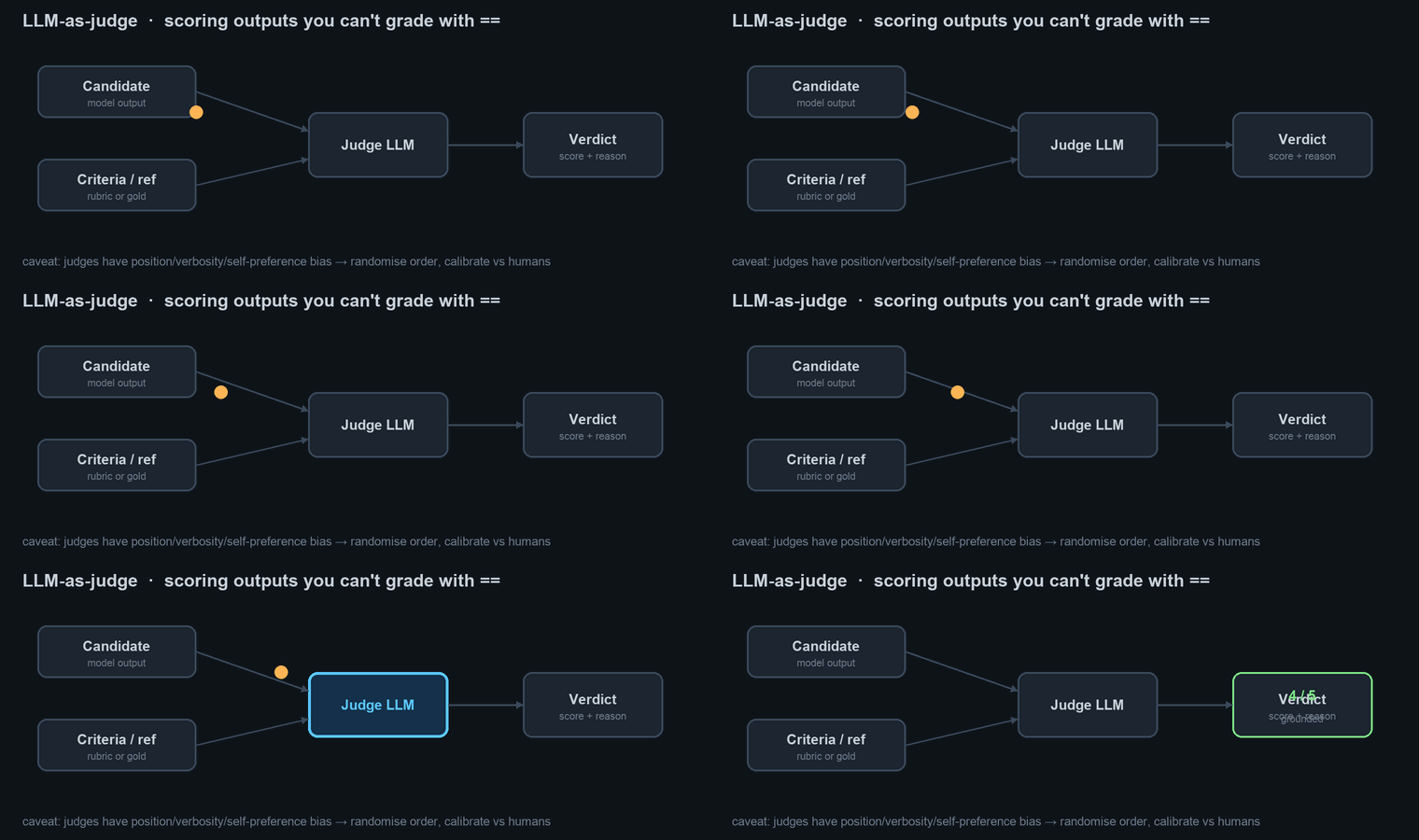
1. Why evals at all: a non-deterministic component on shifting ground
You’re shipping a component that is non-deterministic (same input → different output; even temperature=0 isn’t bit-exact, see 02 - Decoding, Sampling & Reasoning Controls) and built on a model you don’t control and that gets silently re-versioned. Both legs move:
- The model changes — a provider point-release can shift behavior on your exact prompts overnight.
- The prompt/RAG/agent code changes — every PR is a potential regression you can’t catch by reading a diff.
Unit tests assume determinism and exact equality. LLM output has neither. So you can’t ship — or refactor, or upgrade a model — with confidence unless you can measure quality automatically and repeatedly. Evals are that measurement. No evals = you are flying blind and “it looked fine in the demo” is your entire QA process.
The one-line case for evals
An eval is the regression test for a probabilistic system. Without it you cannot tell a real improvement from a lucky sample, or a silent model regression from a flaky run. Evals turn “feels better” into a number with a confidence interval.
2. Offline vs online evaluation
Two complementary regimes — you need both.
| Offline | Online | |
|---|---|---|
| When | pre-deploy, in CI, on a fixed dataset | live, against real traffic |
| Against what | a golden set with known-good answers/criteria | production inputs (often no ground truth) |
| Measures | regression vs a baseline; gate releases | real user outcomes, drift, edge cases |
| Signals | judge scores, RAGAS, exact-match, pass^k | thumbs up/down, A/B conversion, escalation rate, guardrail trips |
| Cost / risk | cheap, safe, repeatable | real users feel the failures |
How they feed each other
Online catches the long tail you never imagined; you harvest those failures back into the offline golden set so the next release can’t regress on them. Offline is your gate; online is your radar. A team with only offline evals ships things that surprise real users; a team with only online evals learns about every regression from users.
3. Golden / eval sets: the asset everything else depends on
The eval set is your definition of “good.” If it’s weak, every number downstream is theater.
- Versioned. Treat it like code — in git, with a changelog. A score is meaningless without knowing which set produced it. Never silently edit cases.
- Contamination-free. Cases must not have leaked into model training data (see §8) and must not be derivable from the system’s own prompt. Hold out a private set you never publish.
- Head AND tail. Cover the common cases (the 80% of traffic) and the nasty tail — adversarial inputs, ambiguity, refusals, multilingual, the bug reports users actually file. Tail cases are where systems break and where naïve eval sets are silent.
- Right-sized & labeled. Enough cases for a tight confidence interval (§10), each with a clear expected output or grading rubric. Start with ~50–100 hand-curated cases; grow from production failures, not from synthetic padding.
- Stratified. Tag cases by category (retrieval-heavy, reasoning, tool-use, safety) so you can see where a regression landed, not just an aggregate that hides it.
Synthetic eval sets are a trap if unaudited
Generating eval cases with an LLM is fine for volume, but if the same model family writes and grades them you bake in its blind spots and self-preference (§5). Always human-audit a sample of synthetic cases before trusting the set.
4. Scoring methods: pick by what you can define
| Method | Use when | Cost | Caveat |
|---|---|---|---|
| Exact / regex / schema match | structured output, classification, JSON, code that compiles | ~free | brittle for free text; says nothing about quality |
| Reference-based metrics (BLEU/ROUGE/embedding similarity) | summarization, translation with a reference | cheap | n-gram overlap ≠ correctness; weak for open-ended text |
| LLM-as-judge (§5) | open-ended quality, helpfulness, tone, faithfulness | $$ per case | judge bias; needs calibration |
| Human eval (§9) | the gold standard / calibration anchor | slow, costly | doesn’t scale; rater disagreement |
The trend: use cheap deterministic checks where the answer is checkable, LLM-as-judge for everything subjective, and humans to calibrate the judge — not to grade every run.
5. LLM-as-judge: modes and when to use each
Use a strong model to score outputs. Three modes, each fit for a different job:
| Mode | What it does | Best for | Watch out |
|---|---|---|---|
| Pointwise (single-answer grading) | score one output on an absolute scale (e.g. 1–5, or pass/fail) | monitoring & regression tracking — you need a number per run over time | absolute scores drift between judge versions; calibrate |
| Pairwise (A vs B) | pick the better of two outputs | selection — prompt A vs B, model A vs B, choosing a winner | more reliable than absolute scores, but O(n²) comparisons; position bias (§6) |
| Reference-guided / rubric | grade against an explicit rubric and/or gold answer | anything with defined criteria; making scores explainable | rubric quality caps eval quality |
Separate the rubric from the score (rubric-separated scoring)
Don’t ask “rate this 1–5.” Give the judge an explicit rubric with named criteria (accuracy, completeness, grounding, tone), have it score each criterion with a one-line justification, then aggregate. Decomposed, justified scoring is more stable, more auditable, and far less gameable than a single opaque number. Force the reasoning before the score, not after, or the score anchors the justification.
Prefer pairwise for decisions, pointwise for trends
When choosing between two candidates, pairwise beats comparing two absolute scores — relative judgments are more reliable than absolute ones. When watching for regressions over weeks, you need pointwise (you can’t pairwise-compare against last month’s run cheaply). Many teams run both.
6. Judge bias mitigation — and judging the judge
The judge is itself a non-deterministic model with systematic, measured biases. Ignoring them produces confident, wrong leaderboards.
| Bias | What it is | Mitigation |
|---|---|---|
| Position bias | judge favors whichever answer is in a given slot (A vs B), worsens with 3–4 options | randomize order; run both orders and average (swap-and-average); discard cases where the verdict flips on swap |
| Verbosity / length bias | longer answers score higher even with no added information | control for length; instruct the judge to ignore length; penalize padding in the rubric |
| Self-preference bias | judge prefers outputs from its own model family (lower perplexity to it) | use a judge from a different family than the model under test; or an ensemble/cross-family panel and look for consensus |
| Sycophancy / formatting bias | favors confident tone, markdown, citations regardless of correctness | rubric scores substance separately from style |
You must EVALUATE THE JUDGE itself
A judge is only trustworthy if it agrees with humans. Calibrate it against a human-labeled set and report agreement (e.g. Cohen’s κ, or % match on a held-out human-graded sample). If the judge–human agreement is low, your eval numbers are noise dressed as signal. Re-run this calibration whenever you change the judge model or its prompt — a judge model upgrade is a breaking change to your measurement instrument. Track judge agreement as a first-class metric, not a one-time setup step.
Don't grade with the same model you're shipping
If your product model is also your judge, self-preference bias inflates every score and you’ll never see your own model’s weaknesses. Pick a different (or independent) judge.
7. RAGAS: metrics for the RAG pipeline
RAGAS decomposes RAG quality so you can tell whether retrieval or generation broke — the single most useful diagnostic split in 07 - RAG. The four core metrics, split by stage:
| Metric | Stage | Question it answers | Low score means |
|---|---|---|---|
| Faithfulness | generation | are the answer’s claims supported by the retrieved context? | model is hallucinating beyond its sources |
| Answer relevancy | generation | does the answer actually address the question (not padded/off-topic)? | answer drifts or is incomplete |
| Context precision | retrieval | are the retrieved chunks relevant, and ranked relevant-first? | retriever pulls noise; reranking weak |
| Context recall | retrieval | did retrieval pull all the info needed to answer? | needed chunks missing from the index/retrieval |
Read them as a 2x2 diagnostic
Low faithfulness but high context precision → fix the generation prompt (it’s ignoring good context). Low context recall → fix retrieval (chunking, embeddings, top-k), no prompt change will help. RAGAS turns “RAG feels off” into a specific subsystem to fix. As of late 2025 RAGAS also ships extras — context entities recall, noise sensitivity, multimodal faithfulness — but the four above are the backbone.
8. Benchmark contamination
Public benchmarks (MMLU, GSM8K, MATH, HumanEval…) leak into pretraining corpora. When test items — or syntactic variants — sit in training data, the model memorizes answers and the score is inflated, telling you nothing about generalization. GSM8K and MATH already show score saturation from exactly this.
Public benchmark scores are marketing, not your eval
A model topping a leaderboard may have seen that leaderboard. For your product, contamination of a public benchmark is irrelevant — but contamination of your own eval set is fatal. Mitigations: keep a private, never-published hold-out; use canary strings to detect leakage; prefer dynamic/freshly-generated cases over static ones; and version cases by date so you can exclude anything predating a model’s training cutoff.
9. Human evaluation
The calibration anchor for everything automated. Use it to:
- Validate the judge (§6) — humans grade a sample, you measure judge agreement against them.
- Resolve the subjective tail — tone, harm, “would a user be satisfied” — where rubrics are fuzzy.
- Build the initial golden set — early on there’s no other source of ground truth.
Human eval has its own noise
Raters disagree; “good” is subjective. Use clear rubrics, multiple raters, and report inter-rater agreement. A judge that disagrees with humans might be wrong — or the humans might be inconsistent. Measure both. Human eval is expensive and slow, so spend it on calibration, not on grading every run.
10. Eval-driven development
Treat evals like tests in TDD: the eval set defines “done,” and you don’t merge below the bar.
- Gate releases on evals. A PR that drops faithfulness or pass-rate below baseline fails CI, same as a failing unit test. Prompt changes, RAG changes, and model upgrades all go through the gate.
- Regression suites in CI. Every production failure becomes a permanent eval case. The suite only grows, so a fixed bug can never silently come back.
- Model upgrades are eval events. “Should we move to the new model?” is answered by running both through the same eval set — not by vibes. This is the only safe way to handle the provider churn from §1.
- Eval before optimize. You can’t improve what you can’t measure; build the eval before tuning the prompt, or you’ll optimize for a metric that doesn’t exist yet.
Eval-driven development = TDD for probabilistic systems
Write the eval, see the system fail it, change prompt/RAG/model, see the eval pass, lock it into CI as a regression guard. Same loop as code TDD — the only difference is the assertion is a score-above-threshold, not an exact equality.
11. Agent / trajectory evaluation
Agents (08 - Agents & Agentic Systems) need more than final-answer grading — how they got there matters, and they’re far more stochastic than a single LLM call. Evaluate at three levels:
| Level | Question | Example metric |
|---|---|---|
| End-to-end (outcome) | did the task succeed? | task success rate, pass^k |
| Trajectory | was the path sound and efficient? | trajectory correctness, step count, no needless loops |
| Component | which tool / retriever / sub-agent broke? | tool-call accuracy, tool-arg validity |
- Tool-call accuracy — did it pick the right tool, with valid arguments, in the right order? A correct final answer reached by a broken path is luck, not reliability.
- Trajectory correctness — compare the sequence of actions against a reference trajectory (exact, or judge-scored for “reasonable path”).
pass^k reliability: agents must be judged over MANY runs, not one
Agents are stochastic, so a single run is a coin flip dressed as a measurement. Two metrics:
- pass@k — succeeds in at least one of k attempts (measures potential / best-case).
- pass^k — succeeds in all k attempts (measures reliability / worst-case).
For anything users depend on, pass^k is the honest metric — “works if you’re lucky once” is not shippable. A 2025/2026 study ran 10 independent runs of agents on SWE-Bench-Verified (60k trajectories): single-run pass@1 estimates varied by 2.2–6.0 percentage points depending on which run you happened to observe, with best-vs-worst gaps up to 24.9 points — even at temperature 0. A single-run agent number is not a measurement.
12. Statistical rigor: the step everyone skips
Eval scores are estimates from a sample, and samples are noisy. Skipping the stats is how teams declare false “wins.”
- Confidence intervals, always. “78%” means nothing; “78% ± 4% (95% CI)” tells you whether a change from 75% is real. Report the interval, not the point.
- Sample size. A 50-case set can’t resolve a 2-point improvement — the CI is wider than the effect. Size the set to the effect you need to detect. Tail categories need their own adequate n, or a regression there hides inside the aggregate.
- Significance, not vibes. Before claiming B beats A, check the difference exceeds the noise (overlapping CIs, or a paired test on the same cases). Many “improvements” vanish under a re-run.
- Run-to-run variance. Run the eval multiple times; if the score swings more than your claimed gain, your gain is noise (this is exactly the §11 agent finding).
The false-win failure mode
Team tweaks a prompt, score goes 75% → 78% on a 50-case set, ships it as an improvement. It was sampling noise; the real change was zero (or negative). Without confidence intervals and adequate sample size you will ship noise as progress and chase phantom regressions. This is the single most common eval malpractice.
13. Pros / cons of the eval approaches
| Approach | Pros | Cons |
|---|---|---|
| Exact/schema match | cheap, objective, deterministic | only for checkable outputs; ignores quality |
| LLM-as-judge | scales, handles open-ended quality | judge bias; cost; needs calibration |
| RAGAS | pinpoints retrieval vs generation faults | judge-based under the hood → same bias caveats |
| Human eval | gold standard, catches the subtle | slow, costly, rater noise |
| Public benchmarks | comparable across models | contamination; rarely match your task |
| Agent trajectory + pass^k | reflects real reliability | many runs = expensive; needs reference trajectories |
14. Caveats & risk mitigation
- The judge is a model, not an oracle. It has biases (§6) and gets re-versioned like any model. Calibrate against humans and re-validate on every judge change. An uncalibrated judge gives you confident, precise, wrong numbers.
- Your eval set decays. As the product and traffic shift, an old golden set stops representing reality. Continuously harvest production failures into it; prune stale cases. A frozen eval set slowly lies.
- Don’t optimize to the eval. If you tune the system to pass a fixed set, you overfit and it stops predicting real-world quality (Goodhart’s law). Keep a hold-out you never optimize against.
- Contamination cuts both ways. Public-benchmark contamination inflates model claims; your-own-set contamination inflates your claims. Keep a private, dated hold-out (§8).
- Single-run numbers lie for stochastic systems. Agents especially — always pass^k over multiple runs with CIs (§11, §12).
- Cost. LLM-as-judge and multi-run agent evals burn tokens; budget them against 15 - Cost, Latency & Performance and cache where the eval set is stable.
15. In practice: an LLM-as-judge sketch
# Rubric-separated, pairwise judge with position-bias mitigation.
# Run BOTH orders; if the verdict flips, the case is unreliable -> drop or flag.

import json

JUDGE_PROMPT = """You are a strict evaluator. Compare two answers to the QUESTION.
Score EACH on these criteria (0-5) and justify in one line BEFORE the score:
  - accuracy: factually correct vs the REFERENCE
  - grounding: claims supported, no invented facts
  - completeness: addresses the full question
  - relevance: on-topic, no padding (ignore length when scoring)

Return STRICT JSON:
{"a":{"accuracy":n,"grounding":n,"completeness":n,"relevance":n,"why":"..."},
 "b":{...same...},
 "winner":"A"|"B"|"tie"}
QUESTION: {q}
REFERENCE: {ref}
ANSWER A: {a}
ANSWER B: {b}"""

def judge_once(client, judge_model, q, ref, ans_a, ans_b):
    msg = JUDGE_PROMPT.format(q=q, ref=ref, a=ans_a, b=ans_b)
    out = client.chat.completions.create(
        model=judge_model,          # different family than models under test (anti self-preference)
        messages=[{"role": "user", "content": msg}],
        temperature=0,              # judge should be as stable as possible
    )
    return json.loads(out.choices[0].message.content)

def judge_pairwise(client, judge_model, q, ref, cand_x, cand_y):
    # Order 1: X=A, Y=B   |   Order 2: swapped, to cancel position bias
    r1 = judge_once(client, judge_model, q, ref, cand_x, cand_y)
    r2 = judge_once(client, judge_model, q, ref, cand_y, cand_x)
    win1 = r1["winner"]                                  # in terms of A/B
    win2 = {"A": "B", "B": "A", "tie": "tie"}[r2["winner"]]  # remap swapped slots
    if win1 != win2:
        return {"verdict": "unreliable", "reason": "flipped on swap"}  # position-sensitive -> distrust
    verdict = {"A": "X", "B": "Y", "tie": "tie"}[win1]
    return {"verdict": verdict, "detail": [r1, r2]}

# Calibration loop (do this BEFORE trusting any judge number):
#   1. Take a human-graded sample of pairwise verdicts.
#   2. Run judge_pairwise on the same pairs.
#   3. Compute agreement (e.g. Cohen's kappa). Low agreement -> fix rubric/judge,
#      do NOT report eval scores yet. Re-run on every judge-model or prompt change.
What this sketch buys you
Position bias cancelled (both orders), self-preference reduced (cross-family judge), scores decomposed and justified (rubric-separated), and a hard rule to distrust cases where the verdict flips on swap. The missing piece — judge–human calibration — is sketched in the comment because it gates whether any of the numbers mean anything.
Sources
- RAGAS — list of available metrics
- RAGAS — concepts: metrics
- Justice or Prejudice? Quantifying Biases in LLM-as-a-Judge (arXiv 2410.02736)
- Self-Preference Bias in LLM-as-a-Judge (arXiv 2410.21819)
- Position Bias in LLM Judges: Measurement and Mitigation
- On Randomness in Agentic Evals — pass@k vs pass^k, multi-run reliability (arXiv 2602.07150)
- LangSmith — Trajectory evaluations for agents
- LLM Agent Evaluation Metrics: tool calling, task completion, trace-based evals (Confident AI)
- Benchmarking LLMs Under Data Contamination: Static to Dynamic Evaluation (ACL/EMNLP 2025)
- Evaluation-Driven Development and Operations of LLM Agents (arXiv 2411.13768)
- Evaluation of RAG pipelines with RAGAS (Langfuse cookbook)