Scope
The knobs that control how a model turns its probability predictions into text: temperature, top-p, top-k, penalties, stop sequences, seeds, logit bias, logprobs — and the 2026 shift on reasoning models from numeric sampling params to effort/thinking budgets. This is “tuning the LLM at inference time” (no training involved). For tuning the weights, see 12 - Fine-tuning & Model Adaptation.
Related: Gen AI Engineer, 01 - How LLMs Work, 03 - Prompt & Context Engineering, 15 - Cost, Latency & Performance
1. The concept: a model outputs a distribution, not a word
At each step an LLM produces a probability over every token in its vocabulary (the logits, after softmax). “Decoding” is the policy that picks the next token from that distribution. The simplest policy — always take the highest-probability token (greedy) — sounds safe but produces flat, repetitive, degenerate text (“the the the”, looping phrases). So we sample, and the parameters below shape how.
Watch what temperature does to that distribution — same predictions, different shape:
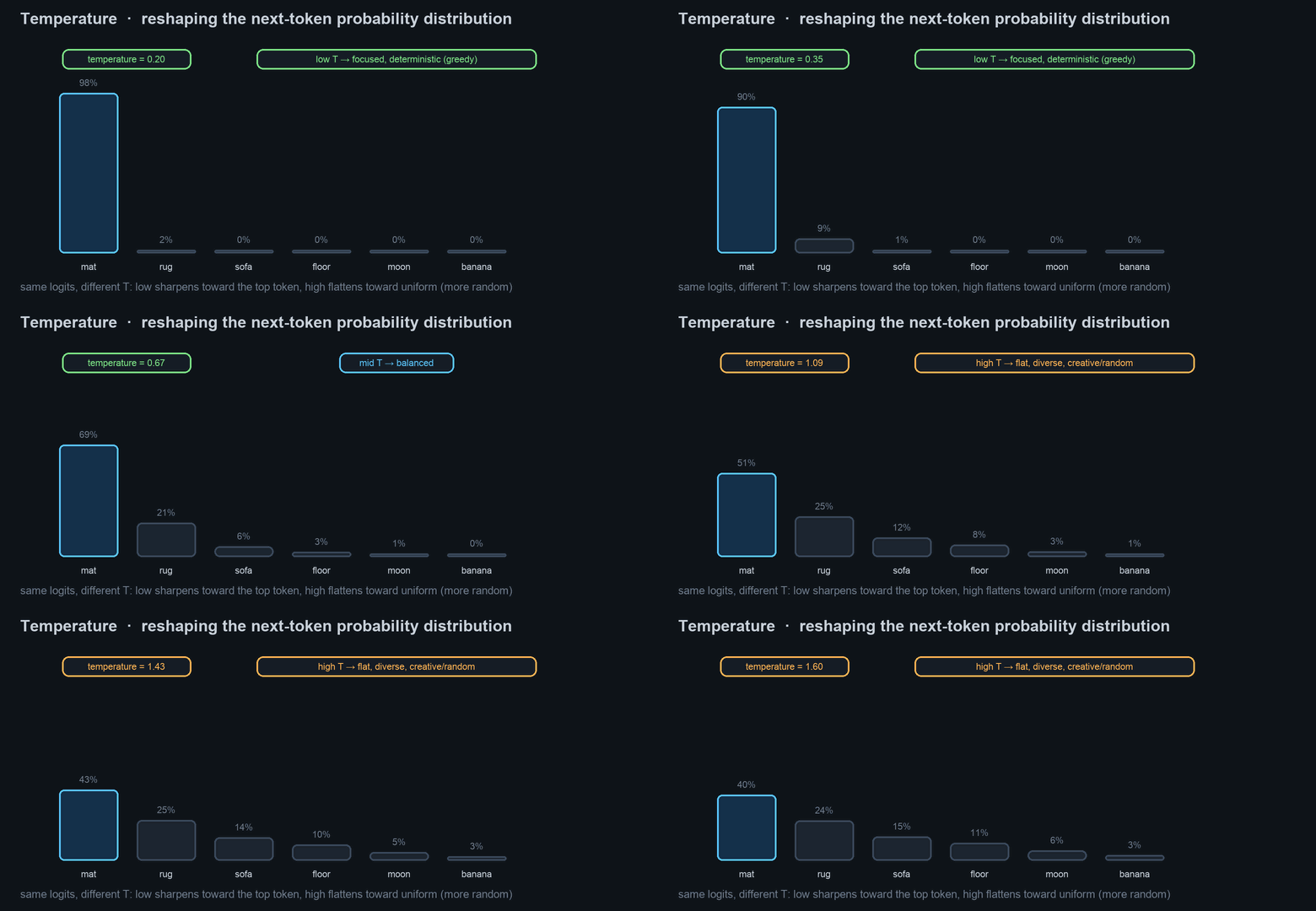
At low temperature one token dominates (near-deterministic); as temperature rises the distribution flattens and rarer tokens get a real chance (diverse, “creative”, eventually incoherent).
2. Temperature
Temperature T divides the logits before softmax: softmax(logits / T).
T | Effect | Use for |
|---|---|---|
| → 0 | distribution sharpens to the top token (≈ greedy, near-deterministic) | extraction, classification, code, structured output, math |
| ~0.2–0.4 | focused, slight variation | factual Q&A, RAG answers, agents/tool-calling |
| ~0.7–0.9 | balanced creativity | chat, drafting, brainstorming |
| ≥1.2 | flat, surprising, risks incoherence | ideation, diverse sampling for eval |
Mental model
Temperature doesn’t add knowledge or “make it smarter” — it only changes how much probability mass the rarer tokens get. Low T = “trust the top prediction.” High T = “take more risks.” For anything you’ll parse or that has a right answer, keep it low.
3. Top-p (nucleus) and top-k
These truncate the candidate set before sampling, so improbable tokens can’t be chosen at all:
| Param | Rule | Note |
|---|---|---|
| top-k | keep only the k highest-probability tokens | fixed count; blunt when the distribution is very peaked or very flat |
| top-p (nucleus) | keep the smallest set whose cumulative probability ≥ p (e.g. 0.9) | adaptive — few tokens when confident, more when uncertain. The common default. |
| min-p (2024) | keep tokens with prob ≥ p × max_prob | newer; robust at high temperature |
Don't tune temperature and top-p together
They interact and you’ll chase your tail. Pick one as your primary knob (most teams hold
top_p≈1and tune temperature, or hold temperature and tunetop_p). Tuning both at once makes results hard to reason about and reproduce.
4. Penalties (OpenAI-family)
Discourage repetition by subtracting from the logits of already-seen tokens:
| Param | Effect | Caveat |
|---|---|---|
| frequency_penalty | penalty grows with how often a token appeared | reduces verbatim loops |
| presence_penalty | flat penalty once a token appears at all | nudges toward new topics |
| repetition_penalty | (some APIs) multiplicative variant |
Penalties break structured output
Values above ~0.3–0.5 will damage JSON, code, and anything with required repeated tokens (braces, indentation, common keywords). Keep penalties at/near 0 for structured or code generation. Anthropic has no direct penalty params — handle repetition with prompting/stop sequences instead.
5. The other controls
| Param | What it does | Gotcha |
|---|---|---|
max_tokens (now max_completion_tokens / max_output_tokens) | hard cap on output length | a cap, not a target; on reasoning models hidden thinking tokens also spend it — set it generously or you truncate before the answer |
| stop sequences | end generation when a string appears | the stop string is not included in output; useful to fence formats |
| seed | request reproducibility | best-effort only — pair with system_fingerprint; not bit-exact across batched serving |
| logit_bias | add/subtract a fixed bias to specific token IDs | operates on tokens not words; tokenizer-specific; easy to get wrong |
| logprobs / top_logprobs | return per-token probabilities | the only way to see what your sampling settings actually did — great for debugging and confidence scoring |
| n | return multiple samples | multiplies cost; useful for self-consistency / pass^k |
Why no beam search in chat APIs? It optimizes for high-probability sequences, which produces bland, generic text for open-ended generation — sampling wins for chat. Beam search lives on in some translation/constrained tasks, not the chat endpoints.
6. ⚠️ The 2026 shift: reasoning models are dropping these knobs
This is the highest-churn part of the topic — and a real interview signal.
Frontier "reasoning" models increasingly reject temperature/top_p
- OpenAI o-series and GPT-5 don’t accept
temperature/top_p/penalties/logit_bias— you control them withreasoning_effort(minimal/low/medium/high).- Anthropic Claude 4.x (Opus 4.7+) dropped temperature/top_p/top_k tuning (returns an error on non-default values); you use an extended-thinking / effort budget instead.
- Google Gemini 2.5 uses
thinkingConfig.thinkingBudget.The mental shift: instead of “how random should each token be,” you now spend “how much should the model think.” Knob-tuning is migrating from per-token sampling to effort/budget abstractions. Classic sampling params still apply to non-reasoning / open-weight models — know both worlds and check what your specific model supports.
Don't bolt manual chain-of-thought onto a reasoning model
Telling a reasoning model to “think step by step” is redundant and can trigger overthinking that degrades accuracy and burns tokens. Use its native thinking/effort setting instead. (More in 03 - Prompt & Context Engineering.)
7. Pros / cons / when
| Goal | Settings (non-reasoning models) |
|---|---|
| Extraction / classification / routing | temperature=0, top_p=1, penalties 0 |
| Structured output / code | temperature=0–0.2, penalties 0 (they corrupt structure) |
| RAG / factual answer | temperature=0.1–0.3 (grounded, low drift) |
| Chat / assistant | temperature=0.5–0.8 |
| Brainstorm / diverse drafts | temperature=0.9–1.2, maybe n>1 |
| Reasoning model (o-series/GPT-5/Claude 4.x) | set effort/thinking budget, leave sampling at defaults |
8. Caveats & risk mitigation
- “Temperature 0 = deterministic” is a myth. Floating-point and batched-kernel non-determinism mean even
T=0isn’t bit-exact across runs/replicas. Don’t promise reproducibility; if you need it, snapshot inputs+outputs and assert on meaning (via evals), not exact strings. See 13 - Evaluation & Evals. - Provider drift. Param names and support differ (OpenAI vs Anthropic vs Gemini vs open-weight) and change per release. Centralize model config; don’t scatter magic numbers. A wrong param can 400 the request or be silently ignored.
- High temperature ≠ smarter. It’s a common misconception that cranking temperature improves creativity quality — past a point it just adds incoherence. Raise it deliberately and eval the result.
- Cost coupling.
n, largemax_tokens, and high reasoning effort all multiply token spend and latency — tie these to 15 - Cost, Latency & Performance budgets. - Debug with logprobs. If output is surprising, pull
logprobsto see whether the model was confident (a knowledge/prompt problem) or uncertain (a sampling problem) — they need different fixes.
9. In practice
# Non-reasoning model: deterministic extraction
resp = client.chat.completions.create(
    model="...",
    messages=[...],
    temperature=0,            # focused
    top_p=1,                  # tune ONE knob, not both
    max_completion_tokens=512,
    stop=["\n\n"],
    seed=42,                  # best-effort reproducibility
    logprobs=True,            # see the model's confidence
)

# Reasoning model: no temperature — spend "thinking" instead
resp = client.responses.create(
    model="<reasoning-model>",
    input=[...],
    reasoning={"effort": "high"},   # the modern knob
    max_output_tokens=4096,         # leave room: hidden thinking tokens count
)
10. Sources
- OpenAI — API reference: chat/completions params
- OpenAI — Reasoning models & reasoning_effort
- Anthropic — Messages API & extended thinking
- Google — Gemini thinking / thinkingBudget
- The Curious Case of Neural Text Degeneration (nucleus sampling)
- Min-p sampling (ICLR 2025)
- Hugging Face — How to generate text (decoding strategies)